Over the past 20 years, the story of globalization in Chinese companies has started primarily with products. Whether it's Yiwu's small items or deep Shenzhen's electronic manufacturing, the heart of the story is often in price, supply chain and speed. Today, the scenery is quietly changing. What China is exporting is no longer “exchangeable products” but the entire set of experience and identification with cultural implications. It is abstract and manifests in intangible things such as culture, emotions, and story recognition. And concrete touched, purchased and remembered through the competitive tides of the game, the daily stories of short dramas, the taste symbols of new consumer products, and the world's capital layouts.
On September 18th, 36kr held a theme exchange event entitled “Breaking Boundaries and Crossing Seas: Chinese Brand Culture Enters Global Markets,” focusing on expanding culture overseas. The representative powers from multiple sectors, including games, new consumer products, short drama and capital were gathered to discuss the new paths, challenges and opportunities for Chinese culture in the global market.
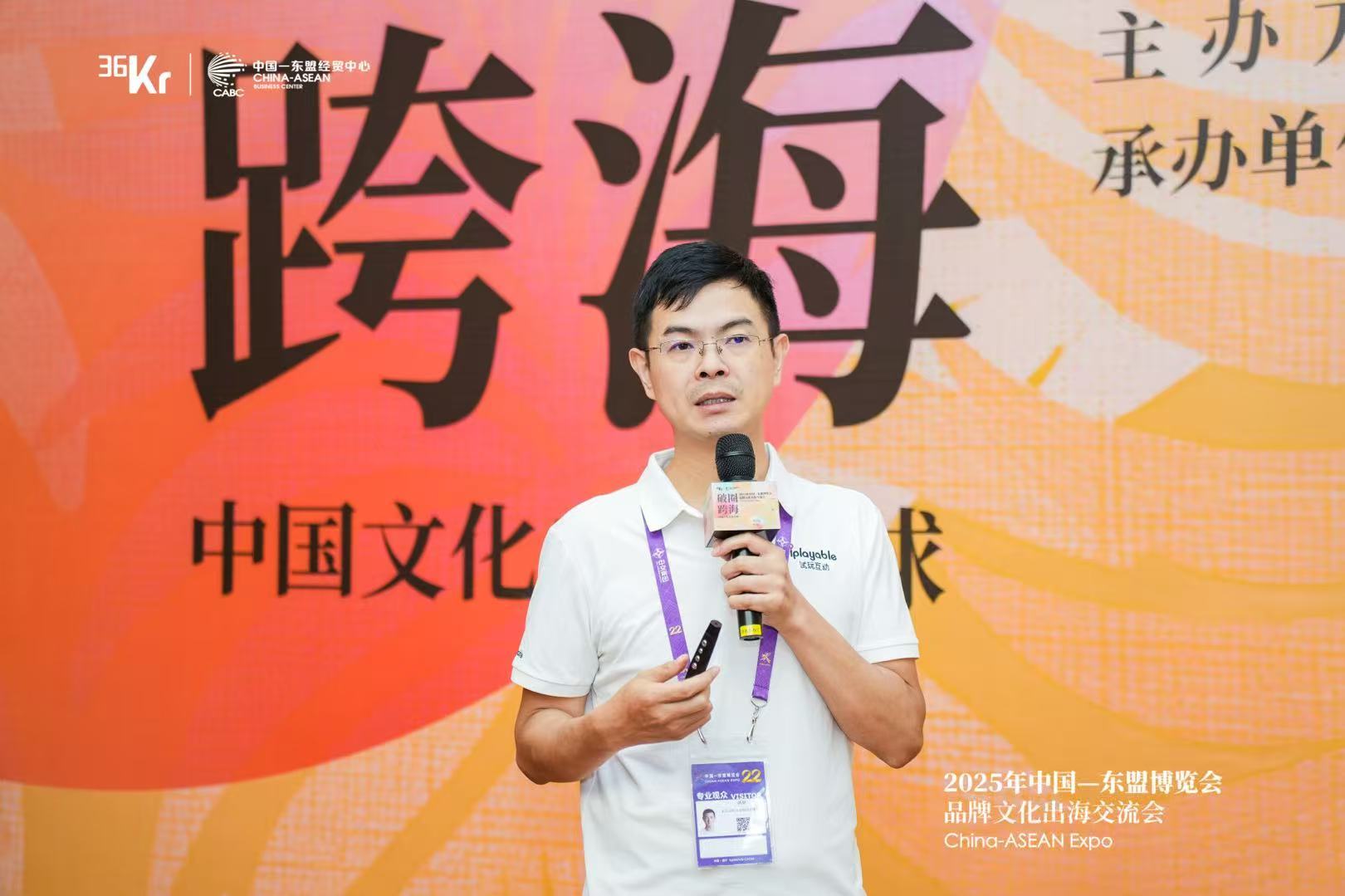
Hu Jian, Founder and CEO of Iplayable Trial Interaction
Hu Jian, founder and CEO of Iplayable Trial Interaction, gave a speech. Below is the transcript of the speech edited by 36kr.
Hello everyone. I'm Tony from Trial Interaction. We are so happy to share with you the opportunities and challenges that make AI applications global today. Combining some market trends with specific cases, we discuss the opportunities for China teams in the global market from the application level.
First, let's take a look at To B Market. As everyone knows, there is a huge space in an enterprise-level market, but it's not really easy to operate. Large domestic platforms like Bytedance and Tencent are basically doing everything on their own and unlikely to open up to external teams. As for the rest of the SMEs, many of them struggle to survive and simply don't have a budget for large paid investments. Truly wealthy customers are state-owned companies, central companies, banks, but such customers need to consider sophisticated customization, local deployment, and security and compliance with extremely complex requirements. So, in the last decade, we have not seen truly large SaaS companies in China, but in Europe and the US, SaaS Enterprises is developing very actively, with many companies with market value over tens of millions of dollars emerging.
It is also not easy for a Chinese team to go abroad for business. To attract large customers, you must permeate local businesses and understand the business process. It is extremely difficult to achieve this through online promotions. Large companies are truly happy to pay only if their sales teams carry out long-term business development, visit customers, demonstrate and build trust. This brings a huge challenge to the Chinese team. First of all, recruiting appropriate local sales talent is extremely difficult. Secondly, the costs are very high and the sales cycle is particularly long. Many of my friends who started the B business went to Europe and the US, led their teams to meet customers and attended exhibitions. It took me a year or two to understand the market, but it was extremely costly and difficult.
So, looking at AI today's globalization, what really suits China's teams is still at the application level, especially for C tool products. In this area, Chinese teams have natural advantages. We have long proven our ability to develop tool applications globally. Previously, Cheetah Mobile used a single tool called Clean Master to acquire over 1 billion download users, reaching 100 million peak daily active users (DAUs), and was also successfully listed on Nasdaq. Today, the thresholds for developing applications are lower than they were 10 years ago. Many AI application teams can consist of only two or three people, or one person working part-time, and can launch products from scratch and earn tens of thousands or hundreds of thousands of dollars in revenue. There are already many such cases.
From a market data perspective, this opportunity is very realistic. Global AI applications' paid revenue was just $30 million in 2021, reaching nearly $1.3 billion last year, dozens of times it has been. In 2024, the global amount of AI applications downloaded exceeded 1 billion times. In other words, user demand is rapidly exploding. North America and Europe contribute almost 70% of global revenue with extremely strong payable capabilities. Southeast Asia, Latin America and India have relatively weak paying capabilities, but are highly downloaded and highly user accepting. However, when combined with advertising models and hybrid monetization, you can actually make money.
When it comes to product formats, there are currently two main types of AI applications: App and Web. The app has a mature distribution and payment system, and the promotional loop is relatively clear. However, the development costs of the web version are low and are very suitable for market testing. Once the model has proven successful, it can be considered an upgrade to the app. One Universe Zero, the company we served, is a typical example. They initially entered the market with simple productivity tools and quickly grew their advertising. For entrepreneurs, the web version is a very low awarding direction.
Meanwhile, the capabilities of the generator AI are still improving rapidly. Essentially, new versions are released every week, with more and more powerful features. Video generation period is long and quality is high. Google's Veo and Banana models have already achieved very surprising results. In the future, the capabilities of AI will undoubtedly be stronger due to the accumulation of computing and data. You shouldn't expect everything to change in the short term, but the long-term potential must be very large.
There is a Turkish company called Codeway. They seized the opportunity early, redeveloping all the original, traditional non-AAI tools, adding AI elements, and reopening them. In fact, it was often just a shell, but because we posted the concept of AI, we had very good results in promotions and customer acquisition, and there were more platform recommendations. The user volume quickly reached tens of millions, and even hundreds of millions. This case shows the point. AI application opportunities don't necessarily need to start from scratch. Even combining AI to convert existing products can be extremely successful.
When it comes to growth, we have to talk about advertising. Advertising is a very important part of AI applications that will become global. Taking Google as an example, its search ads are still the core channel of the European and American markets. I have some experience with advertising. First, when choosing a market, you should prioritize Europe and the US, and an English landing page will have the best effect. Second, core users and top players need to find core users and top players as they can donate between 70% and 80% of their return on investment (ROI). Third, keyword ads should cover both brand keywords, industry keywords, and competitor keywords. Finally, copyright must be taken seriously, especially in the European and American markets. Do not use images of celebrities or politicians in advertising materials. Otherwise, it could lead to account suspensions and legal prosecution directly.
We once helped large domestic video model companies become global. Initially, we only invested a few hundred dollars a day for testing, but then we went beyond $10 million in monthly revenue and gradually increased our daily investment to over $100,000. Now, their focus is on driving the growth of large AI video models and global users, with double digits of monthly growth per quarter. The process we supported can be roughly divided into three stages. During the startup phase, we mainly use search ads to get feedback from core users and iterate quickly. During the growth stage, we expanded our user group by adding display ads and YouTube ads. At the stable stage, we mainly focused on ROI optimization, achieving a return on investment within 30 days. Such models can form a sustainable positive cycle.
AI application scenarios are also constantly expanding. Recently, some entrepreneurs have developed AI versions with monthly revenues of millions and monthly growth rates of 50% to 100%. The low cost and high efficiency of AI can disrupt many industries. He is also involved in this field. For example, we have developed a translation tool to quickly translate short Chinese dramas into smaller languages such as English and Portuguese. The underlying logic is actually quite simple. This is to aggregate major large-scale models overseas, but we optimized our workflows to make them more convenient for customers to use.
In-house, we are also promoting detailed application of AI. For example, you are asking team members to use AI assistance when writing your code, regardless of how simple the code is. They also established reward and punishment mechanisms to force everyone to truly use AI. Many companies encounter resistance when promoting AI implementation because people have inertial thinking and are difficult to change. However, for AI-Native teams, this process is much smoother.
Finally, here is a brief introduction to our company. Founded at the end of 2017, the company focuses on digital marketing and cloud computing services overseas. So far, we have been headed globally to over 5,000 companies. In the early days, our clients were primarily from the gaming industry, and later expanded to social media and short drama. Last year we served many short drama companies that are becoming global in batches, with half of the top 50 being our clients. Our core team members come from Cheetah Mobile and Alibaba. It is also the only company in China to obtain permit certificates from both top international media and cloud computing providers. We support clients with front-end growth and ads, provide cloud computing and AI services on the back-end, and provide one-stop solutions for global enterprises.
That's for today's sharing. thank you!