

Amid a surge in misinformation on the social media site, YouTube, the world's largest video-sharing platform, has announced it is stepping up efforts to tackle the issue using generative artificial intelligence.
The company targets misinformation that is spread through a variety of means, including deepfake videos, which use AI manipulation techniques such as face swapping to create realistic images, creating misleading content.
This issue is exacerbated not only by rapid technological advances, but also by recent regional developments, such as Israel's ongoing attacks on Gaza.
YouTube said it was also addressing other forms of misinformation, including misleading thumbnails, false titles, selective editing, false claims and the reuse of content from unrelated events.
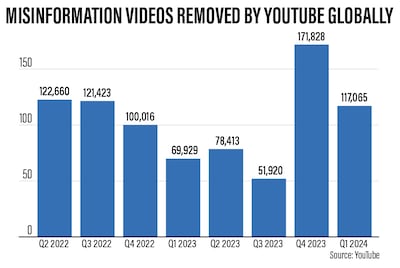
Tarek Amin, YouTube's regional director for the Middle East, Africa and Turkey, said instances of misinformation on the platform have increased, and the company removed more than 117,065 videos globally for violating its misinformation policies in the first quarter of 2024, up about 67% from the same quarter last year.
Amin explained that the company defines misinformation as “falseful content that carries a significant risk of serious harm.”
“During breaking news and crises, what happens in the world happens on YouTube too, which is why stopping the spread of misinformation is one of our deepest efforts in the region,” he said. The National.
For example, Israel's war in Gaza has seen numerous instances of breaking misinformation being spread through platforms such as TikTok, Elon Musk-owned X, Instagram, WhatsApp and YouTube.
A deepfake video that went viral on X on October 28th appeared to show supermodel Bella Hadid apologizing for comments she made in support of Palestinian rights and expressing support for Israel.
However, the original footage was from a speech Hadid gave about battling the disease in 2016. AFP FactCheck says the deepfake altered the video and audio to make it appear as if Hadid was criticising Palestine.
That same month, AI-altered footage from the video game “Arma 3” was uploaded to various platforms and falsely labelled as actual footage from the conflict, misleading viewers and exacerbating tensions and anxiety.
More than 96% of the 8.2 million videos YouTube removed in the quarter ending in March were first flagged by automated, AI-driven systems.
Also last month, a video that circulated on social media and was shared more than 4,000 times on X falsely suggested Rafa actors were preparing to stage an injury scene in Gaza.
The disinformation campaign included repurposed AI-generated content taken from behind-the-scenes footage of a Palestinian drama series filmed in the occupied West Bank. Though it was removed by the platforms, the manipulated content was widely shared and viewed millions of times, likely fueling anger and tensions around the war.
Earlier, during the COVID-19 pandemic, videos were posted across platforms falsely claiming that drinking bleach could cure the virus, and YouTube quickly removed them to prevent misinformation and protect its users.
Amin said misinformation can cause real-world harm, such as the promotion of harmful treatments or cures, certain types of technologically manipulated content, and content that disrupts democratic processes.
Old war, new weapons
The spread of misinformation through social media platforms dates back decades but has grown rapidly through the use of automated systems and generative AI techniques.
Industry experts and authorities say the platforms failed to adequately address misinformation, leading to rumors, distrust and injury.

In October, European Commissioner for the Internal Market Thierry Breton wrote to Alphabet CEO Sundar Pichai urging him to prevent the spread of misinformation about Israel and Gaza on YouTube.
Earlier, letters were also sent to X owner Elon Musk, TikTok CEO Shou Zi-Chu and Meta CEO Mark Zuckerberg, demanding they stop the spread of misinformation within 24 hours.
In a response to the European Commission, X CEO Linda Yaccarino said the platform had removed “tens of thousands of pieces of content” to minimise war misinformation.
Social media users and human rights activists have also criticised the platforms for stifling local voices.
New York-based nonprofit Human Rights Watch said in a report that Instagram and Facebook faced backlash for suppressing Palestinian-related content during the 2021 protests in Sheikh Jarrah in East Jerusalem, leading to the inexplicable deletion or shadowbanning of posts and accounts highlighting the situation.
Around the same time, TikTok users reported that pro-Palestine videos and hashtags were removed without clear reason, raising concerns about biased content moderation, according to a study by Access Now, another New York-based civil society group.
YouTube is National The committee impartially enforces guidelines to prevent the spread of misinformation about the Israel-Gaza conflict, to ensure that legitimate opinions and views are not suppressed.
Amin said the company does not remove content for discussing certain topics or sharing views, which are particularly sensitive issues in cases like the Israel-Gaza conflict.
“We take seriously our responsibility to surface trustworthy news sources, especially in times of war and conflict. Due to the nature of a crisis, there may be violent or graphic content, which would violate our policies. However, we do allow content that has educational, documentary or scientific value, just like news content,” he explained.
But there are also guidelines related to news content, such as blurring graphic scenes of injury where necessary and age-restricting content that is not suitable for all audiences, he added.
AI Defense
Amin said YouTube uses a number of generative AI tools for content moderation to minimize the spread of misinformation, using a combination of human judgment and machine learning, with more than 20,000 reviewers working around the world.
In the back-end system, AI classifiers (digital tools trained to classify multimedia data into predefined classes or labels) It helps detect inappropriate content and has human reviewers check to see if the content crosses policy lines, such as promoting violence, hate speech, or medically inaccurate misinformation.
Amin said one of the areas that has been significantly affected has been the identification of new forms of abuse and misinformation.
“When a new threat emerges, systems initially lack the context to recognize it at scale. But generative AI enables YouTube to quickly expand the datasets used to train its AI classifiers, enabling it to detect such content more quickly.”
Amin said more than 96% of the 8.2 million videos YouTube removed in the quarter ended March 31 were initially flagged by the company's automated, AI-driven systems.
Some of the AI tools used by companies like YouTube are built using machine learning frameworks and software like TensorFlow and PyTorch to create deep learning models that can analyze vast amounts of video content, as well as natural language processing tools used in combination to analyze and understand the context of video transcripts and comments.
“It's healthy to shift the discussion from what to do about generative AI to what we can do with it. We need defensive AI to catch malicious AI,” said Sam Brattis, CEO of Mena Catalyst. The National.
Analysts have recommended that YouTube ensure its distribution algorithms do not spread misinformation.
“Historically, distribution algorithms have been driven by what provokes a response or interest, but this is essentially the attention economy, which poses huge risks,” said Tim Gordon, co-founder and partner at UK-based Best Practice AI. The National.
“But there are opportunities to improve this. [algorithms] Through AI. We can use AI at scale to analyze YouTube videos, understand their content, and identify those that are more likely to spread misinformation.”
In September, YouTube announced a set of AI resources to help video content creators around the world, followed by guidelines in November requiring users to disclose fabricated or altered content.
The company said creators must disclose in an on-screen notification if they have used AI to create content that has been “altered or synthesized,” or the content may be flagged or removed, and repeat offenders may have their accounts suspended.
Amin said YouTube also has AI principles designed specifically to protect music artists and the integrity of their work.
“It's worth noting that YouTube uses a combination of algorithms and human judgment to determine whether content appears on this list.” [misinformation] “We're seeing a lot of growth in AI,” said Dev Nag, CEO of QueryPal, a San Francisco-based AI company. The National.
“But YouTube is much more hands-off in terms of bias and involves more subjective framing… This will also require a hybrid machine approach. [to detect harmful content] And humans [to validate AI’s findings]. “
Updated: June 23, 2024, 4:00 AM


