Start with the right problem shape
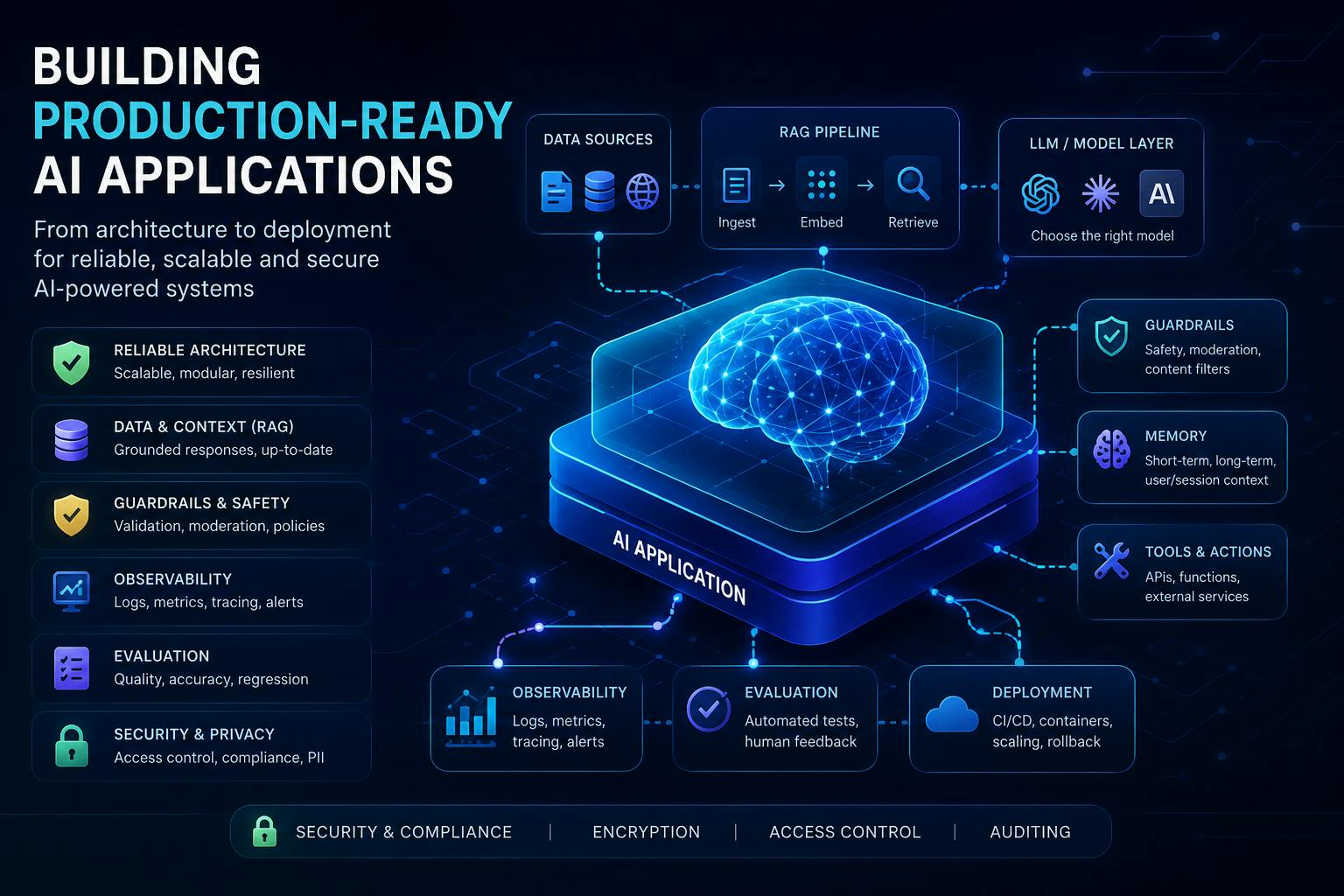
Building with AI only becomes difficult when the demos work. Real-world systems must withstand noisy inputs, latency budgets, legal reviews, cost limits, and operational incidents. As a result, current platform guidance increasingly views generative AI as a software and operations problem rather than a prompt writing problem. OpenAI’s operational documentation focuses on secure access, scaling, rate control, staged environments, and latency management, and Microsoft Foundry and Amazon Bedrock combine model access with evaluation and monitoring capabilities. NIST’s Generative AI Profile takes the same idea further by framing trustworthy development, use, and evaluation as a lifecycle issue rather than a one-time check.
This perspective changes the meaning of “production-ready.” AI capabilities in production are typically narrow, limited, and measurable. Classification, extraction, summarization, grounded search, and assisted workflow routing are easier to control than unlimited autonomy. Anthropic’s effective agent guidance advocates simplicity, transparency, and careful tool design, and its advice generalizes far beyond agent frameworks. Stable applications start with limited scope, explicit success criteria, and fallback paths that maintain business continuity if the model is wrong, slow, or unavailable.
Design your AI perimeter like your API
The most common production mistake is treating model output like reliable free text. Enterprise applications require a contract. Structured output capabilities now allow responses to conform to schemas provided across major platforms. OpenAI documents JSON Schema-compliant structured output, Google documents schema-based structured output for Gemini, and Amazon Bedrock also supports validated JSON results. This means that AI boundaries can be treated as typed interfaces rather than a weak parser problem. This is a fundamental transition from prototyping prompts to production engineering.
Therefore, backend services should require bounded decisions rather than open-ended prose.
@PostMapping("/claims/triage")
public TriageDecision triage(@RequestBody ClaimRequest request) {
    var result = aiGateway.respond(
        """
        Classify this claim for routing.
        Return JSON only.
        Claim: %s
        """.formatted(request.description()),
        triageSchema
    );
    return validator.read(result.body(), TriageDecision.class);
}
This endpoint transforms the model into components that satisfy the contract. Responses can be versioned, verified, rejected, and audited. Once the boundaries are clear, deterministic fallbacks also become practical.
@Retryable(maxAttempts = 3, backoff = @Backoff(delay = 250))
public TriageDecision decide(ClaimRequest request) {
    return aiRouter.triage(request);
}

@Recover
public TriageDecision recover(Exception ex, ClaimRequest request) {
    return rulesEngine.defaultRoute(request);
}
This pattern is important because production AI is judged by stable behavior during failures, traffic spikes, and abnormal inputs, rather than best-case answers. OpenAI’s production guidance explicitly calls for project staging, pricing planning, spend management, caching, load balancing, and latency work. OpenAI and Microsoft also document prompt caching as a way to reduce the cost and latency of repeating prompt prefixes. This is especially important when instructions, tool definitions, or policy blocks are reused on a large scale.
Reasonable answers and continuous evaluation
Most AI failures in production are response quality failures rather than infrastructure failures. Traditional testing does not capture non-deterministic behavior well, so evaluation must become a continuous engineering loop. OpenAI defines eval as a structured test to measure accuracy, performance, and reliability in a production environment. Microsoft Foundry supports pre- and post-deployment performance, quality, and safety assessments. Amazon Bedrock supports evaluation of models, knowledge bases, and search enhancement systems such as calculated metrics and human reviews. Taken together, these sources point to the same operational pattern: all prompts, models, acquisition strategies, and policy changes require measurable regression testing before release and ongoing monitoring after release.
Grounding is a practical partner in evaluation. Google defines grounding as connecting the output of a model to a verifiable source. This ties answers to approved data and reduces the chance of content being fabricated. In a corporate environment, this typically means retrieving from a system of record, document corpus, or approved search index prior to production.
public Answer respond(QuestionRequest request) {
    var docs = knowledgeBase.search(request.question(), 5);
    return aiGateway.respond(
        """
        Use only the provided context.
        If the answer is unsupported, return status NEEDS_REVIEW.
        Context: %s
        Question: %s
        """.formatted(docs.serialized(), request.question()),
        answerSchema
    );
}
This flow is suitable for production because it instructs the model to use evidence and avoid when evidence is missing, and returns structured results that downstream services can audit. This design supports confidence thresholds, citation display, escalation, and controlled case handling. OpenAI’s guardrail guidance combines automatic checks and explicit human approvals to allow sensitive execution to continue, pause, or stop under policy control.
Treat safety and observability as runtime features
Security cannot be added after launch because the AI layer changes the attack surface. OWASP lists prompt injection, insecure output handling, supply chain vulnerabilities, and model denial of service as the main risks for LLM systems. NIST’s Generated AI Profile brings together reliability, risk management, and evaluation as concerns throughout the lifecycle. In fact, prompts, retrieval connectors, tool definitions, models, and policies all require the same change control you would expect from other critical application dependencies.
Observability is similarly not an option. Microsoft describes distributed tracing for generative AI as visualization of model invocations, tool invocations, agent decisions, and dependencies between services. OpenTelemetry GenAI’s semantic rules are specifically developed to standardize spans, metrics, and events for this workload. Therefore, the trace record must include the model version, prompt version, retrieval identifier, latency, token count, moderation results, and final business action. Without that data, debugging quality failures is nothing more than log archeology.
Operational maturity also depends on implementation discipline. Prompt templates and safety policies should be versioned, evaluated against fixed datasets, published in stages, and rolled back like any other release artifact. Setting separate staging and production boundaries or setting explicit rate caps or spending limits is not an option when one quick change can increase costs across thousands of requests. Production AI will only be sustainable if model quality, latency, and economics are all treated as top priorities at runtime.
Keep agents rare and intentional
Agent behavior creates another boundary between prototype and production environments. If a workflow executes tools across multiple steps, the orchestration must survive restarts and support pause and resume semantics. LangGraph emphasizes persistent execution, persistence, streaming, and human control as key runtime concerns, while Anthropic recommends transparent planning and careful tool design. The engineering lesson simply states that autonomy should only be introduced if the workflow truly benefits from it.
Many enterprise applications do not require agents at all. Classifiers with structured output, well-founded search pipelines, or summarizers behind strict policies often have better reliability and lower cost. Agents are justified only if their choice of tools, persistent state, or performing repetitive tasks creates measurable value beyond simpler pipelines. Operational architecture improves when autonomy is the last feature added rather than the first proven feature.
conclusion
Developing production-grade applications with AI is not about connecting model endpoints to existing services and expecting prompts to convey results. It requires the same engineering discipline you would expect for a business-critical system, with additional controls for non-determinism, safety, and cost. Typed output, reasoned retrieval, continuous evaluation, explicit fallbacks, distributed tracing, gradual rollouts, and lifecycle governance are what turn an impressive demo into a reliable product. The future of enterprise AI belongs to systems that are observable, manageable, and accurate even under real-world operating conditions.