
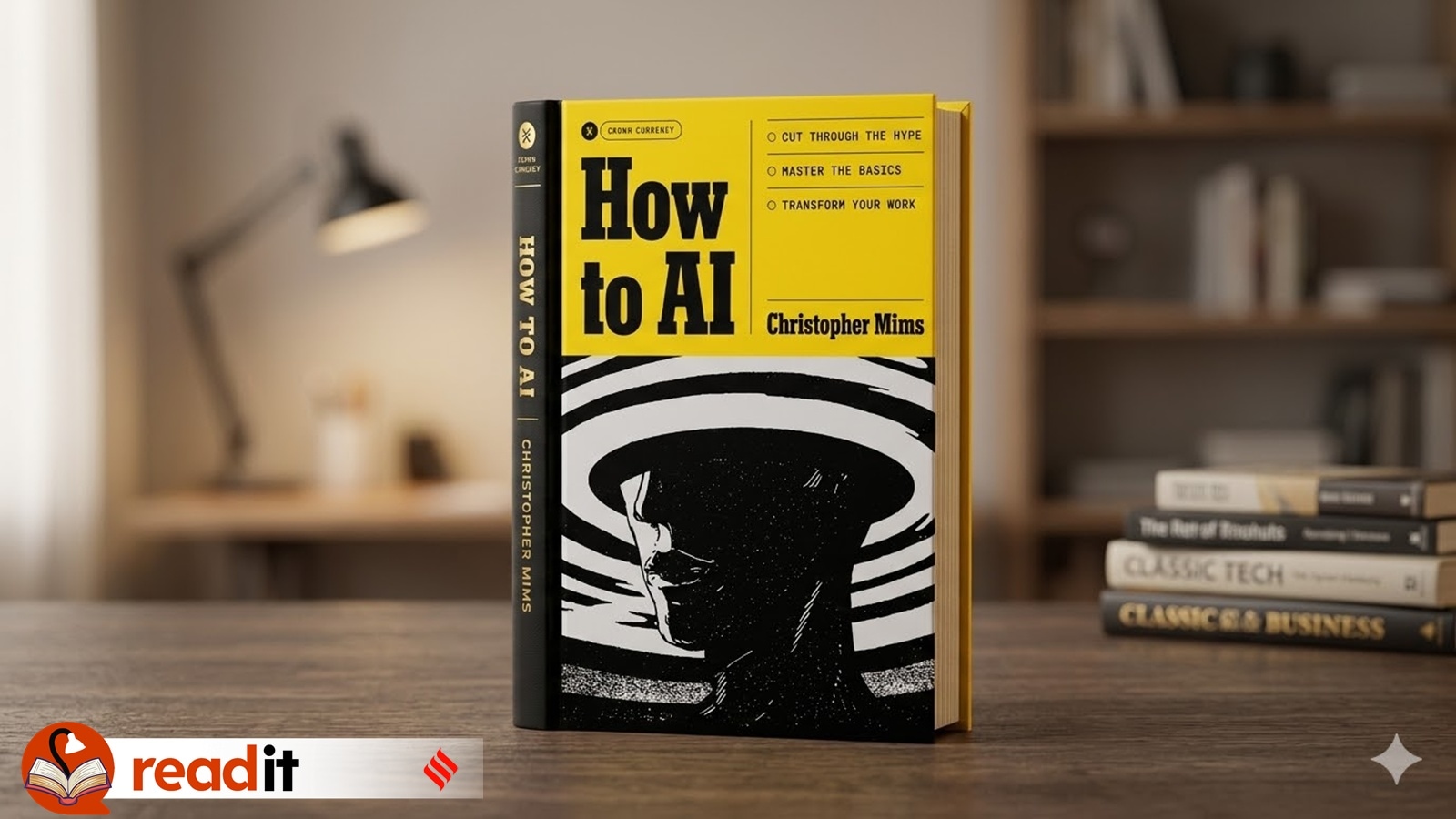
Given that AI is all the rage in all areas of life these days, it’s natural to think that a book with this rather elaborate title would be: Approaching AI: Beating the hype. Master the basics. transform workis another of those self-help and skill-building books by aspiring technologists who claim to turn you into an AI wizard in a few hundred pages of technical jargon. Fortunately, that’s not the case. In fact, How to AI is, as author Christopher Mims says in the foreword, “a book for people who want to use AI to get things done.” And it’s done simply and wisely.
Have you heard about AI? Should you use AI? Confused by AI? this book is for you
How to AI is basically an introduction to AI for people who have heard of AI but are confused. This book aims to help general users understand what AI is, what it can do, and how it can be utilized. This is not a textbook or comprehensive guide, but rather a quick read about the main parts of AI and how they are relevant to many of us. Mims is tech-savvy and does a great job being a regular technology columnist for the Wall Street Journal and host of the podcast “Bold Names.” He avoids too much jargon and delivers what we think is one of the most accessible and readable books on AI. No specialized technical knowledge is required to read and understand this book. If you use a smartphone on a regular basis, there’s a good chance you’ll understand.

Mims has organized the information in what he calls the “AI method.” These are not hard and fast rules, but rather broad guidelines that serve as milestones on this short AI journey. It also peppers the text with lots of examples and explains a lot of the terminology without being too heavy (LLM, Agentic AI, AGI, VLA models, etc. are all explained). The book is about 250 pages in total, 25 to 30 of which include a preface, acknowledgments, notes, and index, making it the kind of book that can be easily read in a few days. Mims writes with a journalistic ease, blending conversations and events with information, making it a very interesting read even for those accustomed to AI.
“AI is an assistant, not a replacement,” “AI is a feature, not a product,” etc.
This is not the book for those people. I want to discuss AI. Mims avoids portraying AI as an angel who will make our lives much easier, or as a demon who will conquer the world and take away our lives. His broader outlook is that AI is more of a capable assistant than a creator. His first law of AI is that “AI is an assistant, not a substitute” (this is the most important of all laws, and he reiterates it at the end), and his third law is that he reiterates that “AI is a feature, not a product.”
Mims repeatedly points out the pitfalls of blindly trusting AI, emphasizing that while it is a technology in progress and is constantly being improved, it is far from perfect and is unlikely to ever be. For example, his 16th Law of AI states that “‘classical’ predictive AI is fragile and breaks when major changes occur,” which he explains using the example of an insurance business that relies heavily on predictive analytics. Similarly, other laws point out that “AI is not creative, but it can aid human creativity” and that “if successfully implemented, AI will scale up rote knowledge work.” Many people are urging caution. One law states bluntly, “Don’t trust this law, always check how it works,” and another law reminds us, “‘garbage in, garbage out’ still applies.”
Most of the laws are explained with examples (some are so simple that they can be explained and understood in just over a page), and the book is peppered with lots of interesting trivia to keep it from becoming a boring read. One of them is an article about how Clorox used AI to invent the toilet bomb concept, which became one of the company’s most successful products, and how bureaucratic stagnation cost Google its leadership in modern AI. There are also references to just about every big name in AI, from Jensen fans to Sam Altman, often with clever personal touches. He touches on trends and gives a glimpse of what the future holds. His ultimate law is that “the area of human endeavor most transformed by generative AI is coding.”
The idea of using laws to highlight key principles of AI is a good one, as it divides the book into clear sections. 24 laws may sound like a lot to remember, but they’re spread across 12 chapters so you never feel overwhelmed. While experts may complain about the relative lack of detail and activists may point out that not much is being said about AI’s environmental impact, How to AI is focused on familiarizing readers with AI and providing a starting point for further reading. This is an AI book that all of us should read as we enter the age of AI.
Story continues below this ad
Approaching AI: Beating the hype. Master the basics. transform work
christopher mims
headline press
254 pages
699 rupees


