- Slack announced Slack GPT. It envisions a new era of customer productivity by enhancing Slack’s capabilities.
- Slack GPT aims to bring automation, shared knowledge, and intelligence across Slack conversations.
A month ago, Slack introduced the ChatGPT app as the first step in a larger vision to integrate generative AI into its platform to improve productivity. Slack’s unique advantage lies in the vast institutional knowledge that covers daily projects, topics, teams, messages, files, clips, and huddles.
Slack recently announced the Slack GPT at World Tour NYC. It envisions a new era of improving customer productivity by enhancing Slack’s capabilities.
This new-age strategy revolves around three pillars. First, Slack aims to integrate AI natively into the user experience to help people work smarter, learn faster, and communicate better. For example, AI can generate one-click conversation summaries in active channels available in Slack.
“Second, we are exploring the role of AI in our new platform, enabling customers to build no-code workflows using AI actions throughout, simplifying the creation and deployment of AI-based automation. We are working on this with multiple LLM options to accommodate companies that want to use OpenAI’s ChatGPT or create custom models.Ali Rayl, Senior Vice President of Products at Slack Mr.
Finally, the new Einstein GPT and Slack make Slack the conversational interface for Salesforce Customer 360. In short, Einstein GPT becomes Slack’s interface for customers to access insights from all their real-time customer data to better help them. Understand your customers across all the Salesforce products your company uses.
Slack CEO Lidiane Jones believes generative AI has huge potential to transform the way work is done and significantly improve business productivity. Jones emphasizes that the technology’s true strength lies in AI’s ability to analyze and act on a company’s most valuable data from its most trusted source: internal knowledge.
“Slack GPT is the conversational AI platform of the future, empowering organizations to work smarter and make smarter decisions faster by putting trusted customer data and key employee knowledge at their fingertips. We want to be able to do it for as long as we want,” says Jones.
What you can do with Slack GPT
Slack GPT aims to bring automation, shared knowledge, and intelligence across Slack conversations. More importantly, tailoring AI to company-specific requirements, such as integrating preferred language models, creating unique AI-driven no-code workflows, and seamlessly embedding AI into his Slack experience. that can be adjusted.
Native features include AI capabilities designed to easily blend into Slack’s interface, making accessing contextual AI assistance easier and more convenient. In the future, customers will be able to:
- Summarize conversations and huddle: Quickly catch unread Slack messages with one click, or join Slack GPT into your huddle to provide quick summaries and follow-up instructions.
- Enhanced communication: Slack’s message composer and AI-assisted contextual integration into the newly launched Slack canvas let users easily refine content or change the tone.
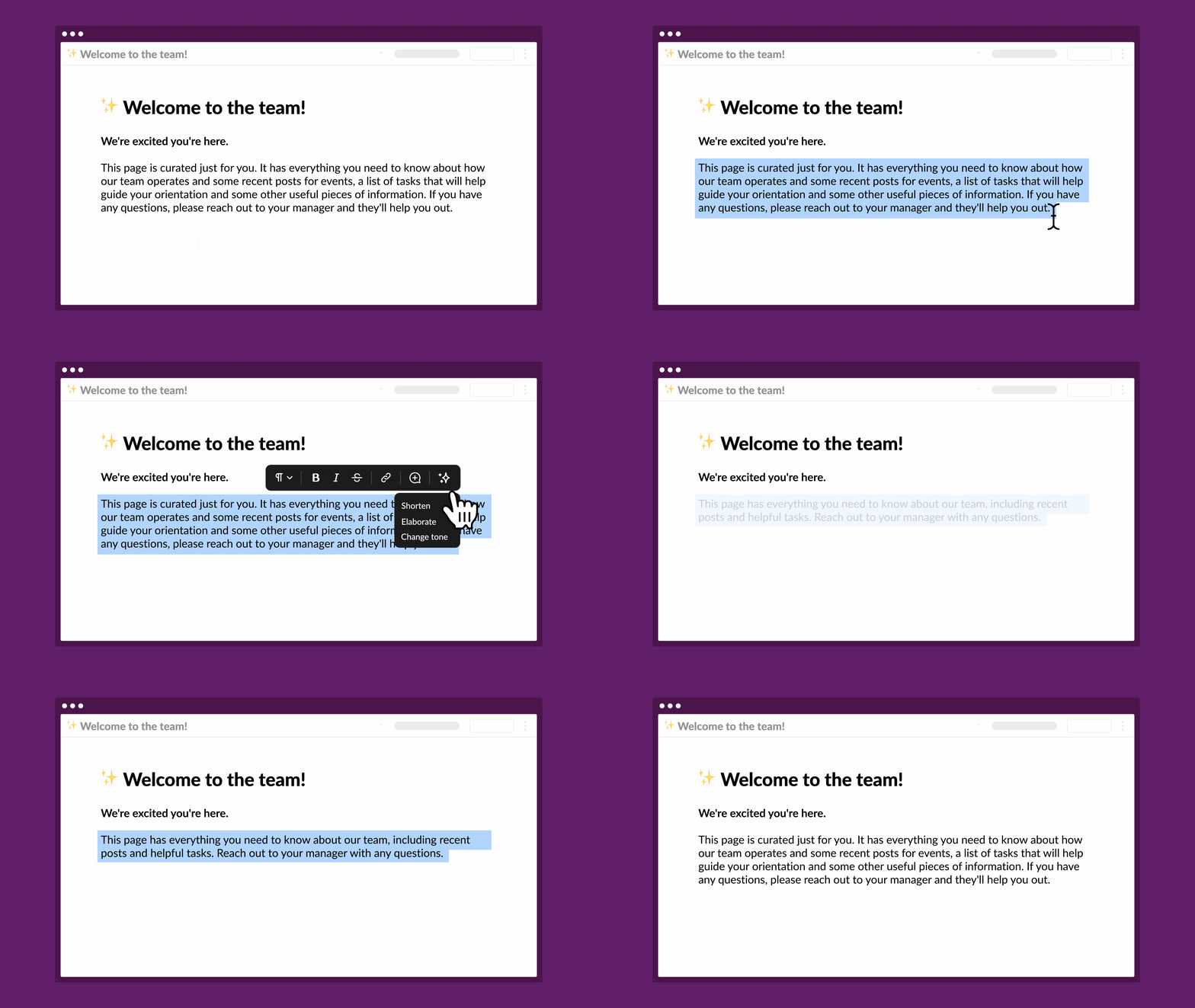
AI assisted writing (Source – Slack)
Integration into Slack’s App Directory provides a fast and secure way for customers to extend the capabilities of third-party or in-house LLMs already in use within Slack. With Slack GPT, customers can:
- Develop no-code workflows that automate work across Slack, LLM, and their software tool ecosystem. Workflow Builder allows users to instantly connect generative AI apps to workflows.
- Embed generative AI apps from leading platforms like OpenAI’s ChatGPT and Anthropic’s Claude, built on Slack’s trusted platform. These apps are not used for training language models at scale.
- Create custom integrations. Customers can leverage the thriving Slack developer community to develop custom integrations that leverage the intelligence provided by top LLMs.
When asked whether Slack’s generative AI can learn from user interactions and adapt to changing contexts, or be a fixed solution, Rayl explains that the answer is context dependent. Companies do not want their private data used to train public LLMs. Improving these models requires training with private customer data, which raises concerns. But Rayl emphasizes the importance of making Slack easier and more accessible through better ways of asking questions, a concept he calls “rapid engineering.”
Slack is looking at where to provide users with a conversational interface rather than a more structured approach to ensure the right questions are asked to LLMs. Rayl cites Adobe Firefly as a good example. Users are given controls to better formulate their queries and increase the likelihood of getting the desired results.
By now, most people are familiar with the wrong answers they can come back to. It’s a way to encourage Questions like “Does this suit you?” A link to the source content is also under consideration.
“If we summarize information from our internal Slack data, how do we provide users with an easy link to cross-reference the information and confirm its accuracy? and deciding how best to publish and ensure that users have confidence in the responses they receive.”