
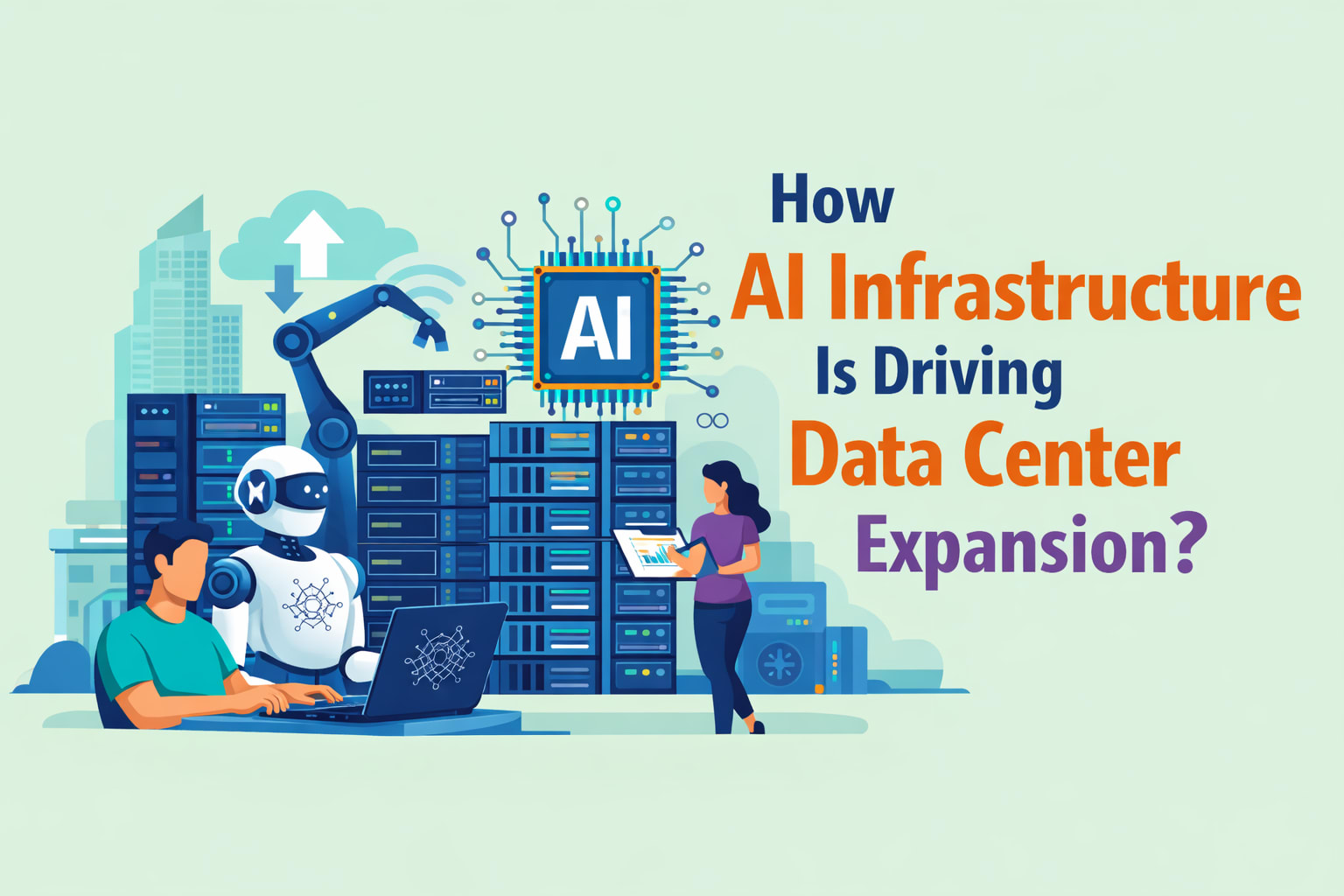
In the early days of cloud computing, data centers were described in simple terms. A vast warehouse filled with servers quietly stored files and ran websites.
That image no longer captures reality.
Today’s data centers resemble high-density computing factories, optimized not only for storage but also for parallel processing at extraordinary scale. Artificial intelligence, especially large-scale language models, generative systems, and advanced analytics, have redefined what these capabilities have to offer.
AI does more than just increase data center usage. It is reshaping their architecture, geography, energy needs, and economic importance.
The Computing Explosion Behind Modern AI
Training cutting-edge AI models requires vast amounts of computational power.
According to research from the Stanford Human-Centered Artificial Intelligence Institute, training compute for frontier AI models has increased by more than 300% annually over the past decade. What once required dozens of GPUs now requires tens of thousands of GPUs to work simultaneously.
SemiAnalysis estimates that building an advanced AI training cluster can cost between $500 million and $1.5 billion, depending on size and chip configuration. These clusters are housed within dedicated data centers with high-bandwidth networks and liquid cooling systems.
The physical footprint of AI is rapidly expanding.
According to Synergy Research Group, global spending on hyperscale data center infrastructure will exceed $250 billion in 2024, with AI-related workloads accounting for a growing share of new construction.
From storage facilities to AI factories
Traditional data centers are optimized for storage and transactional workloads such as web hosting, enterprise applications, and database management.
AI infrastructure requires something different.
High-performance GPUs, tensor processing units, and advanced interconnect systems require higher power density and cooling capabilities. The Uptime Institute reports that the average power density per rack in AI-focused facilities can exceed 30 kilowatts per rack, compared to 5 to 10 kilowatts in older facilities.
This change will force operators to redesign layouts, cooling systems, and power distribution networks.
Once rare, liquid cooling technology is becoming more common. According to a report from Dell’Oro Group, spending on advanced cooling solutions for data centers increased by more than 25% last year, driven primarily by AI adoption.
Data centers are evolving from passive infrastructure to active computing hubs.
Energy demand and new power equations
Artificial intelligence workloads consume large amounts of energy.
The International Energy Agency predicts that global electricity demand from data centers could double by 2030, and AI could account for a significant portion of that growth.
In 2023 alone, data centers consumed approximately 460 terawatt-hours of electricity worldwide. This is roughly equivalent to the annual energy use of some medium-sized countries.
Technology companies are responding by securing long-term renewable energy contracts. Amazon has announced more than 100 new renewable energy projects in recent years to support its growing cloud footprint. Microsoft and Google are similarly working to expand their renewable energy sourcing to offset increased demand.
Energy procurement is closely tied to AI expansion strategies.
Geographical redistribution of infrastructure
AI-powered expansion is not limited to existing hubs.
Cloud providers are building new data center regions in North America, Europe, and Asia to reduce latency and comply with local data regulations.
According to CBRE’s Global Data Center Trends Report, vacancy rates in major data center markets fell below 3% in several U.S. regions during 2024, reflecting strong demand.
Emerging markets are also attracting investment. Regions with access to renewable energy and cooler climates offer operational advantages for AI workloads.
Geography is currently influencing the economics of computing.
Capital investment and competitive position
Expanding AI infrastructure requires huge financial inputs.
Meta predicts that infrastructure spending will exceed $35 billion in 2024, much of which will go toward AI hardware. Microsoft increased capital spending by more than 50% year over year as it expanded its AI services across Azure.
Analysts at UBS estimate that the top hyperscale cloud providers collectively invest more than $120 billion annually in data center infrastructure.
These expenditures create barriers to entry.
Companies without access to large computing clusters may struggle to train competitive AI models. Infrastructure is a competitive moat.
Enterprise demand and AI adoption
AI adoption is no longer limited to research institutions.
According to a McKinsey study, 55% of organizations report using AI in at least one business function, up from about 20% five years ago. As usage grows, the demand for inference workloads (running trained models in production) increases as well as training demands.
Inference doesn’t require a cluster as large as a training environment, but it does need to run continuously and support millions of user interactions in real time.
This continued demand will drive further data center expansion.
Edge computing and latency requirements
AI applications such as real-time translation, autonomous systems, and augmented reality require low-latency responses.
Gartner predicts that by 2027, more than 50% of enterprise data will be processed outside of traditional centralized data centers, compared to less than 10% in 2018.
Edge computing facilities (small, distributed sites close to end users) complement hyperscale centers by reducing response times.
The combination of centralized AI training hubs and distributed inference nodes is reshaping global infrastructure patterns.
Ripple effect on software development
Expanding AI infrastructure will impact how applications are built.
Software teams are increasingly designing products that integrate AI services through APIs hosted in large cloud environments. Developers must consider latency, scaling behavior, and cost implications when incorporating AI capabilities.
Even the team working on mobile app development portland Assess infrastructure availability and balance performance and operational costs when designing AI-powered features.
Infrastructure decisions shape product potential.
Cooling, water usage and environmental considerations
Physical expansion of AI data centers creates environmental issues.
Cooling systems often require the use of large amounts of water. The World Resources Institute has highlighted concerns about water consumption in drought-stricken regions.
Operators are experimenting with air cooling in cold regions and advanced liquid systems that reduce dependence on water. Sustainability indicators increasingly influence site selection.
Environmental considerations are now directly tied to AI infrastructure planning.
Funding to build AI
Financial markets continue to support infrastructure expansion despite high costs.
Morgan Stanley analysts say investors view spending on AI infrastructure as a long-term position rather than a short-term expense. Capital markets often reward companies that demonstrate a commitment to AI capabilities, which they interpret as poised for future growth.
At the same time, rising interest rates and supply chain constraints are causing alarm. According to Deloitte’s Technology Outlook, 43% of executives express concern about over-investing in AI infrastructure against an uncertain demand trajectory.
The balance between ambition and prudence remains delicate.
Structural changes beneath the surface
Artificial intelligence has moved from an experimental project to mainstream adoption. Its computing power is reshaping physical infrastructure around the world.
Data centers are growing in size, density, and geographic distribution. Energy contracts, cooling systems, and semiconductor supply chains are evolving accordingly.
What appears to users as chatbot responses and automated recommendations rests on a vast network of specialized hardware working continuously behind the scenes.
The digital economy has always relied on physical infrastructure. AI has simply made that dependency visible again.
As the demand for intelligent systems increases, data center expansion is likely to continue, not as a temporary spike but as a defining feature of the next technological era.
The future of AI will be written not just in code, but also in concrete, fiber, silicon, and power lines spanning continents.


