A last minute dive. A fingertip save that changes the game. Keepers read angles, adjust in a split second, and react instinctively and accurately.
In EA SPORTS FC 26, goalkeepers move with more human-like movements, react more dynamically, and adapt faster, delivering moments that feel authentic and real.
This leap forward is powered by innovative and creative solutions developed by team members at EA SPORTS, Frostbite (which provides model training integration and runs models during gameplay), and the Search for Extraordinary Experiences Division (SEED), a pioneering group within Electronic Arts that combines creativity and applied research.
Let’s dive in.
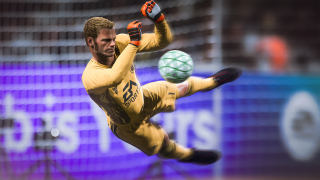
“The result is the most authentic goalie in FC history, built entirely on innovative and creative solutions crafted in-house by EA’s team of experts.”
A designer-first approach to machine learning
By leveraging deep reinforcement learning, the team enabled faster training and more human-like behavior compared to traditional methods, reducing training time and increasing realism.
“We used machine learning to train on hundreds of thousands of in-game situations to find optimal positioning, including the small microsteps that world-class keepers use to close angles,” said Mike Jones, senior software engineer at Electronic Arts.
“This method utilizes a reinforcement training agent that learns how to play the game on its own through a novel training framework developed with the aim of increasing data efficiency,” said Alessandro Sestini, research scientist at SEED. “And finally, an evaluation and fine-tuning framework that allows designers to provide feedback on goalkeeper behavior.”
Compared to traditional coded goalkeepers, the new system brings obvious improvements.
Goalkeepers using reinforcement learning can improve their ball save rates by 10%, train 50% faster than standard reinforcement learning methods, and can be trained overnight. A robust validation system with over 300 “unit test” scenarios ensures continuous evaluation and tuning.
Reinforcement learning approaches produce more adaptive positioning, improved angular range, and movements that feel more natural for real-world sports.
The result is the most authentic goalie in FC history, built entirely with innovative and creative solutions created in-house by EA’s team of experts.
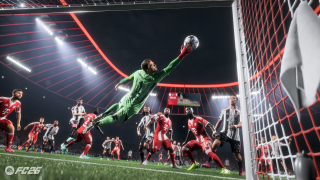
“We used machine learning to train on hundreds of thousands of in-game situations to find optimal positioning, including the small microsteps that world-class keepers use to close angles.”
Further in the future
The introduction of goalkeeper positioning using reinforcement learning in EA SPORTS FC 26 is more than just a system upgrade. This reflects an evolution in the way gamers are built, trained, and refined in production.
By combining machine learning and designer-first frameworks, teams can iterate faster, continuously validate, and deliver more human-like behavior directly into player-facing experiences.
For players, that means smarter reactions, better positioning, and moments when they feel closer to the real sport. For developers, this presents a scalable approach to applying machine learning in a way that is practical, measurable, and built for real-world production.
And for EA SPORTS FC, this marks another step in providing a more authentic and engaging soccer experience.
Check out other great EA stories at ea.com/news.