In his 1993 book, Dual Strategy Management, Derek Abel made the then-bold argument that running a business and changing a business are not sequential activities, but must occur in parallel. He said that changing a business requires a clear vision of the future and a strategy for how the organization must evolve with it.
In the age of AI, that’s difficult. In the age of AI, there is no fixed roadmap for the future. And it’s especially difficult for CIOs, who are expected to simultaneously run and transform their businesses, who still lack the deep business partnerships needed to successfully do both.
The gap often starts with HR. Jonathan Feldman, CIO of Wake County, North Carolina, said in a recent interview that “IT is fundamentally a people business, and without a strong partnership with HR, CIOs risk being left wanting.”
In the age of AI, this partnership is a must, not an option. As partners, CIOs and HR leaders can define and shape the future of work in their companies, working closely with CEOs. The risks of inaction are significant.
Organizations that fail to adapt will face higher costs than their competitors, struggle to build the necessary workforce, and lack the speed needed to compete in an increasingly AI-driven world.
This article focuses on three areas that CIOs need to work on in parallel to compete.
-
How work is changing across roles and functions.
-
How will systems need to evolve to support AI-enhanced work?
-
What skills do employees need to stay relevant?
Employment disruptions and workforce shifts
Last November, aA 2025 Stanford University research Using ADP data from millions of ADP payroll records, researchers led by Dr. Erik Brynjolfsson found that AI is already driving changes in the labor market. Employment for early-career workers in jobs exposed to AI has declined by 16%, while employment for experienced workers has remained stable so far. To be clear, the changes in employment are focused on jobs that will be automated rather than augmented by AI.
Undoubtedly, AI will impact tasks, occupations, and industries in a variety of ways, replacing some jobs, enhancing others, and even transforming others. Occupations already affected at the employment level include software developers and customer service representatives. Experienced employees are less likely to adopt AI to enhance their work, yet they are not disrupted at the same rate. Generative AI tools such as Claude And open AI models are already demonstrating increased productivity for individuals.
The questions that CIOs need to answer with their HR partners are: Which business processes and tasks within the enterprise will be automated, scaled, or changed, and over time, what will the work look like when agents handle execution? In a long-term agent world, humans are responsible for designing work, putting together governance structures (guidelines, guardrails, standards), and managing how agents perform. In this phase, Ian Beecraft said A few weeks ago at South by Southwest, we moved to an agency organization.
Which tasks will be automated, enhanced, and restructured?
To advance the workforce shift, CIOs should ask enterprise architects to map business functions and processes and decide which to automate, scale, or change. In practice, this results in Mechanisms for redesigning enterprise architecture work. This often needs to be done using future state maps that reflect how AI can transform operating models and create new value propositions.
With this knowledge, CIOs should work with their HR partners and AI-savvy architects to assess job skills and determine what can be automated or enhanced with AI to align with the job description.
Enterprise architect role
Enterprise architects can help by linking maps of business capabilities, skills, and job descriptions. To be clear, the EA has a supporting role. They should not directly own the workforce or the redesign of jobs.
Instead, EA must connect the dots across business functions, processes, systems, data, operating models, and governance, and help inform changes in roles and skills alongside HR and the business.
This joint effort should accomplish two things. One is to identify highly automated jobs. The second is to define new job classifications that combine job tasks from partially automated jobs or agent-driven work with performance management roles. This may be the most important job an enterprise architect has ever undertaken: reengineering an entire enterprise.
Systems need to support AI-enhanced work
Once this is done, the next logical question to consider is how should the system be designed to better support the expansion job?
For these roles, the question that CIOs, CHROs, EAs, and CEOs need to consider is: What do systems need to be able to do to support expanded work, and where are today’s systems falling short?
These are big questions that we must work together to answer. Once again, enterprise architects need to take center stage.
CIO says 12 skills employees need to stay relevant
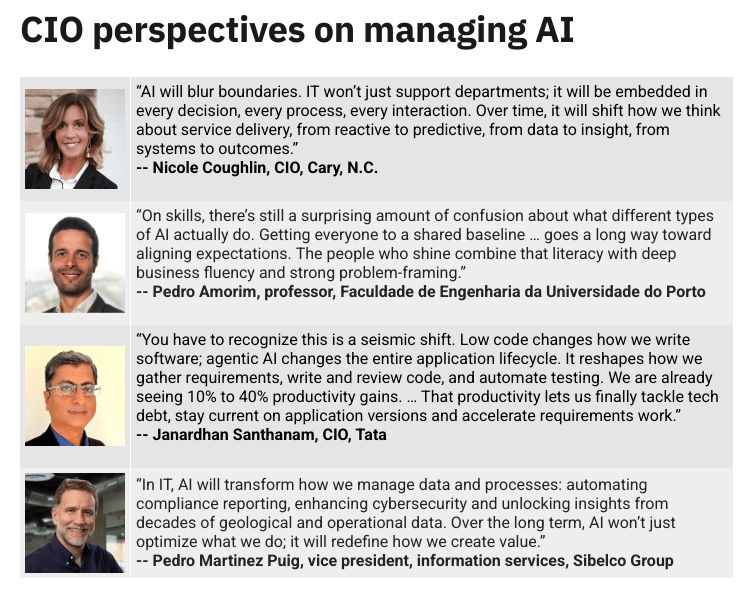
Finally, I asked CIOs what skills their employees should develop to prepare for an AI-driven future. Their responses were combined into 12 recommended skills.
-
AI fluency. Understand how AI models work: how they ingest, process, and validate data, and where their limitations lie.
-
human judgment. Apply critical thinking to evaluate the AI’s output, especially if something feels wrong or incomplete.
-
problem solving. The ability to frame the right questions and use AI to accelerate better-informed decision-making.
-
Ethical responsibility and AI safety awareness. Understand how AI can be used responsibly, being mindful of bias, risk, accountability, and governance.
-
adaptability. Ability to continually adapt to rapidly evolving tools, workflows, and business expectations.
-
Continuous learning philosophy. Engage in continuous skill development as AI reshapes roles and required capabilities.
-
business acumen. Understand your core business objectives, processes, and value drivers to ensure AI delivers meaningful outcomes.
-
Process and systems thinking. The ability to reimagine workflows end-to-end. Move from isolated tasks to integrated, AI-enabled outcomes.
-
creativity and innovation. Optimize existing work as well as identify new datasets, use cases, and ways AI can unlock value.
-
Communication and translation skills. It bridges the gap between the technical and business worlds by explaining AI concepts in clear, practical terms.
-
Collaboration across departments. As AI becomes embedded in every function, it will work effectively across IT, HR, and business departments.
-
Direction of results. Focus on building systems that provide predictive insights and measurable business impact.
This is a powerful list. Clearly, the level of fluency, process and systems thinking is different for IT and business workers. However, all employees should be somewhat AI-savvy.
What CIOs cannot afford to do wrong
This article argues that now is the time for CIOs to step up and collaborate deeply across the organization. It also highlights the important opportunity for enterprise architects to define the path forward. Realizing this opportunity will require discipline and strong collaboration. Success depends on building the right combination of skills. Winners in the AI era will not be determined solely by their technical depth, but by their ability to combine human capabilities such as judgment, creativity, and ethics with AI as a partner to drive business outcomes.