
image:
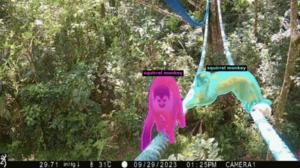
Image of SA-FARI tracking squirrel monkeys
view more
Credit: SA-FARI
Wildlife research projects around the world could benefit from a new AI system that can automatically locate, name, and track individual animals in footage.
A team at the University of Bristol working on AI for animal biometrics and conservation is a key contributor to the SA-FARI (Segmenting Every Part of Animal Footage for Recognition and Identification) project. The project was developed by an international consortium including lead author Dante Wasmuht and senior author Didac Suris, and is led overall by ConservationX Labs (CXL) and META.
SA-FARI is built on META’s latest Segment Anything Model 3 (SAM3). It is a fundamental and state-of-the-art visual language model designed to accurately identify, segment, and track objects in images or videos using text and visual prompts.
This allows researchers to track animals in footage using a “masklet” that represents the exact outline of the animal in the video from frame to frame. This means that animals can be accurately separated from their background and form the basis for individual and behavioral analyses. This method could potentially save thousands of hours in terms of manually viewing content for researchers using camera trap surveys.
SA-FARI’s paper will be presented on Saturday June 6th at the Computer Vision and Pattern Recognition Conference (CVPR) in Denver, USA, widely known as the leading conference for visual AI.
This paper was shortlisted for a CVPR award. This is the second year in a row that the Bristol team working on animal biometrics and AI conservation has secured such a prestigious international nomination.
Thilo Burkhardt, Professor of Computer Vision and Animal Biometrics at the University of Bristol, said: “Global problems require global solutions. Based on the group’s pioneering track record of over 20 years, the University of Bristol is seen as one of the go-to places for leveraging AI in conservation in the UK and beyond, and is an important part of a growing international community working in this field.”
Dr Otto Brooks, Lecturer in AI and Animal Biometrics from the Bristol team, added: “The ability to localize animals in space and time is critical for wildlife monitoring. This is a prerequisite for many tasks, such as recognizing behavior, distinguishing between individuals, and ultimately measuring how animals respond to conservation interventions.”
In this project, we trained and benchmarked an AI system that can automatically detect, name, and track nearly 100 animal species in footage with pixel accuracy. To do this, a huge dataset of over 11,000 wildlife videos taken in their natural habitats was curated and annotated. The project makes this data freely available for download by biologists, researchers, and conservationists, leveraging cutting-edge AI capabilities to advance ecological projects around the world.
Professor Burghardt believes SA-FARI’s research could be extended by others in the future by adding new features such as tracking animal body pose, depth, and natural language descriptions.
The SA-FARI project was led by CXL and META, with key input from co-authors including Dr Otto Brooks and Professor Majid Mirmedi from the University of Bristol, and teams from the Hasso Plattner Institute, the University of Oviedo, the Osa Nature Reserve, the Senckenberg Museum of Natural History, the Max Planck Institute for Evolutionary Anthropology, and the Climate Corridor, and the groups worked together to deliver the large-scale project. and truly interdisciplinary reach.
Paper: “SA-FARI Dataset: Segmenting Everything in Animal Videos for Recognition and Identification”, by D. Francisco Wasmuht et al. CVPR 2026
Article title
SA-FARI Dataset: Segmenting everything in animal footage for recognition and identification
Article publication date
June 6, 2026
Disclaimer: AAAS and EurekAlert! We are not responsible for the accuracy of news releases posted on EurekAlert! Use of Information by Contributing Institutions or via the EurekAlert System.


