

Andrew Jose, Data Work by Wade Zhou

JLco Julia Amaral // Shutterstock
Multi-generational family-owned businesses are often built on reputation and relationships. Today, the rise of generative artificial intelligence presents both challenges and opportunities for family-owned businesses that have long sought ways to maintain their values and succession goals while evolving with the times.
To better understand how family businesses can adapt to AI, Verbit analyzed data from PwC's Global NextGen Survey 2024. Respondents were the next generation members of family businesses (referred to as “NextGen”) and all worked for companies with revenues of over $500 million. Survey respondents included third and fourth generation leaders of family conglomerates across a range of industries, including retail, hospitality and manufacturing.
A family business is an enterprise that is owned by multiple family members and has been run for several generations. Many members often hold shares in the company, and their approaches vary widely based on geographic and cultural differences, regulatory environments, and interpersonal dynamics. It is worth noting that many of the world's largest companies are family-owned businesses, including Walmart, LVMH, LG Group, and Mars, Inc.
PwC research found that while corporate-owned businesses are rapidly adopting AI tools in their operations, family businesses, which account for about one-seventh of the world's gross domestic product and provide employment to about 60% of the global workforce, are lagging behind in adopting AI despite the enthusiasm of the next generation.
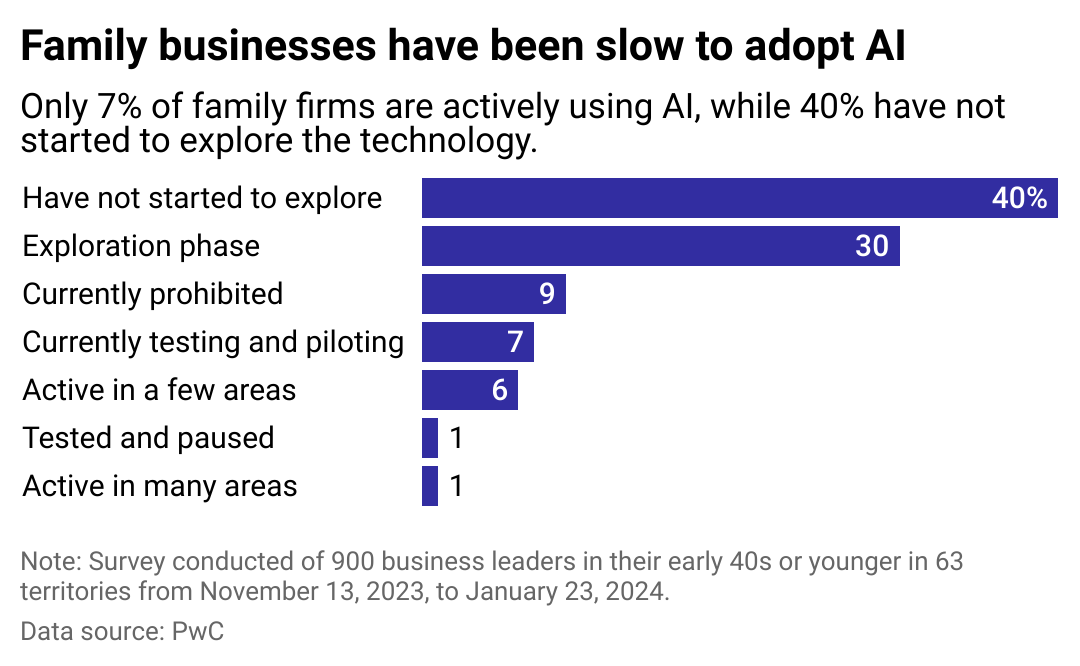
Nearly half of family businesses have not yet considered AI or have ruled it out for now: In the survey, only 12% of NextGen leaders said they are currently actively working with generative AI, and only 7% of family businesses said they have implemented it.
Generative AI, which can create images, text, code, and other forms of content, has opened up new opportunities across industries. GitHub Copilot's ability to help programmers generate code and Boost.ai's ability to automate customer support through AI-powered chat are just two of the countless AI tools businesses are using to increase productivity, efficiency, innovation, and growth.

Family-run businesses have concerns about AI
Verbit
Despite the ease of access to most tools and relative ease of integration, family businesses are taking a cautious approach to adopting generative AI. This reflects the unique challenges they face. In contrast to transactional, corporate-owned businesses, family businesses tend to value long-term stability, reputation, family traditions, and long-standing relationships. Compared to newer, more agile startups or heavily capitalized public companies, this approach may seem overly cautious. But it is these values and priorities that have helped family businesses earn the public's trust.
As PwC points out, one of the main reasons family businesses are cautious about adopting AI is that they have limited access to investment capital compared to publicly listed companies. Additionally, as the type of business most trusted by consumers, family businesses risk reputational damage if their AI adoption goes awry.
However, the study found that in family-owned businesses, the next generation is less risk-averse towards AI adoption due to their personal experiences with the technology. The survey found that members of the younger generation are also more optimistic about the prospects brought by AI adoption. However, CEOs are cautious about implementing AI, citing concerns over cybersecurity and bias.
The next generation of family businesses may have some catching up to do. Large companies are already implementing AI tools into their businesses, with more than half (55%) of executives surveyed reporting that their companies have made significant investments in AI in the past 12 months, according to PwC's 2023 Emerging Technologies Survey. Additionally, 89% of executives said they will increase their technology budgets to fund AI initiatives.
Automation is risky for family businesses

Fh Photo // Shutterstock
Concerns about AI adoption are not unfounded: Respondents cited cybersecurity, misinformation, legal and reputational risks, and systemic bias as the top four significant risks associated with AI, with the next generation being less concerned about these risks than CEOs.
AI tools can be subject to hallucinations, producing inaccurate information based on insufficient data. Moreover, bias can creep into AI decision-making, exposing companies to legal action if that bias violates the rights of people in protected categories.
The survey highlights two clear trends for the next generation: they have more trust in emerging technologies, are less risk-averse and see great benefits in a technology-first approach to business, and consider ethical practices and maintaining trust to be business essential.
As younger family business leaders take the helm of their family businesses, we may see a more open, yet balanced, approach to AI that respects and values traditional principles.
Story editor: Alizah Salario. Additional editor: Elisa Huang. Copy editor: Paris Close. Photo selection: Clarese Moller.
This story originally appeared on Verbit and was produced and distributed in partnership with Stacker Studio.


