

In 2025, AI did not sneak in politely. It went straight to the studio, editing room, and camera bag, uninvited and fully caffeinated. If you film, edit, or direct for a living, you've not only heard about AI developments this year, you've experienced them first-hand.
This year, what was once the “exciting technology of the future” has become much more accessible. It has changed briefs, workflows, client expectations, and sometimes the entire blood pressure of photographers and filmmakers.
Most surprisingly, we all started wondering what this means for our careers, especially if we're in AI-in-demand photography jobs.
Because the AI image generator delivers photorealism so convincingly, portraits retouched from real shots sometimes struggled to look more polished. Conversely, the editing suite was packed with tools that silently shaved hours off masking, color correction, and rough cuts. Indeed, AI can give and take away.
Above: Check out the Sora 2 sizzle reel
And just when everyone thought they had held their breath, OpenAI released Sora 2 in September. Suddenly there was software that could create physically consistent, dialogue-synchronized video clips that felt like they came straight out of a mid-budget Hollywood production.
Filmmakers and editors had a taste of what photographers had already experienced. They were no longer staring at a theoretical mess. It appeared on the screen asking to be added to the workflow.
deeper story
But the story of 2025 is much more than just the evolution of AI. Of course it has been improved. The deeper story was the conflict it forced. What counts as real, what counts as ours, and what does creativity look like when machines can imitate almost anything?
The launch of Sora 2 perfectly captured this tension. Technically it was amazing. Shots that once required an entire department can now be called at a prompt. Movement followed physics, voices matched lips, and shadows fell in exactly the right places. However, the development quickly caused confusion.
The discovery that Sora's training data contained copyrighted material unless creators actively opted out sparked understandable outrage from studios and rights groups. Directors and editors feared that if they adopted this tool too soon, their clients would become embroiled in the next big intellectual property scandal.
Then came the twists and turns where viewers also didn't wholeheartedly embrace AI-generated videos.

These viral AI clips enjoyed a short week in the sun, but disappeared almost as quickly as they arrived. Filmmakers reported that when clients were presented with a choice between footage produced by AI and footage shot by humans with a clear creative point of view, they were still drawn to the latter.
If anything, the excitement surrounding Sora 2 highlighted that there remains a significant gap between technical competency and cultural readiness.
industry split
Around the middle of this year, it felt like the industry was starting to split into two different lanes.
One lane is lined with works that AI can produce cheaply, quickly, and convincingly. Product shoots, corporate headshots, stock-style photography, and the kind of quick-fire branded content that was once the backbone of many photographers' calendars.
Much of this effort evaporated almost overnight, severely impacting personal bank accounts and mortgage payments.
But something interesting happened in the opposite lane. Creative labor that relies on emotional intelligence and spontaneity is beginning to flourish. Brands increasingly value unmistakable traces of human intent.
At the same time, the middle ground, a comfortable space for technically brilliant but stylistically neutral pieces, has shrunk dramatically.

For photographers and filmmakers themselves, mixed emotions were the norm in 2025.
Meanwhile, AI has been integrated into every tool we use, from Lightroom to Premiere Pro. The autofocus seemed to read your mind. The color grading assistant prepared a surprisingly decent first pass. The retouching tasks that once robbed me of my will to live are now taken care of with a single stroke.
Even within cameras themselves, computational photography is becoming increasingly popular, with AI-powered phones like the Samsung Galaxy S24 Ultra and Google Pixel 9 leading the way.
But with this convenience came an equal amount of anxiety. Subscription fees have increased. Storage costs have ballooned. And perhaps most painfully, the skills we spent years honing became, almost overnight, at best optional, and at worst, unnecessary. And at the bottom of all this lies the year-defining revelation: the paradox of perfection.
paradox of perfection
Once AI was able to produce perfect images on an industrial scale, perfection itself lost its cultural value. Social feeds were filled with technically perfect visuals, but the images that caught our attention were those that looked like they had been touched by a real human hand.
As a result, many photographers turned to cameras with film grain, motion blur, eccentric colors, accidental flare, and even intentional limitations.
Similarly, some filmmakers employed hand-held jitters, imperfect light, and textures to indicate the presence of the real world. This wasn't nostalgia for nostalgia's sake, but an intentional response to visual saturation. When everything looks pretty, people crave unpredictability.
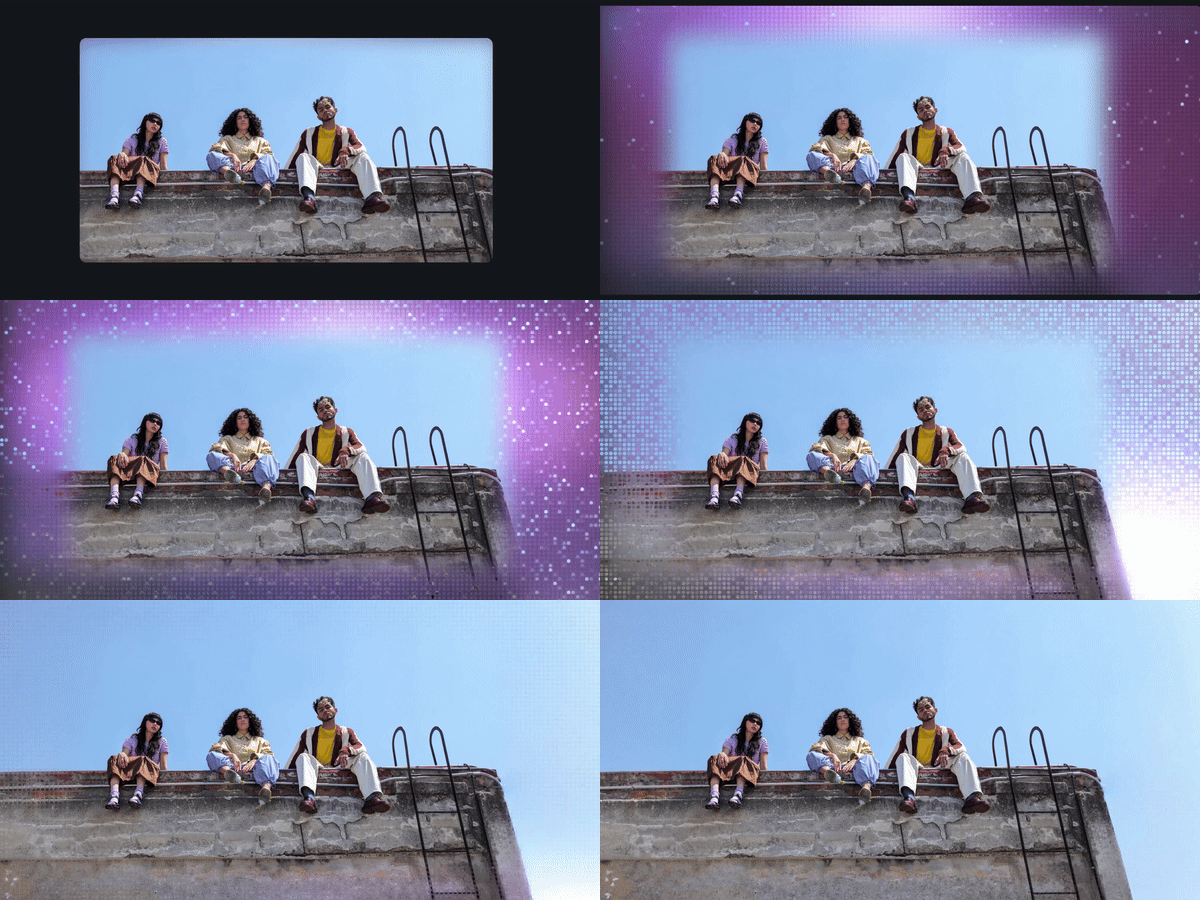
High-end clients quickly understood all of this. They didn't want a job that would compete with AI for technical accuracy. They wanted a job that could never be mistaken for AI.
Imperfection, or more precisely, human existence, became an indicator of value. The more synthetic the landscape became, the more desirable the unpolished truth felt.
conclusion
So where does 2026 leave us? Meanwhile, it seems undeniable that AI will remain a staple of everyday creative work. This is so useful in combating the repetitive, tedious, and unfun parts of production and post-production that it cannot be abandoned. But it no longer defines the pinnacle of technology.
Perfection is no longer the goal. Successful creators in 2025 could not match the accuracy of AI. They were the ones who focused on the parts of image-making and film-making that still belong entirely to humans: perspective, emotion, connection, and the ability to transform real moments into something poignant.
In short, this year has taught us that AI can imitate aesthetics, but not intent. Style can be reproduced, but meaning cannot. And while it can create spectacle, it cannot create emotion.
The tools have changed. Economics has changed. But the core of the craft, the brilliance that makes the viewer feel something, remains firmly, defiantly human. In the end, I think that's the most important lesson 2025 will bring.


