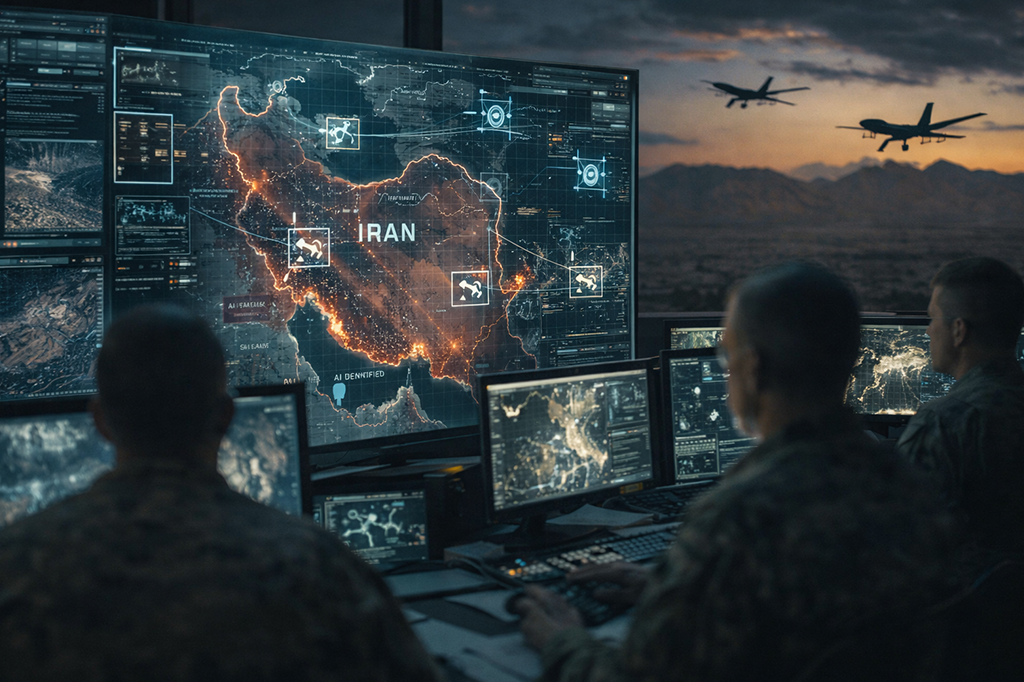
Artificial intelligence is rapidly transforming the battlefield, shortening decision-making cycles and increasing the speed at which militaries gather information and launch operations. The escalation of the conflict involving Iran provides one of the clearest illustrations of how advanced algorithms are reshaping modern warfare.
From automatic drone targeting to real-time satellite analysis, AI tools are enabling militaries to process vast amounts of information and respond much faster than traditional command systems. The result is a battlefield where decisions that once took hours or even days unfold in minutes.
Why AI has become a strategic weapon
Artificial intelligence is emerging as a central pillar of military modernization programs around the world. Governments increasingly view machine learning as essential to interpreting the massive data flows generated by satellites, drones, sensors, and communication systems.
In conflicts, such as the one involving Iran, AI tools can help commanders identify patterns, detect threats, and coordinate responses faster than human analysts alone can.
This technology is particularly effective in environments saturated with surveillance data. Modern reconnaissance systems generate vast amounts of imagery and signals intelligence, and AI models sift through that data to identify potential targets and suspicious activity.
Military planners believe this capability will provide what analysts say is a significant time saver. “From sensor to shooter” cycle– Time from detecting target to attacking.

The rise of autonomous and semi-autonomous systems
One of the most visible ways that AI is impacting warfare is through autonomous and semi-autonomous weapons systems.
Drones equipped with machine learning software can identify vehicles, track movement patterns, and help operators make targeting decisions. While many systems still require human approval before launching an attack, AI dramatically increases the speed and accuracy of battlefield assessments.
These technologies are not limited to aviation systems. AI is increasingly being integrated into surveillance platforms, missile defense systems, and cyber defense networks.
Integrating these systems creates a multi-layered battlefield where sensors, algorithms, and weapons platforms continuously exchange data.
Data is becoming the most valuable military resource
In modern conflicts, the most valuable asset is often information, not weapons.
Military organizations currently rely heavily on: data fusion– Integrate information from satellites, drones, radar systems, and communications intercepts to create a unified operational picture. AI systems excel at this type of analysis, identifying patterns that human analysts might miss.
The importance of data-driven warfare has led governments to invest heavily in computing infrastructure that can process vast data sets in real time.
| military AI capabilities | strategic purpose |
|---|---|
| Satellite image analysis | Detection of troop movements and infrastructure changes |
| Drone targeting algorithm | Helps operators identify potential threats |
| cyber defense system | Automatically detect network intrusions |
| battlefield analysis | Coordinating operations across multiple units |
These systems allow commanders to make faster, more informed decisions in high-pressure situations.
Silicon Valley’s role in the AI arms race
Technology companies are increasingly involved in developing AI systems for use by defense agencies. Cloud computing providers, chip manufacturers, and software developers provide the infrastructure that enables advanced machine learning models.
Cooperation between private technology companies and governments has sparked debate within the technology industry. Some technologists argue that their work should remain private, while others believe that maintaining geopolitical stability requires cooperation with democratic governments.
Abacus News also looked at the defenders of this shift in reporting. autonomous weapons.
The global race to weaponize AI
The growing role of AI in military operations is creating what many analysts describe as a global technological arms race.
Countries including the United States, China, Russia, and several European countries are investing heavily in AI research related to defense applications. These investments are aimed at developing systems that can analyze information, guide self-driving vehicles, and coordinate complex military operations.
China is particularly emphasizing the civil-military integrationencourages commercial AI companies to contribute to defense technology development.

The scale of this competition highlights why governments are viewing AI as a strategic resource.
For broader policy and military context, see the RAND report. future war ai.
Ethical issues are becoming increasingly urgent
Despite the benefits that AI brings on the battlefield, the technology raises difficult ethical questions.
Critics warn that increased reliance on automated systems could lead to unintended escalations and reduce human oversight in deadly decisions. Some worry that fully autonomous weapons could operate without meaningful human control.
International organizations and policymakers are currently debating whether global rules should govern the use of AI in warfare.
The challenge is to balance innovation with safeguards to prevent abuse.
War in the age of algorithms
The Iran conflict shows how artificial intelligence is reshaping the pace and structure of modern warfare.
Military operations increasingly rely on algorithms that can process data faster than human teams can analyze it. As these systems evolve, the distinction between traditional and digital warfare continues to blur.
Future conflicts are likely to be determined not just by the size of armies and the sophistication of their weapons, but also by the speed and intelligence of the algorithms that guide them.