

Traditional predictive models can no longer keep up with the complexity of global trends, changing consumer behavior, and dynamic industry cycles. Market research companies are increasingly turning to artificial intelligence (AI) and machine learning (ML) to achieve predictive accuracy that manual models cannot achieve. These technologies are redefining how data is analyzed, interpreted, and translated into predictions, enabling businesses to make faster, smarter, and more resilient decisions.
Why forecasting in market research needs reinvention
For decades, forecasting in market research relied on historical data and static models to predict growth trajectories. While these techniques are effective in stable environments, they are difficult in markets where changes occur overnight. Global disruptions such as changing supply chains, emerging technologies, geopolitical conflicts and economic fluctuations require a new generation of predictive models that can adapt in real time.
AI and ML provide that adaptability. It can process large and diverse data sets, uncover nonlinear relationships, and detect early market signals long before they appear in traditional indicators. This change allows research companies to provide forecasts that continually evolve with the market.
Limitations of traditional predictive models
Traditional forecasting techniques such as linear regression and moving averages rely heavily on past performance. They work best when markets behave predictably, which is not the case in modern industry. These methods have several challenges, including:
- Static assumptions: The model cannot be adjusted quickly in the event of an external shock.
- Human bias: Analysts' subjective judgments may skew results.
- Data delay: Forecasts take time to update and often lag behind actual conditions.
For research companies competing on reliability and speed, these pain points are driving the need for AI-enabled systems that can continuously automate, refine, and validate insights.
How AI and machine learning improve market forecasting
AI and ML enable market researchers to analyze more data in less time while uncovering insights missed by traditional models. Three applications are particularly transformative for market research:
1. Predictive analysis for market trend detection
Machine learning algorithms identify emerging trends by analyzing both structured and unstructured data, from trade statistics to social media sentiment. Subtle patterns, such as increases in online mentions of sustainable packaging or changes in raw material prices, can be correlated to future market demand. Therefore, predictive analytics can help research firms predict inflection points earlier than their competitors.
2. Neural networks for nonlinear prediction
Unlike standard regression models, neural networks detect complex relationships between multiple variables. For example, Long Short-Term Memory (LSTM) models can analyze time-series data to predict demand for electric vehicles and semiconductors under different policy and supply scenarios. This approach allows for continuous learning as new information enters the system, resulting in predictions that self-improve over time.
3. Natural Language Processing (NLP) for sentiment and policy analysis
Market intelligence increasingly relies on understanding narrative data such as investor calls, industry reports, and government statements. NLP models extract insights from these text sources to identify tone, intent, and policy direction. This capability helps research firms improve their predictions using context-aware signals, especially during cycles of regulatory change and innovation.
How leading research companies apply AI to predictions
Leading market research companies are now incorporating AI into every layer of their predictive workflows.
Main uses include:
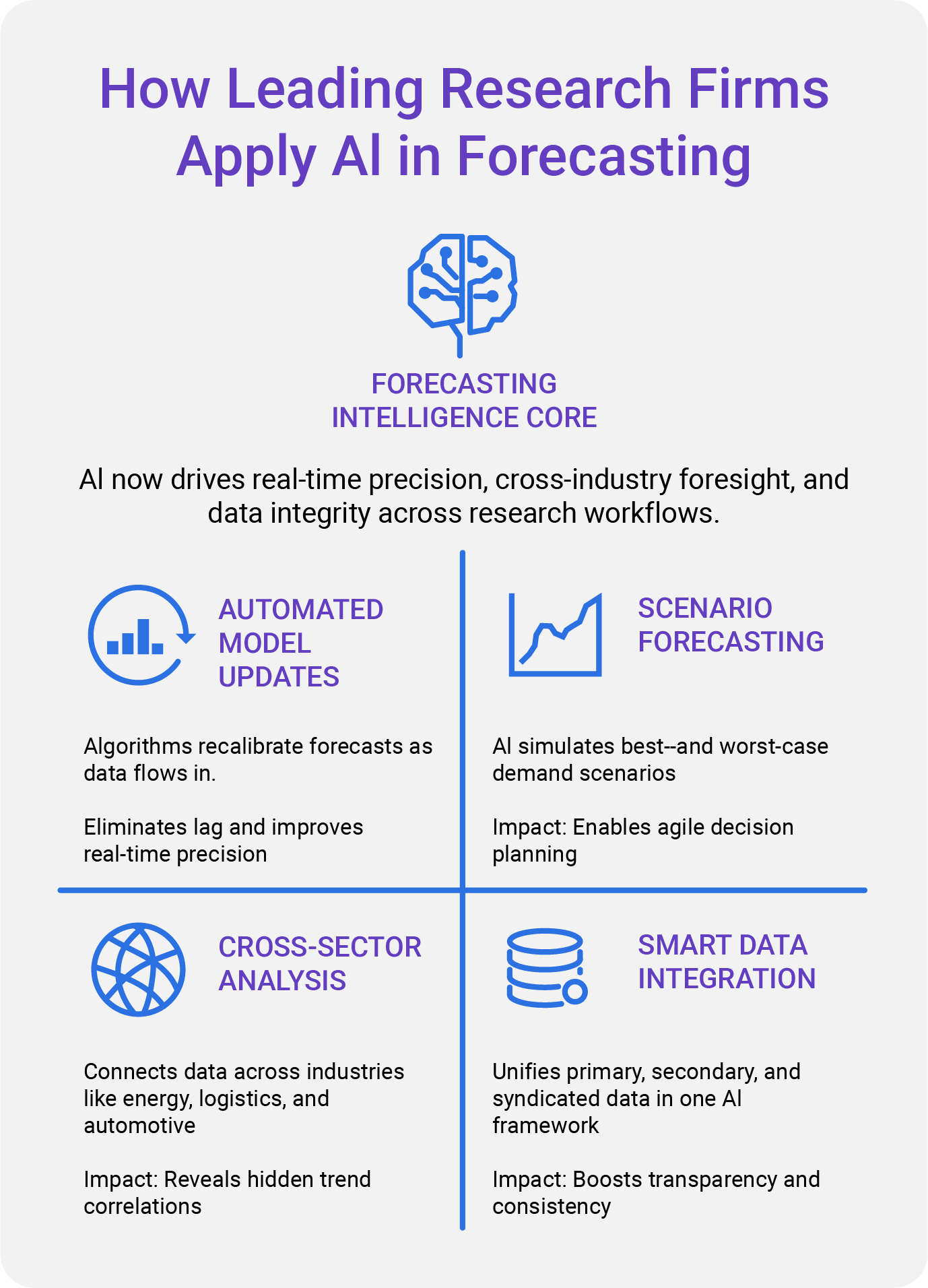
- Automatic model update: Algorithms readjust predictions as new data comes in, eliminating manual delays.
- Scenario prediction: AI creates multiple demand or pricing scenarios based on dynamic variables, allowing clients to plan for best- and worst-case outcomes.
- Cross-functional analysis: By connecting interdependent markets such as energy, logistics, and automotive, AI uncovers hidden correlations that impact long-term demand.
- Smart data integration: AI platforms integrate primary, secondary, and syndicated data into a single analytical framework, improving model consistency and transparency.
Turn AI predictions into trusted foresight with data triangulation
Even as AI improves accuracy, human validation remains important. Data triangulation ensures that machine predictions stand up to real-world evidence. Modern predictions look like this:
- AI detects and models patterns across diverse datasets.
- Analysts interpret findings Eliminate outliers and spurious correlations.
- Client validates assumptions Use market feedback or operational data.
Additionally, the Explainable AI (XAI) framework allows researchers to clarify how their models arrive at their conclusions, meeting the transparency standards expected in client boardrooms.
Benefits for research companies and customers
AI-powered predictions enhance both operational efficiency and customer value.
|
For research companies |
For clients |
|
Faster model iteration and updates |
Real-time access to evolving insights |
|
Scalable processing of global datasets |
Greater confidence in strategic planning |
|
Reduce analyst bias and manual errors |
More defensible decisions backed by data |
|
Enhanced verification through automation |
Early identification of growth opportunities |
Challenges and responsible recruitment
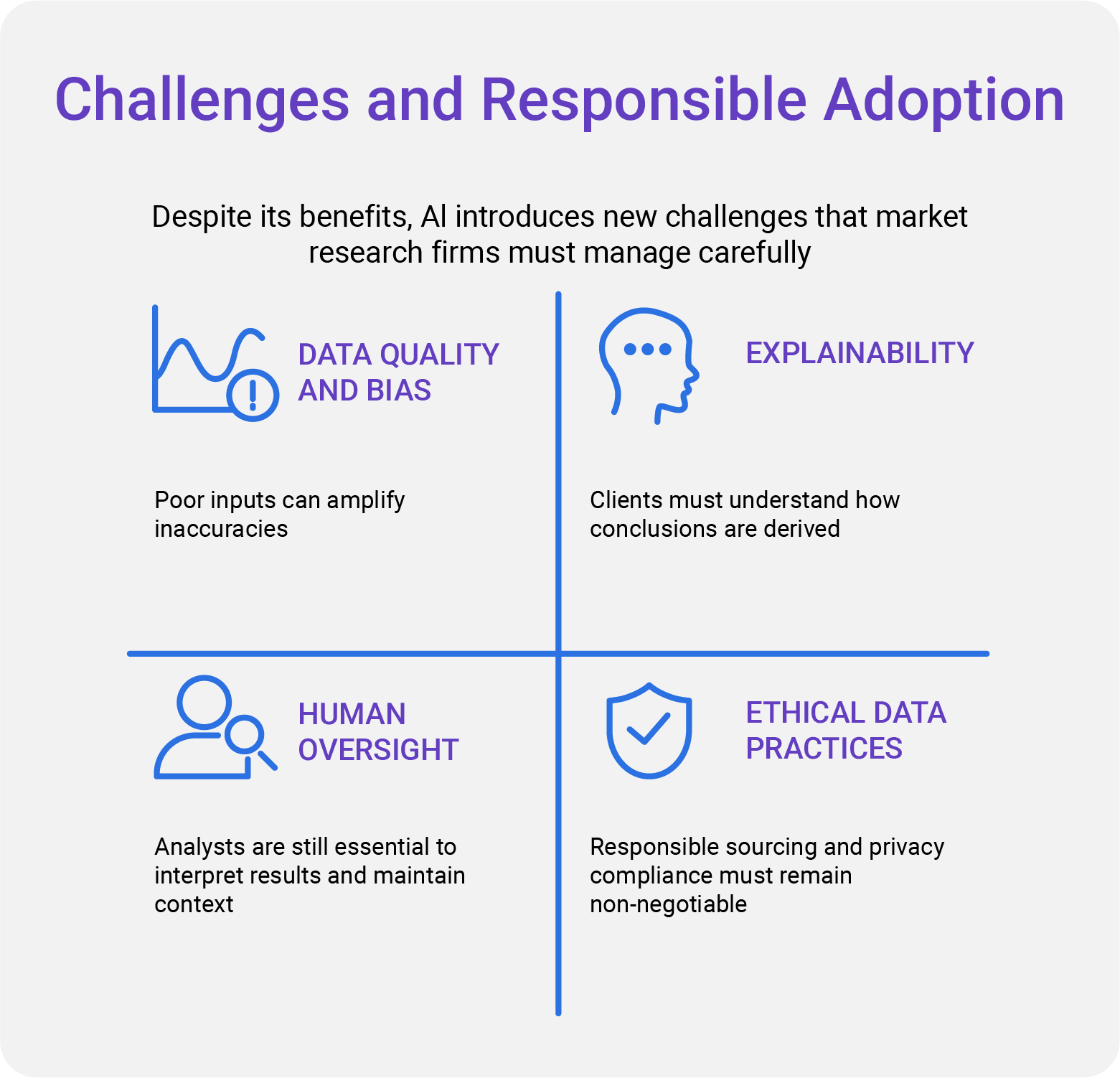
Despite its benefits, AI brings new challenges that must be carefully managed by market research companies.
- Data quality and bias: Insufficient input can amplify inaccuracies.
- Explainability: Clients need to understand how conclusions are drawn.
- Human monitoring: Analysts remain essential to interpreting results and maintaining context.
- Ethical data practices: Responsible sourcing and privacy compliance must be non-negotiable.
The future of AI-driven predictions in market research
By 2026, AI will become an essential layer for any reliable market prediction.
You can expect the following:
- Real-time predictive dashboard Continuously updated as data changes.
- Integration with IoT satellite data Monitor industrial production, supply chains, or agricultural cycles.
- Collaborative AI system Assist analysts by suggesting fixes and detecting anomalies before reports are finalized.
This evolution marks a shift from static, forward-looking reporting to a living intelligence system that reflects global market trends in real time.
conclusion
AI and machine learning are redefining the meaning of accuracy in market research. The most powerful predictions come from the collaboration of analytical algorithms and human judgment. As market complexity increases, companies that combine transparent methodologies with intelligent automation will set new benchmarks for trusted, data-driven insights.
Kings Research outlines a future where human expertise and machine precision work together to generate predictions that help organizations navigate uncertainty with more certainty and clarity.


