

-
Continuing our series on model distillation.
-
This Week in AI discusses recent analysis of coding benchmarks from OpenAI.
-
In the Opinion section, we will discuss the opportunities in the meta and the tremendous challenges for AI Frontier Lab to catch up.
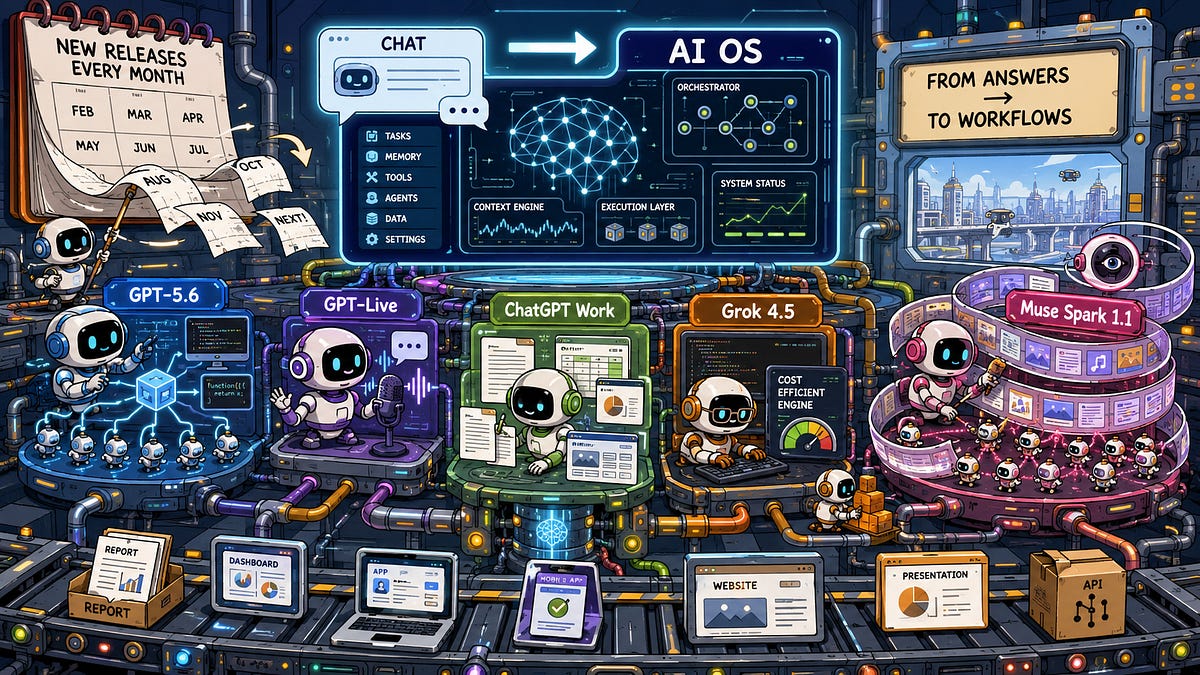
Frontier AI Lab has settled on a roughly monthly release frequency. New models, agents, or interfaces make last quarter’s frontier feel like legacy infrastructure. This week’s GPT-5.6, GPT-Live, ChatGPT Work, Grok 4.5, and Muse Spark 1.1 reveal changes. The model has become the runtime, the chat window has become the control plane, and “response” has been replaced by execution.
GPT-5.6 makes that transition explicit. OpenAI has split the family into Sol, Terra, and Luna to optimize intelligence and performance per dollar. The most exciting feature is programmatic tool invocation. This allows the model to create programs that adjust tools and process intermediate results. When you add parallel subagents, inference starts to look more like distributed systems engineering than autocomplete.
GPT-Live attacks another bottleneck: turn-based interfaces. Its full-duplex architecture allows you to listen and speak at the same time, decide when to pause or remain silent, and delegate deeper reasoning while maintaining the conversation. This isn’t just improved text-to-speech. This is an event loop for human-machine collaboration, replacing “your turn, my turn” with something more akin to shared cognitive bandwidth.
ChatGPT Work completes the stack. It can work across connected apps, websites, and files. Work on a project for hours on end. Create editable documents, spreadsheets, presentations, and sites. Product migration is subtle but massive. Units of value are no longer responses. It is a finished product and increasingly an ongoing process.
Meta’s Muse Spark 1.1 makes races more crowded and cheaper. It combines a million-token context window with multimodal recognition, coding, computer usage, and multi-agent orchestration. Its most interesting trick is active context management. Choose between scripting actions and directly manipulating the interface while compressing extended sessions without losing the state you need later. Paid metamodel APIs are also a strategic turning point. Meta doesn’t just release models. They want to sell measured intelligence.
Grok 4.5 arrives at similar coordinates from a different direction. Built for coding, agent tasks, and knowledge work, pushed to application generation and complex productivity artifacts. Its aggressive pricing puts pressure on the execution layer. Model competition is becoming a competition to provide the cheapest reliable unit of finished work.
The timing will become clear. Frontier Labs vertically integrates models, voice interfaces, agents, browsers, desktop environments, and artifact layers. They are fighting for ownership of the loop between intent and outcome. Whoever owns that loop gets the feedback data, developer ecosystem, and switching costs.
Of course, abstraction layers introduce new failure modes. Long-running agents require privileges, audit trails, checkpoints, and graceful rollbacks. Paragraphs with hallucinations are annoying. A hallucinatory workflow that impacts your CRM, file system, or financial model is an incident.
That’s why this week is so important. The frontier is moving from raw IQ to system design: orchestration, latency, token efficiency, computational usage, memory, governance, and interfaces. Winners may not outperform all static benchmarks. This could be a model that optimally schedules intelligence across tools, time, and people.
The era of chatbots is not over. It is being compiled as infrastructure.
AI Lab: OpenAI
summary: An audit of the popular SWE-Bench Pro coding benchmark revealed that approximately 30% of its tasks were broken due to issues such as overly stringent tests, poorly specified prompts, and misleading instructions. Because these flaws belie the model’s true capabilities, OpenAI is withdrawing its benchmark recommendation and emphasizing the need for new, rigorously designed evaluations built by experienced software developers.
AI Lab: Anthropic (in collaboration with AE Studio)
summary: In this study, we introduced GRAM (Gradient-Routed Auxiliary Modules). This is a technique that separates specific categories of dual-use knowledge, such as virology or cybersecurity, into dedicated, removable neural network modules during training. GRAM allows developers to effectively turn risky features on and off to suit different deployment environments without costly retraining the entire model or reducing overall performance.
AI Lab: LMMS-Lab, NTU MMLab, and Microsoft
summary: In this paper, we present SkillOpt-Lite, a minimally viable pipeline for autonomous agent skill optimization that replaces complex algorithmic architectures with a file system-based trajectory search approach. By treating rollout trajectories as independent flat files and using primitive coding agent tools for consensus mining and validation gates, our framework achieves faster convergence and better performance across multiple benchmarks compared to highly engineered baselines.
AI Lab: Peking University and DeepSeek-AI
summary: DSpark is a speculative decoding framework that combines a semi-autoregressive architecture that reduces acceptance degradation with a hardware-enabled confidence scheduler that dynamically adjusts the verification length based on system load. When deployed under live user traffic in a DeepSeek-V4 serving system, this approach significantly improves the allowed sequence length and accelerates the per-user generation rate without reducing aggregate throughput.
AI Lab: NVIDIA, Georgia Tech, HKU, University of Chicago, MIT
summary: In this work, we present a three-mode language model that reconciles autoregressive and diffusion objectives within a single architecture and allows dynamic switching between causal, parallel diffusion, and self-speculation decoding modes. The resulting Nemotron-Labs-Diffusion model family consistently outperforms state-of-the-art open source alternatives by maximizing generation throughput and maintaining high accuracy across a variety of deployment constraints and concurrency levels.
AI Lab: Google Research, University of California, Berkeley, Stanford University GSB
summary: This paper details a large-scale empirical study of ten major US cities. In this study, an algorithm rerouted a small portion of Google Maps trips from a congested stretch of road to a less congested alternative. The intervention increased vehicle speeds by an average of 2% on targeted sections and improved travel times across the network. This shows that minimal route adjustments can significantly improve road efficiency and reduce CO2-equivalent emissions.
OpenAI Announcing GPT 5.6 This pushes the frontiers of AI models.
OpenAI ChatGPT Work has been releaseda new agent for productivity workflows powered by GPT 5.6.
SpaceXAI Grok 4.5 released Featuring new agent, coding, and knowledge work capabilities.
Meta Introducing Muse Spark 1.1the second version of the multimodal inference model.
OpenAI GPT-Live also releasedits new generation audio model.
-
Loveable is reportedly in talks to raise $300 million at a valuation of $13.2 billion.is a deal expected to be led by Menlo Ventures, just doubling from its December round (Sifted broke this, so no company announcement yet, so remains original source).
-
Prime Intellect announces $130 million Series A led by Radical Venturesis reportedly valued at $1 billion and will build an “open superintelligence stack” of compute, RL post-training, environment, and evaluation, allowing companies like Ramp to train their own models instead of renting Frontier APIs.
-
SambaNova Completes First Close of $1 Billion Series F at Post-Money Valuation of $11 Billion News was also announced that General Atlantic will lead the way and JPMorganChase will deploy SN40 and SN50 systems for on-premises inference.
-
Memory chip maker CXMT will start recruiting investors next week for its roughly $4.3 billion Shanghai STAR Market IPOoffering 6.688 billion shares in the year’s most anticipated Chinese listing (link to Bloomberg left as the underlying source is China exchange filings).
-
Positron is negotiating new funding at a valuation of approximately $5 billion The inference chip challenger to Nvidia is seeking about $750 million over two phases (Bloomberg scoop on private talks, no press release exists).
-
Paradigm Announces Fourth Fund, $1.2 Billion Vehicle This officially expands the crypto-native company’s remit to AI, robotics, and other “steep exponential phenomena,” with early bets already being made on Zipline, True Anomaly, and Nous Research.
-
Norm Ai raises $120 million in Series C at $1.2 billion valuation led by Khosla Ventures To extend the “Agency Law” model that combines AI agents with associated AI-native law firms and supervisory agents for regulated deployment.
-
OpenAI discontinues Atlas browser less than a year after launchredistributes its agent browsing capabilities into a new ChatGPT Chrome extension and an enhanced desktop app with a built-in browser and a remote cloud browser for agent tasks. This is a concession that the browser is a function, not a destination.
-
Gradium expands seed round to $100 million with new investors including NVIDIAhas raised approximately $30 million, on top of the $70 million the Kyutai spinout raised during its December launch, and is opening a San Francisco Bay Area office to scale its ultra-low-latency, real-time voice AI models.
-
Orama Announces $65 Million Series B Led by Theory VenturesWith participation from Benchmark, 8VC, and Y Combinator, the open model platform now has 8.9 million developers per month (double from January), approximately 1 million installs per week, a presence in 85% of Fortune 500 companies, and $88 million in total funding. Both have 14 employees.


