
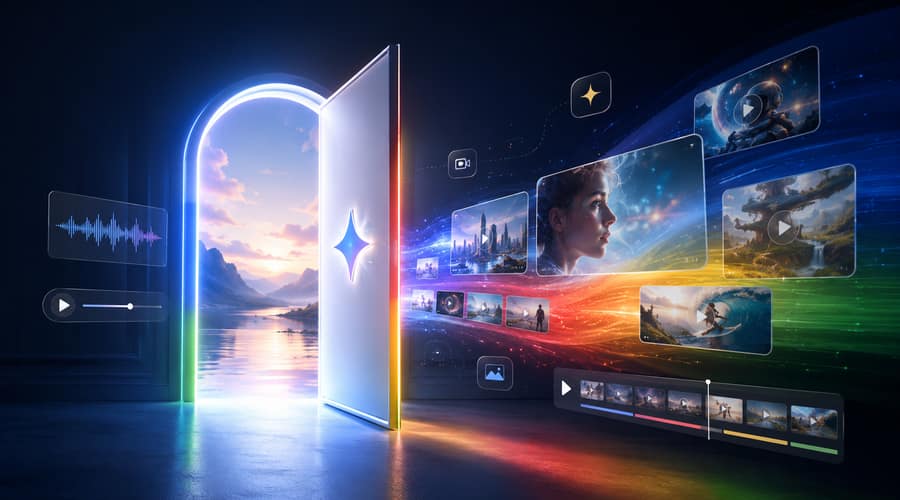
Google is moving AI video from prompt boxes to everyday creator tools. Gemini Omni is the clearest indication that the next battle is about editing, not just generation.
Google announced Gemini Omni, a new family of models that takes text, images, audio, and video as input and lets you create and modify videos through conversations. The first version, Gemini Omni Flash, is published through the Gemini app, Google Flow, YouTube Shorts, and YouTube Create. So this is more than just a developer lab demo. It’s located directly where people are already creating and sharing content.
This is important because AI video has spent the past year pursuing visual quality. Better movement, clearer faces, cleaner lighting, and more convincing sound are still important. But the more difficult commercial problem is control. Creators don’t just want polished clips. They want to adjust scenes, keep characters consistent, change camera language, and build from real video without having to learn a professional editing suite.
According to Google’s announcement article by Koray Kavukcuoglu, CTO of Google DeepMind and Chief AI Architect at Google, Omni is designed to combine Gemini inference and media creation, starting with video and later expanding to other output types such as images and audio. That positioning is intentional. Google doesn’t describe Omni as a standalone toy. This is presented as a creative layer for the entire Gemini ecosystem.
The most important part of Gemini Omni Flash may not be the model itself. Distribution. Google says the model will roll out globally to Google AI Plus, Pro, and Ultra subscribers through the Gemini app and Google Flow, and YouTube Shorts and YouTube Create will be accessible for free starting this week. This makes the same functionality available to hobbyists, paid AI users, and short video creators at the same time.
This is an advantage Google has over smaller AI video companies. Models like Omni are great on their own, but they become even more important when connected to YouTube, Gemini, and Flow. YouTube naturally feeds Google with creators who already have scenes, clips, and remixes in mind. Gemini provides a conversational interface. Flow enables a more structured AI filmmaking workspace.
For business, the implications are real. Product demos, social ads, training clips, founder videos, and short descriptions can all start with messy source material rather than a blank prompt. Marketers can combine product photos, rough scripts, and brand reference videos to continue refining the output for specific changes. This doesn’t replace professional creative work, but it reduces the cost of early drafts and speeds up iterations.
The same goes for individual creators. When short video creators can remix footage, change settings, add new visual styles, and generate scenes from audio instructions, the editing barrier drops dramatically. It’s convenient, but it also puts pressure on you. The easier it is to create, the faster your feed will fill up. The winner is not the one who generates the most clips. They will be people using the tool with preference, timing, and a clear reason for publishing.
Google is making AI videos editable
Gemini Omni’s even bigger promise is conversational editing. With current AI video tools, users often restart if the results are close but incorrect. This is frustrating because video creation is rarely completed in one prompt. Creators may like the setting but not the motion, the characters but not the lighting, the first few seconds but not the end, and so on. Omni aims to help users keep working on the same idea without abandoning it.
This is a more natural fit for how creatives work. Actual editing is a series of decisions. Move this object. Slow down and enjoy the moment. Makes the background feel lively. Same subject, but change the weather. If Omni can maintain enough continuity across these changes, AI video will move closer to a real tool and further away from a novelty generator.
There are still practical concerns. YouTube’s use of Gemini Omni in short videos raises obvious questions about consent, attribution, and low-effort AI content. Google said remixes powered by Omni will include signals such as watermarks and metadata identification, giving creators control over their visual remixes. While these safety measures are important, we plan to test this feature as soon as it becomes available to the general public at YouTube scale.
Competitive pressures are also evident. OpenAI, Runway, Adobe, and others are working to define how AI video fits into everyday creative work. Google is betting that the best answer is a model within the apps people already use, rather than a separate destination. This strategy may not be as appealing as a single viral demo, but it’s often how the platform wins.
The next thing to note is how much control Gemini Omni Flash can actually offer users. If they can keep the scenes consistent, respect the source material, and make follow-up edits feel believable, Google will have a serious creative product on their hands. If it mostly produces impressive but unpredictable clips, the creators will likely treat it as another experiment. In any case, AI video has entered a new phase. The question is no longer whether the model can generate clips. It’s about helping people create something worth watching.
Also read: Fake illness shows why medical AI needs evidence, not sophistication • Google DeepMind shows AI can solve real research mathematics • ECB wants banks to treat AI cyber risks as urgent.


