

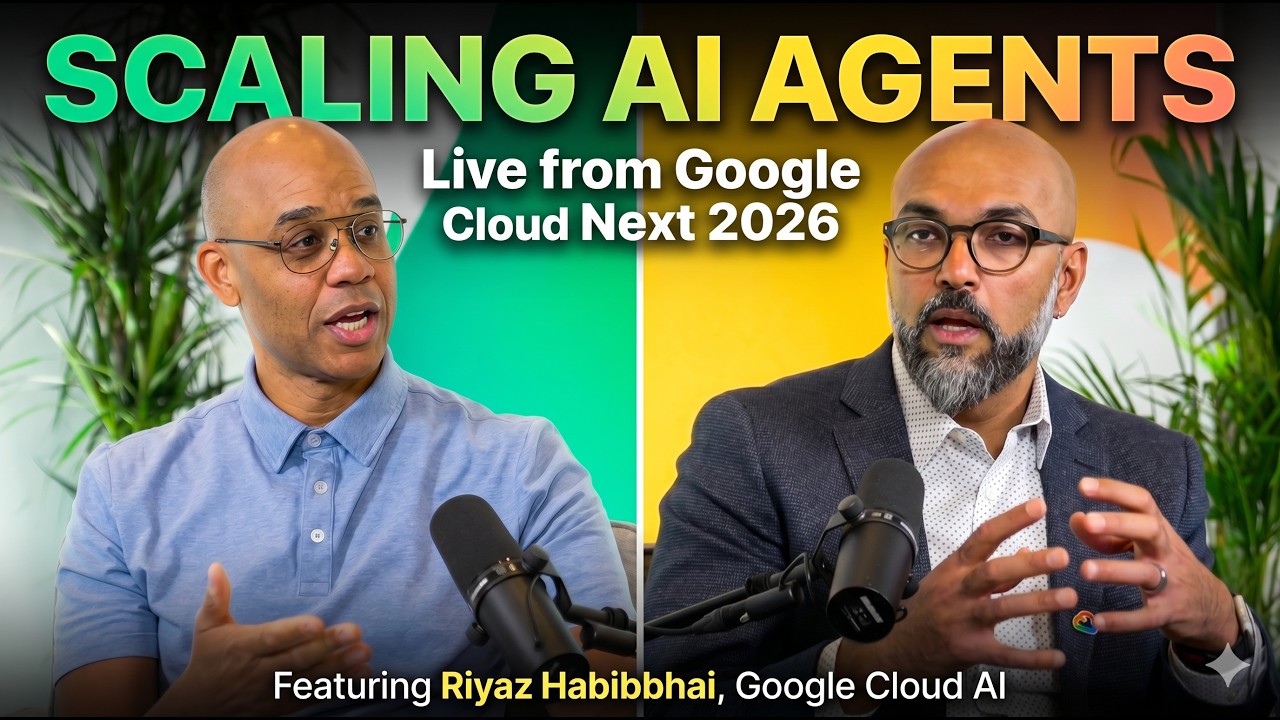
At Google Cloud Next 2026 in Las Vegas, Riyaz Habibibhai, Director of Cloud AI Product Marketing at Google Cloud, shared insights about the company’s AI agent strategy. Habibibhai spoke with TWiML founder and principal analyst Sam Charrington to learn more about Google Cloud’s commitment to a comprehensive, full-stack approach to AI-powered agent development and deployment.
Riyaz Habibibhai: Driving AI Innovation
Habibibhai leads product marketing for Google Cloud’s AI services. His role includes translating the company’s advanced AI capabilities into tangible value for the enterprise. He helps shape how customers understand and deploy Google’s AI solutions, from foundational models to specialized agent platforms.
Complete discussion can be found here: TwimulYouTube channel.
Google’s full stack approach
Mr. Habibibhai emphasized Google Cloud’s consistent strategy of providing complete AI solutions. This includes everything from custom silicon such as TPUs to base models and the data infrastructure required to support them. The goal is to provide a unified platform that simplifies the development and deployment of AI applications.
“One of the themes that has been consistent over the years is articulating the value of what Google brings to the table, which is the entire AI-optimized stack from chips to research and models to what we have from a data cloud perspective to platforms and applications, all wrapped in security.” — Riyaz Habibibhai
This end-to-end integration is intended to reduce complexity and accelerate customer adoption. By controlling multiple layers of the AI stack, Google Cloud can ensure better performance, cost efficiency, and a more consistent user experience.
Meet your customers where they are
Key aspects of Google Cloud’s strategy are flexibility and interoperability. Habibibhai emphasized the importance of meeting customers wherever they are in their AI journey, whether they are already leveraging a multi-cloud environment or building a custom solution.
“We want to meet our customers where they are, and we want to have interoperability with other platforms, including what we’ve announced with Microsoft Azure. Interoperability with other platforms, including Microsoft Azure, is something that our customers really want.” — Riyaz Habibibhai
This approach ensures that Google Cloud integrates with existing customer workflows and infrastructure, rather than forcing a complete overhaul. Our focus on openness allows customers to bring their own models and data, allowing us to deliver more personalized and adaptive AI solutions.
Simplify messages and portfolios
As the AI landscape rapidly evolves, Google Cloud is also focused on simplifying its messaging and product portfolio to help customers understand and access AI capabilities.
“We continue to strive to simplify the message and portfolio that the AI portfolio is evolving very rapidly. How can we help our customers understand our portfolio of products across these stacks and how they can get started?” — Riyaz Habibibhai
This simplification is critical for widespread adoption, allowing businesses to quickly identify the right tools and services for their specific AI needs.
Full stack innovation
Habibibhai reiterated that the “full stack” approach is not just a marketing term, but a core tenet of its innovation strategy.
“Full stack innovation is really the idea that Google Cloud offering full stack is a consistent theme across the next few events and platform innovations.” — Riyaz Habibibhai
Google Cloud aims to optimize each layer of the stack, from hardware to software applications, to deliver superior performance and cost-effectiveness, and to address common integration and deployment challenges faced by many enterprises.
Surface-wide management agent
A key challenge for enterprises is managing and controlling AI agents across different platforms and surfaces. Google Cloud addresses this issue by providing a unified governance solution.
“One of the things that really struck me is around observability and governance. Before, I mean, a few years ago, it was more siled, but now you can actually see what your agents are doing, and you see a platform to manage and run them across the surface.” — Riyaz Habibibhai
Gemini Enterprise Agent Platform is designed to provide a central registry for managing agents, providing visibility into agent behavior, and enabling policy enforcement across different environments.
Openness of the agent platform
The platform’s emphasis on openness is a key differentiator, giving customers the flexibility to leverage their existing investments and choose their preferred models.
“Openness is about meeting customers where they are and giving them the choice and flexibility to do it.” — Riyaz Habibibhai
This means customers can bring their own machine learning models or leverage Google’s own powerful models to ensure they build the best agent for their specific use case and data requirements.
MCP and governance
Mr. Habibibhai touched on the importance of governance, especially in the context of managing multiple agencies and ensuring compliance.
“MCP and governance talk has been part of the evolution…Customers are asking, ‘How do we manage these?’…We have our own MCP, and you can bring in your own MCP and link it to your own registry.” — Riyaz Habibibhai
This integrated approach to governance, which includes the use of model cards and other compliance tools, is designed to give organizations the control they need to responsibly manage their AI deployments.
Looking ahead: challenges and opportunities
Looking to the future, Habibibhai sees a huge opportunity for AI agents to transform businesses, but he also recognizes the challenges ahead, especially when it comes to implementation.
“The biggest issue that enterprises face is integration challenges, so you can build your own agents and run them on the Gemini Enterprise Agent Platform, which allows you to run them on multiple different surfaces.” — Riyaz Habibibhai
Our advice for organizations considering deploying AI agents is to focus on building a clear business case, engaging stakeholders, and leveraging the capabilities Google Cloud offers to simplify the process.
Agent recruitment challenges
The discussion also touched on the challenges organizations face when deploying AI agents, with integration and ROI being key concerns.
“Yesterday, we held a customer panel and asked, “What’s one piece of advice you would give to your audience?” And everyone said, “Build a proof of concept, build a business case, and bring in stakeholders.” — Riyaz Habibibhai
This practical advice highlights that successfully implementing AI agents and realizing their full potential requires a clear strategy and strong internal buy-in.
Thoughts of parting
Habibibhai concluded by highlighting the collaborative nature of AI development at Google Cloud and the importance of customer feedback in shaping the future of the platform.
“Thank you for your partnership. Feedback from customers like you helps us continue to develop our product, simplify it, and drive a consistent story.” — Riyaz Habibibhai
The continued advancement of Google Cloud’s AI capabilities, particularly the Gemini Enterprise Agent Platform, demonstrates our commitment to providing businesses with accessible, scalable, and manageable AI solutions.


