
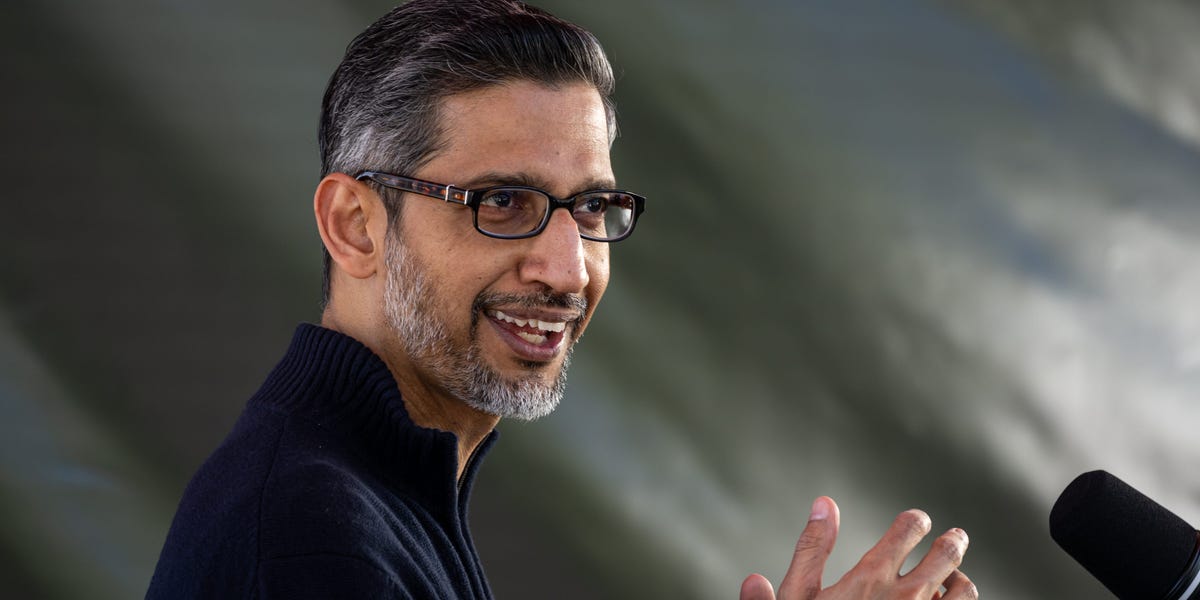
Google is one of the companies leading the AI revolution.
But Google CEO Sundar Pichai didn’t mention it in his commencement speech to Stanford graduates on Sunday, and for good reason.
Students booed mercilessly when one of Pichai’s predecessors, former Google CEO Eric Schmidt, praised the potential of AI in a commencement speech at the University of Arizona last month. Students booed Big Machine Records CEO Scott Borchetta when he spoke about AI at Middle Tennessee State University.
“I think today is the day to give you some advice,” Pichai told the graduates. “But people also gave me a lot of advice about what to say. In fact, it was the same advice, about what not to say.”
While the lessons of AI may have been more well-received at Stanford University, the epicenter of Silicon Valley and the AI boom, it was the closest he came to acknowledging the disdain many young people have for technology these days in his speech.
He risked a light joke: “People thought it would be really difficult for me,” he said. “After all, those are the last two letters of my last name.”
Instead, Pichai told the graduates to “choose optimism,” which may be a subtle allusion to their fears about the impact of AI on entry-level jobs, and explained how he learned how to maintain a positive mindset.
Pichai said he expected a lush landscape when he first came to California in the 1990s. Instead, he said that everything he saw was brown, until the host corrected him that the word he was looking for was “golden.”
The bigger lesson for graduates, he said, is how to rebuild something unattractive into something promising.
“By choosing optimism, that’s exactly what I mean. It’s about reframing towards the positive. Where I saw brown, she saw gold,” Pichai said. “This slight shift in perspective had a huge ripple effect on how I thought about the world around me.”
Students just starting out in their careers can probably be forgiven for having a hard time seeing the world through gold-colored glasses.
Those building products that power the world’s AI transformation, such as OpenAI CEO Sam Altman and Anthropic CEO Dario Amodei, have repeatedly warned that AI could make traditional entry-level jobs obsolete.
More than a dozen major companies are citing AI as a way to reduce staff this year. And recent graduates told Business Insider they’ve been looking for full-time work for months to no avail.
Pichai, a Stanford graduate, has led Google since 2015 and has seen several waves of technology hit Silicon Valley. But AI has brought about a level of change that humans have never seen before, he said on a recent episode of the Hard Fork podcast.
“These graduates will actually play a key role in driving that progress and also addressing its impact,” he said, referring to AI.