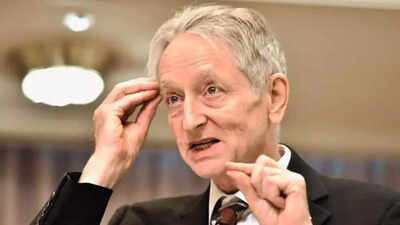
Jeffrey Hinton, the godfather of AI, is back with another prediction about AI. Hinton believes AI will cause mass unemployment. Nvidia CEO Jensen Huang recently said that AI will not lead to mass layoffs, but will change the nature of many jobs. Meanwhile, Bill Gates feels that humans may soon not be needed “for most things,” while Elon Musk believes that within 20 years most people won’t need to work at all. However, the Godfather of AI feels that all these predictions overlook one big reality: AI has the potential to wreak economic havoc and cause mass unemployment.
Jeffrey Hinton’s Warning: Jobs at Risk
Speaking at Georgetown University with Bernie Sanders, Hinton said the rise of AI could leave millions of workers behind, Fortune reported. “For many people, it seems very likely that AI will cause mass unemployment,” he said.Hinton also pointed out that tech giants are busy investing trillions of dollars in data centers and chips, and are betting big on AI systems that can replace human labor at low cost. Hinton increasingly believes that Big Tech’s priorities are misplaced, arguing that the industry is driven more by short-term profits than scientific progress.
The economics of AI under scrutiny
The economic realities of AI are also a cause for concern. ChatGPT developer OpenAI is not expected to become profitable until at least 2030, and could need more than $207 billion to sustain growth, according to HSBC estimates.The godfather of AI left Google in 2023 to speak freely about the risks of AI. He warned that while AI would lead to new job creation, it would not be able to offset the scale of the losses. “Trying to predict the future will be very difficult,” he said, likening the uncertainty to driving in fog.
Jobs and humanity are at risk
So did Bill Gates, and Bernie Sanders echoed the warnings of technology leaders including Tesla CEO Elon Musk and Anthropic CEO Dario Amodei, who warned that AI could eliminate millions of jobs. “Right now, if I’m a factory worker and I work in an office, how am I going to support my family? How am I going to pay my rent? Who’s telling me that?”Sanders also expressed concern about the impact of AI on relationships, noting that teenagers are becoming increasingly dependent on AI companions. “If today’s children have AI as their best friend…what kind of change will that mean for humanity?”Sanders also warned that cooperation between AI companies and the U.S. military could violate privacy. “How far are we from a few people who have access to every email you send, every phone call you make, really every aspect of your life? We’re not that far away.”While Gates and Musk envision a future in which humans are freed from labor, Hinton argues that the conversation must also address the social and economic consequences of mass displacement.