

“The scammers were very believable,” said Kim Sawyer, a former university professor in Melbourne. “He had a British accent, used all the proper financial market terminology, and knew how to guide us by appearing trustworthy every time.”
The Sawyers are not an isolated case.
Using sophisticated cyber tools, artificial intelligence, and spoofing techniques, fraudsters holed up in centers across Southeast Asia are defrauding victims of billions of dollars in savings. In 2024, $10 billion in losses were reported in the United States alone due to scams based in this region. [AP1] [LG2] .
Scammers target victims all over the world and are often highly educated. Both Sawyers have master’s degrees and are experienced stock market investors.
Partnership against organized fraud
Fraud is becoming increasingly global, but the response to these crimes is also transnational.
Governments, law enforcement, the private sector and civil society were brought together by the United Nations Office on Drugs and Crime (UNODC) and Interpol at the Global Fraud Summit in Vienna, Austria, with a mandate to work more closely together, including:
- shared intelligence
- joint investigation
- Reasonable prosecution across borders
Additionally, last December in Bangkok, Thailand, representatives from around 60 countries came together with tech giants Meta and TikTok to launch the Global Partnership Against Online Fraud.
The Bangkok conference and subsequent Global Fraud Summit, hosted by the Thai government and UNODC, mark a diplomatic turning point in international cooperation against fraud centers.
However, the criminal infrastructure that has established itself across Southeast Asia and drives fraud continues to spread globally.

UNODC staff visit an attacked fraud center in Cambodia’s capital Phnom Penh.
The entire criminal ecosystem is functioning.
These activities, which are taking place across the region, are more than just scams. These networks facilitate money laundering, develop and deploy malware, weaponize artificial intelligence (AI) for deepfakes and voice cloning, and sell cybercrime capabilities as a service.
Recent raids in the Philippines and Cambodia show the same thing. A fraud center is actually just one part of a connected criminal infrastructure that generates billions of dollars in illicit financial flows.
This is organized crime on a large scale, and fraud is just the surface layer of a deeper ecosystem that includes corruption, human trafficking, and cross-border money laundering.
“We need to look at prosecuting high-level criminals, conducting financial investigations to trace their funds, and identifying the large networks operating behind these operations,” said Delphine Schantz, UNODC’s regional representative for Southeast Asia and the Pacific.
“The complexity of these crimes requires an equally complex whole-of-government approach and increased collaboration between governments, financial intelligence agencies, and digital banks.”

A karaoke room used by the administrator of a fraud center in the Philippines.
On-site response
Philippines: During a recent visit to an ex-fraud center in Manila, Philippines, UNODC officials and investigators walked through the rooms where crime bosses once organized their fraud operations, just a few hundred meters from government offices and foreign embassies.
Now converted into offices for the Philippine Presidential Anti-Organized Crime Commission (PAOCC), some rooms remain in their original condition, including areas for bosses to entertain themselves, such as a karaoke room and game hall, and a torture chamber used to punish trafficked workers who don’t meet their quotas.
Red light district diaries list politicians, municipal officials, and police officers who were entertained as guests, providing evidence of the corruption that allowed these activities to flourish.
“How do you prove cybercrime within 36 hours? It’s impossible,” said PAOCC’s operations director, recalling the confusion when police first raided the site. They had just over a day left to file charges before the legal deadline expired.
UNODC is helping countries in the region address these gaps.
- Covers the ability to collect, analyze and share electronic evidence
- Reduced space for organized crime groups to move and invest resources through underground banking systems and local casino industries
- Strengthen cooperation to stem the flow of human trafficking to regional fraud centers
In the Philippines, UNODC is supporting PAOCC and other relevant agencies involved in combating fraudulent operations and developing standard operating procedures for victim-centered responses.
- Victim identification and repatriation
- collect evidence
- Detain the alleged perpetrator.
UNODC is also working with authorities to develop a national strategy against transnational organized crime.

Fraudsters who fail to meet their quotas are often tortured.
Cambodia: A delegation of prosecutors, investigators and central authorities from around the world visited a raided fraud center in Phnom Penh last December, along with UNODC officials.
Participants discussed key aspects of dealing with the fraud industry: mutual legal assistance, extradition, asset recovery, and proper handling of cross-border digital evidence.
The timing was deliberate. Cambodia recently established the Committee to Combat Online Frauds (CCOS). The commission is a high-level coordinating body chaired by the Prime Minister with the mandate to work with military and law enforcement agencies across the country, along with representatives from 25 ministries.
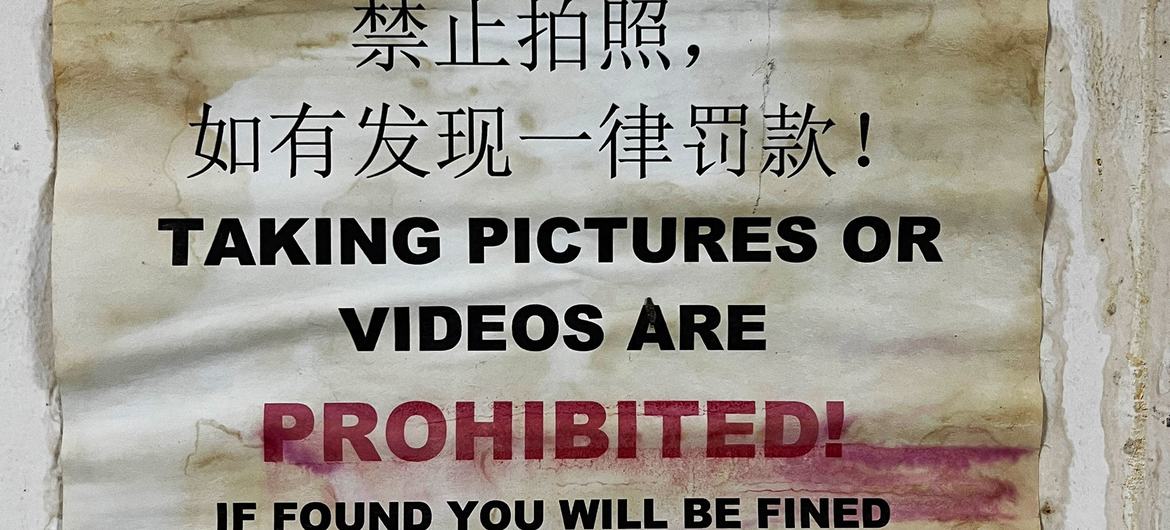
Workers who violate the rules are fined or even beaten.
Toward implementing a global response to fraud
Despite increased attention and local law enforcement efforts, fraud centers continue to operate, often simply relocating after one facility is raided. Victims continue to lose billions of dollars as governments rush to pursue the crimes. This week’s Global Fraud Summit focused on just that challenge: translating political will into concrete, long-term impact.
World leaders discussed priorities, a coordinated response and advanced solutions, but officials stressed the next steps require operational follow-through.
- Joint operations across borders
- coordinated prosecution
- Real-time intelligence sharing
“They take your money and they take your soul.”
Sawyer said he and his wife, along with hundreds of other victims, are disappointed in the response from banks and the government.
“Scammers work double. They take your money, they take your soul. They really do. They take away your self-respect. And with the authorities’ non-response, you feel like you’re being scammed again,” he said.
He hopes that as countries share solutions and engage in international cooperation, and as global attention to the issue grows, victims like him can benefit from responses that are already working in other countries.
Find out what UNODC is doing to combat these and other crimes. here .


