

Hydrogels are soft, permeable materials consisting of a polymer network and water with applications ranging from biomedical engineering to contact lenses. Intrinsic hydrogels are the ability to impart a variety of properties by modifying the polymer network. Professor Gong's lab at WPI-ICREDD at Hokkaido University specializes in hydrogel technology and designs hydrogels with self-reinforcement, self-repair, and underwater adhesion properties. For adhesive hydrogels, achieving immediate, strong, and reproducible underwater adhesion is a common challenge.
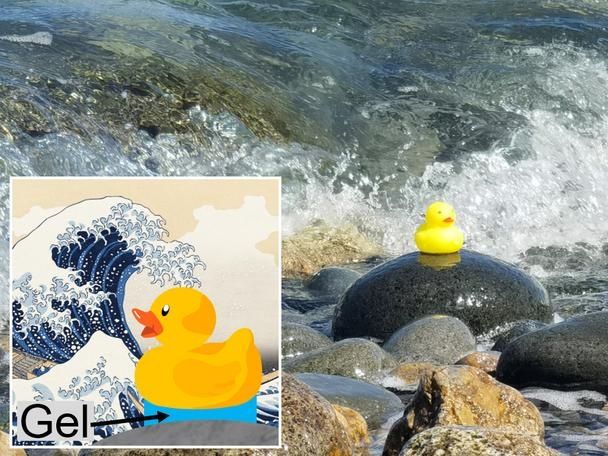
Photographs of rubber ducks stuck to seaside rocks using new hydrogel technology that withstands repeated ocean tides and wave impacts.
Hokkaido University WPI-ICREDD
A combination of data mining and machine learning has recently been developed by Professor Gong, Professor Takakawa, Professor Hwang, Graduate Student Riao and colleagues, who have developed the most powerful underwater adhesive hydrogel ever in adhesive strength (F)a) Over 1 MPa. The strength of the gel is instantaneously reproducible and works across different surfaces under different levels of salinity from pure water to seawater. This study was published in Nature It was chosen for the cover.
For reference, if these hydrogels were cut to the size of a single postage stamp (2.5 x 2.5 cm), they could theoretically support 63 kg (for example, adult humans). The researchers have demonstrated the adhesion strength of the hydrogel. It was applied to rubber ducks on the rocks by the sea, where it withstanded the repeated impacts of sea tides and waves.
Taking inspiration from biology, these hydrogels were designed with polymer networks derived from adhesion proteins found in archaeals, bacteria, eukaryotes, and viruses. Despite the diversity of these organisms as a whole, these proteins share a common sequence pattern that confers adhesion in a wet environment. Therefore, the ~25,000 adhesion protein datasets collected from the National Center for Biotechnology Information (NCBI) protein database were data mined for the relevant amino acid sequences important for water adhesion.
They replicated these sequences into a polymer network and synthesized 180 hydrogels. Data compiled from these hydrogel studies were analyzed with machine learning to further extrapolate the most important polymer sequences. The original 180 gels synthesized from data mining showed greater adhesion than previously reported gels in the literature. However, the machine learning-inspired gel was more incredible and exceeded the highly desirable quality mentioned above.
Repeatable instantaneous adhesion is of a highly desirable quality for applications from biomedical engineering and deep sea exploration. These qualities have been confirmed in experiments where water is leaking from damaged pipes and are instantly repeatedly covered.
Original Publications
Hongguang Liao, Sheng Hu, Hu Yang, Lei Wang, Shinya Tanaka, Tichigaku Takigawa, Wei Li, Hailong Fan, Jian Ping Gong; “A data-driven de novo design of ultra-stick hydrogels.” Nature, Vol. 644, August 6, 2025


