
image:
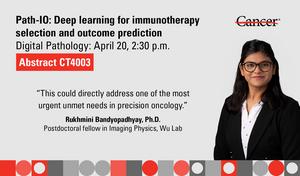
Important research information for AACR Abstract 4003
view more
Credit: University of Texas MD Anderson Cancer Center
- Path-IO is a machine learning platform that incorporates pathology data to predict how non-small cell lung cancer patients will respond to immunotherapy.
- Unlike molecular approaches, Path-IO uses pathological data that is already routinely collected from patients.
- Path-IO outperforms current standard of care biomarkers to guide immunotherapy use in non-small cell lung cancer
Abstract: 4003
SAN DIEGO, April 20, 2026 – An artificial intelligence (AI) model developed by researchers at The University of Texas MD Anderson Cancer Center has demonstrated the ability to accurately predict response to immunotherapy in patients with metastatic non-small cell lung cancer (NSCLC). If clinically validated, it could provide clinicians with much-needed insight into one of the most pressing challenges in oncology.
Details of this model, called Path-IO, were presented today at the American Association for Cancer Research (AACR) 2026 Annual Meeting by Dr. Rukmini Bandyopadhyay, a postdoctoral researcher in the lab of Dr. Jia Wu, associate professor of image physics and thoracic/head and neck oncology.
“While there have been a number of AI-based approaches that have shown promise in recent years, Path-IO really stands out because it was designed from the beginning for clinical translation,” said Bandyopadhyay. “To do that, the model needs to make explainable decisions based on known factors and do it in a way that persists across the dataset. What we’re showing here is that Path-IO can not only do that, but it can do it using data from slides that are already being collected on a regular basis.”
For more information on all content from the UT MD Anderson AACR Annual Meeting, visit MDAnderson.org/AACR.
What is the importance of Path-IO and how can it contribute to clinical care?
Immunotherapy is a revolutionary advance in cancer treatment, but not all patients benefit from it. A key challenge in oncology is determining who is most likely to benefit so that physicians can customize treatment and avoid unnecessary treatments.
The current standard-of-care biomarker for immunotherapy outcome is PD-L1 expression, but its predictive ability is only modestly demonstrated. In fact, in some of the validation groups used in this study, PD-L1 expression was as predictive as flipping a coin.
New research shows that specific intratumoral structures known as niches are also important biomarkers for predicting response. Path-IO uses pathology slides to look for these niches and other complex patterns that can be difficult for humans to reliably identify. The model then uses that information to stratify patients into groups based on their risk of disease progression after immunotherapy treatment.
This biologically-based approach is one of the things that makes Path-IO unique. Rather than acting as a “black box” AI that identifies entirely new and often uninterpretable patterns, Path-IO focuses on established tissue features and structures that are difficult to consistently detect and quantify but are known to influence treatment response. The ability to explain this decision is an important characteristic for potential clinical adoption.
Using historical datasets from UT MD Anderson, Path-IO categorized patients into high-risk and low-risk groups. Patients in the high-risk group had twice the risk of death or disease progression compared to patients in the low-risk group. For validation, the researchers tested the model on several external datasets and found comparable results.
Overall, Path-IO was validated in over 1,000 patients from multiple institutions and multiple countries and significantly outperformed PD-L1 testing across all datasets.
What’s next for Path-IO?
The next important step for this technology is to validate it in prospective clinical studies. In preparation, the team is already expanding its testing cohort to include a more diverse group of patients.
Like most AI tools, the more data Path-IO uses, the more accurate its predictions will be. In this study, researchers have already combined pathology-based predictions with radiomics and clinical data to further improve the model’s prognostic ability.
Bandyopadhyay believes this model will soon be able to predict not only whether a patient will respond to immunotherapy, but also the optimal immunotherapy strategy, such as immune checkpoint inhibitors alone or in combination with other drugs.
In the future, Bandyopadhyay hopes to be able to fully integrate this platform with additional data into digital twin models that include multimodal data, CT imaging, genomic factors, and other clinical variables.
“To our knowledge, this is the most rigorously validated deep learning pathomics framework to date. But it’s really just the beginning,” Bandyopadhyay said. “As we continue to integrate more data streams into our models, we expect their predictive capabilities to improve and become more specific, making them a great asset to clinicians helping patients make important decisions about treatment options.”
***
This research was funded by the National Institutes of Health, Utah MD Anderson Institutional Funds, Munaini Fund for Lung Cancer Research, Rexana Foundation to Fight Lung Cancer, QIAC Research Partnership (QPR) Funds, and Permanent Health Fund. Scientific and financial support for the Cancer Immune Monitoring and Analysis Centers-Cancer Immunology Data Commons (CIMACs-CIDC) network was provided by the National Cancer Institute. A complete list of authors and their disclosures is provided in the abstract.
Disclaimer: AAAS and EurekAlert! We are not responsible for the accuracy of news releases posted on EurekAlert! Use of Information by Contributing Institutions or via the EurekAlert System.


