
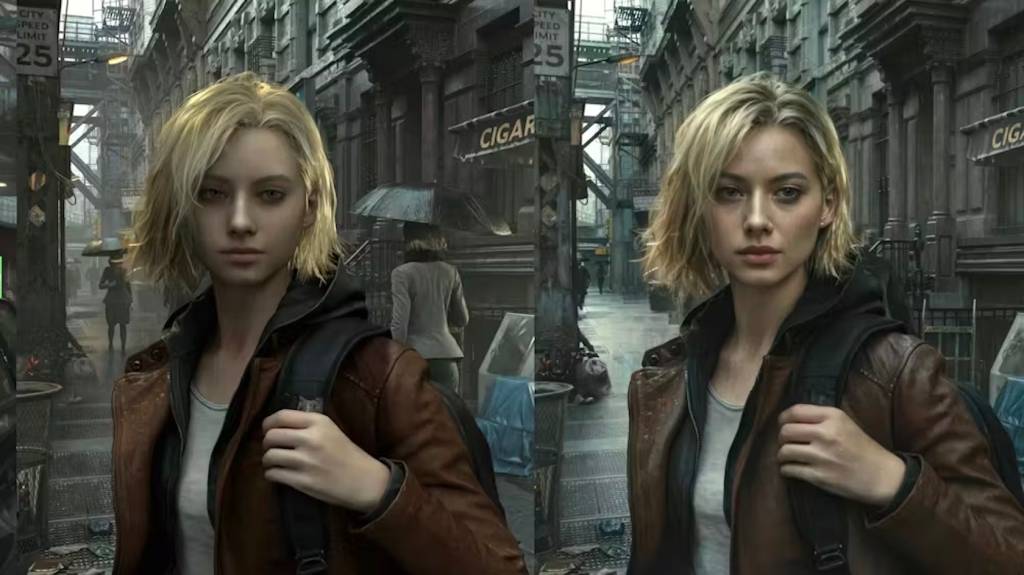
Last week, leading chipmaker Nvidia announced DLSS-5 (Deep Learning Super Sampling), a new artificial intelligence (AI) rendering tool that the company calls “a breakthrough in visual fidelity for games.”
The software takes low-resolution images and uses AI to enlarge them and add what NVIDIA calls “photorealistic lighting and materials.”
The tool is designed to make video games look more photorealistic, but the example Nvidia chose to show off the technology reveals something unexpected. Not only does AI make images sharper and glossier, it also makes characters much more appealing than before.
The growing backlash is not limited to makeup. This points to broader fears about what will happen if we give creative decision-making control to AI, and if its ideas of “better” are encoded into algorithms.
“Beauty filter” for games?
Nvidia used Grace Ashcroft, the protagonist of the recently released Resident Evil: Requiem, to showcase the technology.
A before-and-after comparison showed that the software changed her hair color, added defined eyebrows, lip tint, and facial contours. Some gamers were quick to label this a “beauty filter”, criticizing the way it applied what looked like heavy makeup and shaped her face to be more traditionally attractive.
The choice of Grace to introduce the technology is worth considering. Resident Evil Requiem features all sorts of monsters and gritty characters, and Nvidia could have used any of them.
The decision to spotlight young, traditionally attractive female characters and make them even more appealing feels poignant. The representation of women in gaming has been an issue that has been a flashpoint for years.
Female characters in games are treated badly
Historically, female characters in games have been portrayed as helpless and weak, or as secondary sexual objects to the male protagonist.
The 2000s saw the introduction of more diverse female characters, but attempts to increase diversity sparked intense backlash during the 2014 Gamergate harassment campaign. Women and minorities in and around the gaming world have been targeted with abuse, identity theft, and rape and death threats.
The debate has continued ever since. Some players were outraged by Abby Anderson’s muscular depiction in The Last of Us: Part 2, claiming her body shape was unrealistic and demanding that she be made more conventionally attractive.
DLSS-5 adds a new dimension to this discussion. Rather than designers making intentional choices about how a character should look, algorithms can silently override those choices in certain directions.
Looksmaxing game characters
Certain changes that DLSS-5 makes to Grace’s face also reflect the manosphere’s trend toward looksmaxing.
Born in the incel community, Lookmax Thing is built on the idea that certain facial features are biologically more sexually desirable to women, leading some men to pursue techniques to alter their faces to increase their “sexual marketability.” Seeing software automatically apply similar logic to female game characters raises uncomfortable questions.
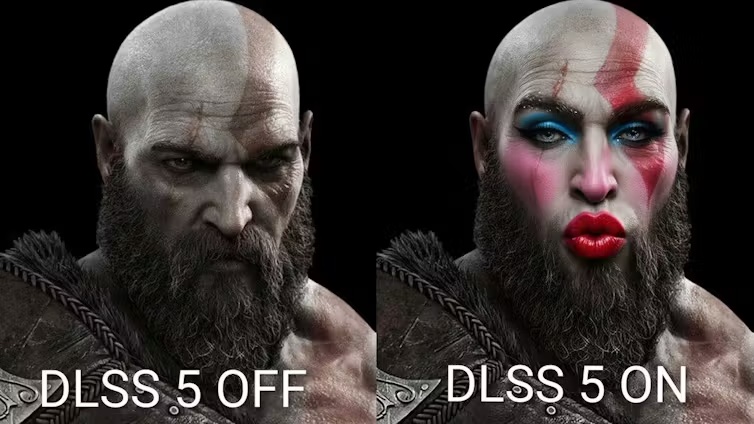
Gamers have noticed, and many have responded with humor. The software has been derided as a “crazy” character, and one widely shared meme applies the same treatment to God of War’s hulking protagonist Kratos, complete with blue eyeshadow, pink blush, and plump lips. This joke is successful because it exposes the absurdity of gender.
This reaction mirrors how some gamers previously responded to criticism of Aloy, the protagonist of 2017’s Horizon Zero Dawn. After complaints that Aloy was “woke” because she didn’t wear heavy makeup or conform to conventional beauty standards, some gamers cynically created a “non-woke” version of the character to make the same point in reverse.
Bad news for game designers
The second obvious complaint about DLSS-5 is that it undermines the developer’s artistic choices.
The software uses algorithms to change textures and lighting, rather than simply sharpening existing ones. The result has the familiar AI aesthetic: shiny, smooth, bright, and generic.
A dark, gritty game like Resident Evil Requiem can end up looking like an ad for high-end skin care. In at least one case, in EA Sports FC, a filter drastically altered the appearance of a real-life player, making him completely unrecognizable.
The future of game visuals – and who controls it
It’s worth noting that DLSS-5 can truly improve the visual quality of many games, enriching environments and bringing old character models to life.
Nvidia has also pushed back against critics, with CEO Jensen Huang insisting that DLSS-5 is not a filter and developers can control how it is applied.
But the backlash reveals real tensions. Many players objected to Nvidia’s choice of a young female character and the use of AI to make her more traditionally attractive and sexual. Many others objected to AI overriding the intentional creative choices of game developers.
Both concerns are pushing back against the same forces: tech companies’ push to deploy AI as broadly as possible and define “better” visuals on their own terms.
This article is republished from The Conversation under a Creative Commons license. Read the original article.


