
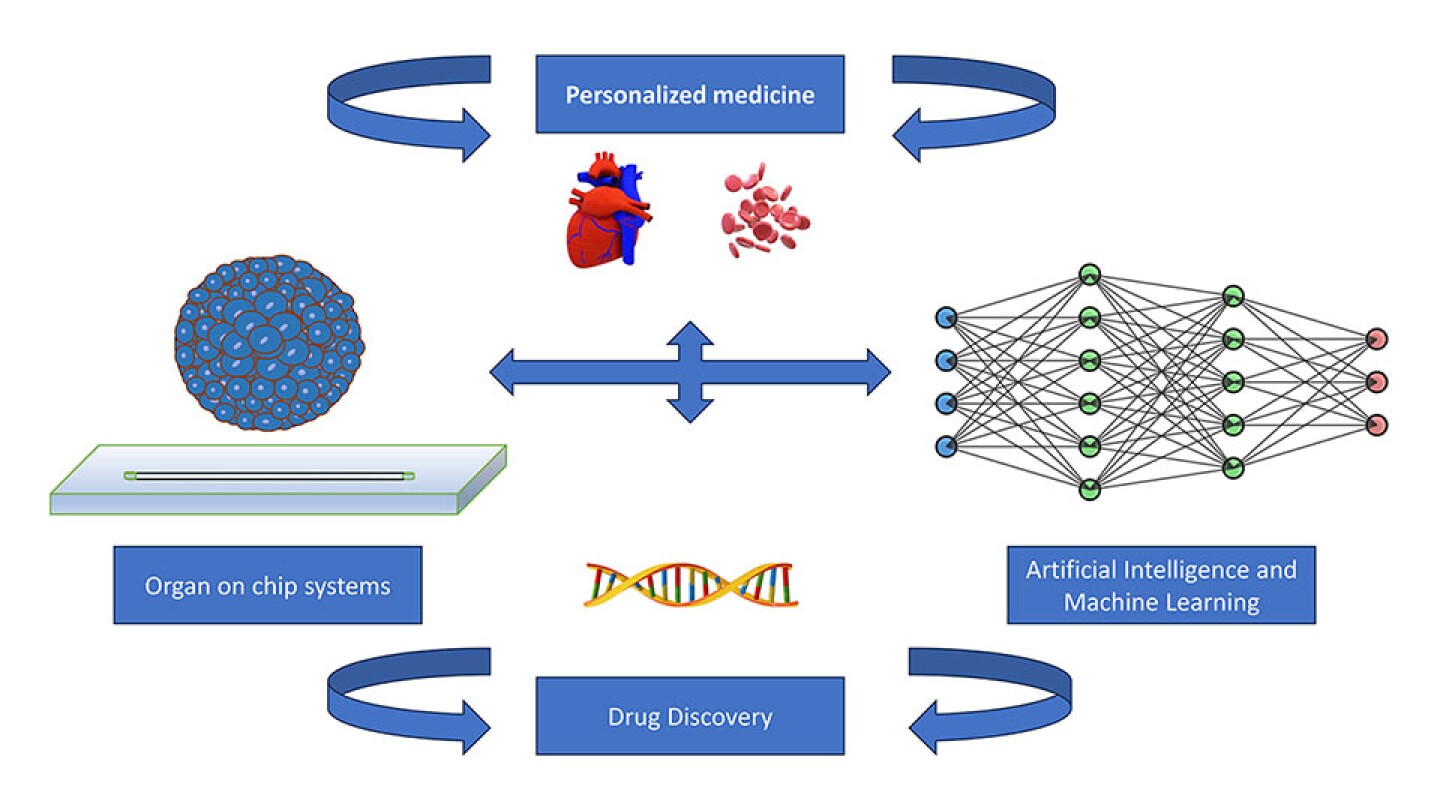
Developing technologies in parallel will make personalized and predictive medicine more achievable.
Artificial intelligence and machine learning are transforming biomedical research, including image analysis, drug discovery, and diagnostics. These tools are also poised to power organ-on-a-chip (OOC) platforms, which are three-dimensional in vitro spheroids and organoids that provide microenvironments to study diseases, drugs, and therapeutic responses.
Datasets generated from OOC platforms, such as real-time biosensor output or high-content imaging, are complex, noisy, and multidimensional, making them natural targets for analysis by AI and ML. However, the development of these technologies has not yet progressed synergistically, leading to missed opportunities to evolve OOC systems.
To foster a more consistent framework for developing AI/ML for use in OOC platforms, Khurana et al. provide a basic overview of the technology that will appeal to researchers from a variety of backgrounds.
Author Kiran Raj M said, “This study aims to foster tighter integration between microfluidics, biology, computational modeling and machine learning, while providing a structured perspective that will help guide future developments towards more predictive and clinically relevant platforms for drug delivery. It also aims to encourage young researchers to engage in this rapidly evolving interdisciplinary field.”
This review synthesizes current approaches to optimizing OOC systems and identifies key challenges such as data standardization and interpretability. Researchers expect deeper collaboration between AI/ML and OOC systems in the coming years to improve the study of drug responses and biological variation, accelerating progress in personalized medicine.
“What excites us most is the steady convergence towards personalized and predictive medicine, where complex biological systems can be studied and interpreted in patient-specific terms rather than generalized models,” Raji M. said.
sauce: “Intelligent organ-on-a-chip platform: Machine learning in predictive and personalized drug delivery” by Tanishq Khurana, sourav Ganguly, Kiran Raj M. biomicrofluidics (2026). This article can be accessed from: https://doi.org/10.1063/5.0306883 .


