


BENGALURU: For most of 2025, artificial intelligence did not enter people's lives through dramatic product launches or viral demos. Instead, it quietly slipped in and took over small, repetitive tasks that many users barely noticed. What started as a casual experiment with chatbots has now evolved into a set of everyday tools for many people that handle information storage, planning, creation, and filtering in the background.One of the most common uses of AI today is as a personal memory and ledger. Saumya Shikhar, a Hyderabad-based AI product manager, uses ChatGPT to document her work accomplishments, the skills she's building, and the challenges she encounters on the job. He also maintains another chat to track developments in RBI interest rates, which affect loan repayments, and another to record health history. “That way, you feel like you always have a personal assistant with an infinite memory and quick wits,” he says.
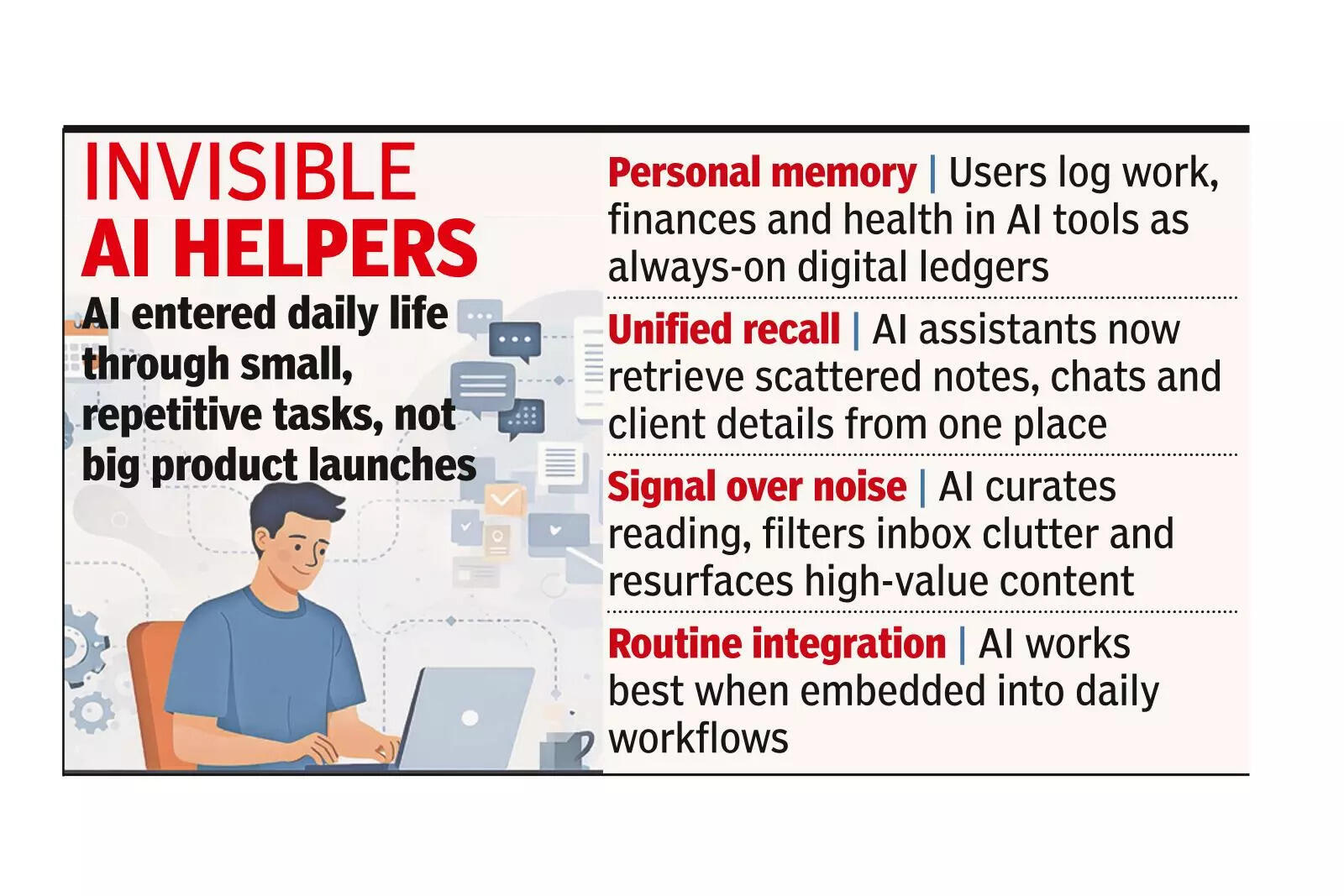
Some companies are embedding AI even more deeply into everyday memory. Vignesh Ramakrishnan, founder of a Bangalore-based AI consulting firm, has built a WhatsApp-based AI assistant that acts as an operational memory. The system records voice notes, handwritten notes, calendar entries, and conversations with customers, and details can be retrieved weeks later upon request. “Previously, customer details were scattered across chats, notes, and spreadsheets,” he said. “Then I would like to ask you about one thing.”Another far-reaching change is the use of AI to filter the signal from the noise. Instead of scanning through crowded inboxes and unread newsletters, users are increasingly relying on AI-powered curation tools. Dr. Sneha Jain uses Readerwise and Pocket to curate and prioritize what she reads for the week. “I start each morning by scanning for high-signal insights instead of wading through the noise in my inbox,” she says, adding that saved articles will reappear during short breaks between meetings, turning idle time into focused reading time.Drafting and structuring tasks remain among the most common everyday uses of AI. Tools like ChatGPT, Claude, and Copilot are now routinely used to turn rough ideas into emails, memos, and first drafts of long documents. New tools like Gemini's Nano Banana and Gamma are increasingly being used to generate presentation visuals and slide decks from basic prompts. Meeting-specific tools like Granola are also gaining traction for recording conversations and automatically generating summaries and action points. Founder and author Pavan Govindan said the biggest change was eliminating friction in thinking. “AI has not replaced judgment or creativity,” he says. “It has been replaced by a blank slate.”


