
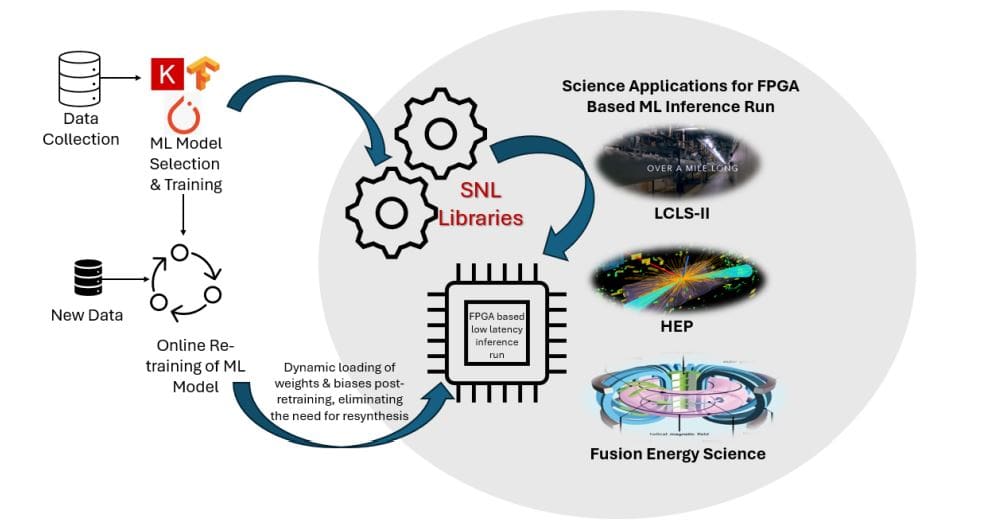
Controlling the incredibly complex behavior of plasma remains a central challenge in the pursuit of fusion energy, and accurately predicting instabilities is critical to maintaining stable, high-performance operation. Abhilasha Dave, James Russell, Mudit Mishra and colleagues demonstrated a major advance in this field by integrating machine learning systems directly into the real-time diagnostic infrastructure of DIII-D fusion experiments. Their innovative approach utilizes field programmable gate arrays (FPGAs) to accelerate the analysis of beam emission spectroscopy data, enabling ultra-low-latency prediction of destructive events in plasmas. Built using the SLAC neural network library, this system uniquely enables dynamic updates of machine learning models without the need for hardware changes, paving the way for adaptive control strategies and continuous improvements in plasma confinement and stability, an important step toward realizing practical fusion power generation.
Machine learning improves tokamak plasma control
Scientists are advancing research into fusion energy by integrating machine learning into tokamaks’ real-time control systems, especially the DIII-D facility. The goal is to improve plasma control, in particular by avoiding interruptions and achieving advanced operating regimes. To do so, it is necessary to overcome challenges related to computational delays and ensure system reliability. The team successfully deployed a system that leverages field-programmable gate arrays, a specialized processor, to speed up machine learning models and reduce latency. The resulting system achieved microsecond-scale inference latencies, was successfully integrated into a DIII-D control system, and demonstrated the ability to classify plasma states and detect the onset of destructive events. The researchers validated the ability to dynamically reload neural network parameters into an FPGA without requiring a complete hardware redesign, allowing it to adapt to changing plasma conditions. Future work will focus on bypassing current CPU-based data collection systems to further reduce latency and enable true streaming inference. They also plan to explore adaptive control strategies and investigate the deployment of more complex neural network architectures. This research represents an important step toward realizing the potential of data-driven control in fusion energy and highlights the importance of hardware acceleration to achieve real-time control and improve disruption avoidance.
Real-time plasma monitoring with scalable hardware
Scientists designed a real-time plasma monitoring system for the DIII-D tokamak, integrating high-bandwidth diagnostics and plasma control systems to enable advanced control strategies. The system is built around a diagnostic scalable hardware I/O execution layer that is a modular software framework that facilitates deterministic, low-latency data acquisition and communication across diverse computing platforms. This architecture streams data from diagnostics such as beam emission spectroscopy to processing hardware such as field programmable gate arrays and graphics processing units for feature extraction and inference. Real-time data acquisition relies on an analog input card operating at 500kHz to capture signals from the 64-channel beam emission spectroscopy with high precision.
These digitizers are housed within a PCIe-based acquisition server and are synchronized using a specialized framework to ensure accurate timing throughout the system. The research team achieved a 1MHz sampling rate by utilizing dual analog-to-digital converters to capture rapid fluctuations in plasma behavior. This node also includes a powerful GPU, which interfaces directly with the plasma control system and enables rapid response of the actuators within microsecond-level delays.
A key innovation is the library’s support for dynamic reloading of neural network parameters. This allows task-specific configurations to be loaded at runtime without completely redesigning the FPGA. This flexibility allows multiple inference tasks, such as predicting instability and recognizing confinement regimes, to be performed in a single firmware-based model. This system achieves 4.4 microsecond-scale latencies for neural network inference and demonstrates the feasibility of incorporating dynamically reconfigurable hardware-accelerated machine learning into real-time fused diagnostic pipelines.
Real-time plasma control using machine learning
Scientists have achieved a breakthrough in the real-time control of tokamak plasma, which is essential to maintaining the high-performance operation of future fusion reactors. This study demonstrates a hardware-accelerated machine learning system integrated into the real-time diagnostic and control infrastructure of a DIII-D tokamak, enabling ultra-low-latency plasma state classification and edge local mode (ELM) prediction. The system utilizes Xilinx FPGAs to process data from beam emission spectroscopy, a diagnostic that provides high-resolution measurements of electron density variations. Experiments revealed that the system achieved a neural network inference latency of 4.
4 microseconds is a significant advance for responsive plasma control. This capability supports multiple classification tasks and adaptive control strategies to accommodate the evolution of plasma conditions during operation. Researchers have successfully deployed a single firmware-based neural network model capable of both ELM prediction and confinement regime recognition. The results establish a scalable and resilient path towards intelligent and autonomous plasma control, an essential feature for achieving reactor-related operations in future magnetic confinement fusion devices. By deploying a fully connected feedforward model on a dedicated FPGA, the researchers achieved microsecond-scale inference, enabling accurate classification of plasma confinement regions and early detection of edge local mode (ELM) events using data from beam emission spectroscopy. The system works seamlessly with existing control frameworks to support rapid decision-making, which is essential to avoid disruption and maintain stable plasma operation. A key achievement lies in the system’s ability to dynamically reconfigure the FPGA-based inference engine, allowing neural networks to be updated without the need for hardware resynthesis.
This adaptability supports continuous model refinement, facilitates seamless task switching during live operations, and paves the way for more responsive and intelligent plasma control strategies. Although the current data acquisition pipeline introduces some delay, this architecture exhibits strong scalability for future deployments with more direct data interfaces. Future work will focus on establishing a direct connection between the data acquisition system and the hardware inference engine to further reduce latency and enable true streaming inference. This tighter integration supports more adaptive control strategies, which are critical to optimizing performance and preventing disruptions in next-generation tokamaks.
👉 More information
🗞 FPGA-accelerated real-time beam emission spectroscopy on DIII-D using the SLAC neural network library for ML inference
🧠ArXiv: https://arxiv.org/abs/2511.21924


