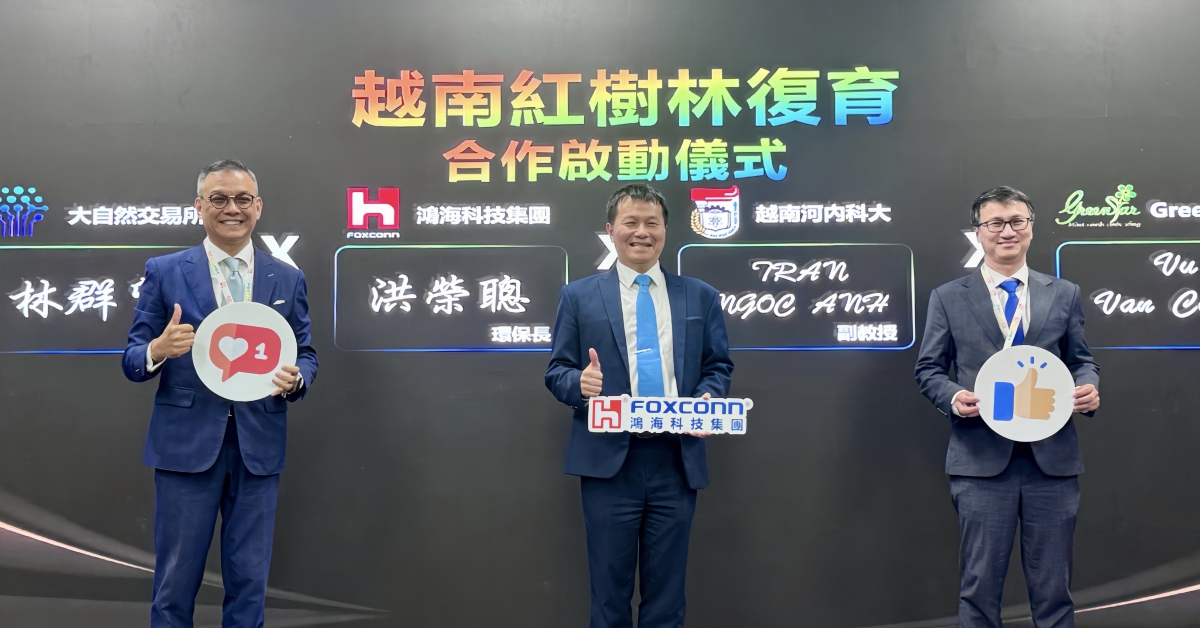

.jpg) At Hon Hai Tech Day 2025, experts affiliated with Foxconn outlined the goals and progress of AI-powered nature-based solutions. (Photo: Wendy Lo)
At Hon Hai Tech Day 2025, experts affiliated with Foxconn outlined the goals and progress of AI-powered nature-based solutions. (Photo: Wendy Lo)
Taiwanese electronics manufacturer Foxconn is expanding its sustainability strategy with a new suite of AI-enabled nature-based solutions, collaborating with universities in Taiwan and Vietnam to accelerate coastal protection, ocean restoration, and soil carbon sequestration. At Hon Hai Tech Day 2025 on November 21, experts outlined the pilot sites, schedule, and anticipated climate benefits of these efforts.
Vietnam’s mangrove restoration aims to unlock blue carbon credits
Foxconn partners with Hanoi University of Science and Technology to launch mangrove restoration program in northern Vietnam. The three-year project, scheduled to begin next year, will serve as a nature-based solution for coastal protection and blue carbon development in one of the country’s most disaster-prone regions.
The program’s top priority is to strengthen coastal defenses and reduce typhoon damage to vulnerable communities. Foxconn’s Central Environment Vice President Ron Horn (HK榮聰) said this is also in line with customers’ increasing emphasis on “water compensation,” the principle that companies that use local critical water resources should offset their impacts through ecosystem restoration.
Associate Professor Tran Ngoc Anh from the university said the cost of verifying carbon sequestration remained a major barrier for many communities. “The fees for calculating carbon are very high, so people have no incentive to do it.” As a demonstration project, the initiative aims to prove the feasibility of generating verifiable blue carbon credits in Vietnam and ultimately transfer monitoring and calculation tools to local communities.

According to Associate Professor Tran Ngoc Anh from Hanoi University of Science and Technology, Foxconn’s mangrove restoration in Vietnam will begin as a demonstration project to verify carbon sequestration, after which the monitoring tools will be transferred to local communities. (Photo: Wendy Lo)
AI tools will be developed to identify optimal planting zones, and growth and carbon uptake will be tracked through drone surveys and monthly monitoring flights. Remote sensing, field data, and AI-driven analysis will be integrated into an integrated verification system that can quantify the total amount of carbon captured.
Mangroves protect coastlines from storm surges and sequester large amounts of carbon dioxide, and with more than 3,000km of coastline, Vietnam has great potential to expand its blue carbon sink, Tran said.
Turning construction waste into coral reefs
Building on its efforts in Vietnam, Foxconn is also advancing ocean restoration efforts in Taiwan. Through a partnership with National Taiwan Ocean University, the company invested US$795,000 (NT$25 million) in the Sustainable Marine Circulating Resources Project, which recycles salty construction waste into 3D-printed artificial reefs.
These reef structures mimic natural coral formations and serve as “social homes” for marine life, contributing to the recovery of life in degraded coastal waters, said NTOU Vice President Phan Hua Nan (冉州). The project will support the development of blue carbon by promoting coral and microalgae growth, while strengthening Taiwan’s carbon absorption capacity and addressing microplastic pollution.

The National Taiwan Ocean University project is reusing salt-rich construction waste into artificial reefs to restore marine habitat, said NTOU Vice President Phan Hua Nan. (Photo: Wendy Lo)
Since its inception, the project has completed six habitat surveys, developed deep learning tools for marine ecosystem analysis, and restored and released 40,000 native juvenile fish.
Accelerate and improve accuracy of soil carbon analysis with AI
Foxconn complements our ocean and coastal efforts and also supports land-based climate solutions. In collaboration with the Department of Agricultural Chemistry, National Taiwan University, we developed an AI-based technology to monitor soil carbon. The research team introduced the concept of “yellow carbon” to refer to Taiwan’s typical yellow soil, which darkens in color as carbon content increases.
 Researchers at National Taiwan University are using AI to more accurately and efficiently measure soil carbon, support low-carbon agriculture, and monitor Taiwan’s “yellow carbon,” said Emeritus Professor Zeng Yi-hsiu. (Photo: Wendy Lo)
Traditional wet chemical analysis can take several weeks, consumes large amounts of reagents, and generates chemical waste. The new AI-based approach uses spectroscopy and machine learning to measure soil carbon directly in the field in one to two seconds, said Zhengyi Xu, a distinguished professor in the department. This method reduces costs, improves accuracy, and supports both low-carbon agriculture and circular economy practices.
These projects demonstrate how Foxconn is experimenting with both high-tech tools and land-based projects as it seeks practical ways to expand its sustainability efforts in Asia.
.jpg)