
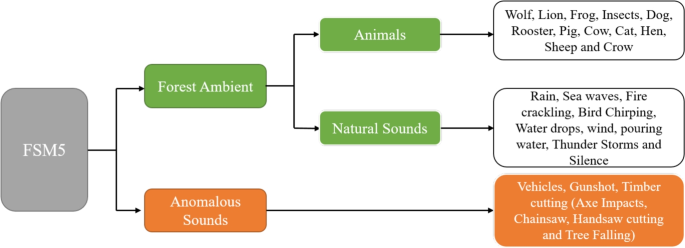
In our study, we introduce the Forest Sound-scape Monitor (FSM5) dataset, which is designed for forest monitoring using audio signals. Unlike general-purpose datasets such as UrbanSound8K and ESC-50, FSM5 focuses only on forest-related acoustic events, with special emphasis on distinguishing between forest ambient sounds and important acoustic events caused by humans and activities. Creating such datasets can address limitations of existing domain-specific knowledge and improve model performance in the domain of interest. This dataset is used to narrow down the task of acoustic event classification to forest scenarios. As shown in Figure 1, the dataset consists of five main classes. Classes include animal sounds, nature sounds, chainsaw sounds, gunshots, vehicle sounds, and more. Animal and nature sounds are very common in any forest area, and the other three groups can be considered important acoustic events.

FSM5 consists of 2,258 audio clips organized into five balanced high-level classes: Animals, Nature Sounds, Vehicle Sounds, Gunshots, and Wood Cutting. As shown in Table 1. The datasets were hand-picked from ESC-50, UrbanSound8K, Freesound database, and Google AudioSet and integrated based on consistent labeling, sampling rate, and duration format. All audio clips are resampled to 44.1 kHz, 16-bit PCM format.

Distribution of Auido durations.
FSM5 is broadly classified into two categories: forest environmental sounds and abnormal sounds. The Ambient category consists of various animal sounds, from wolves and lions to dogs, chickens, pigs, cows, cats, chickens, frogs, insects, sheep, and crows, as well as environmental sounds such as rain, ocean waves, crackling of fire, birdsong, water drops, wind, downpour, thunderstorm, and silence. The category of significant acoustic events includes three categories: vehicle sounds, gunshots, and wood cutting processes. For wood cutting, finer differences such as ax impact, chainsaw cuts, handsaw cuts, fallen trees, and wood cuts are recorded, allowing the dataset to accommodate different types of logging hazards. This taxonomy enables focused evaluation of acoustic monitoring systems that need to separate normal forest soundscapes from potentially harmful or illegal activities.
Data collection and selection criteria by class: Comprehensive dataset statistics including per-source contribution and clip duration characteristics are reported in Table 3. The animal sounds class includes sounds associated with forest and livestock vocalizations and movements, and serves as an indicator of biodiversity and wildlife activity. Subclasses include wolf, lion, frog, insect, dog, rooster, pig, cow, cat, chicken, sheep, and crow. Animal sound samples were mainly sourced from ESC-50 (\(\about\)75%), using supplementary samples from the Freesound database (\(\about\)14%) and Google AudioSet (\(\about\)11%). Freesound clips were selected using a keyword-based query (e.g., wolf, forest animal, lion) and manually verified to ensure non-overlapping outdoor recordings and minimal background noise. Vehicle sounds indicate unauthorized access or transportation activity in forest areas. The vehicle category includes engine sounds and vehicle operating sounds, carefully selected from UrbanSound8K (\(\about\)20%), ESC-50 (\(\about\)30%), free sound (\(\about\)10%), Google AudioSet (\(\about\)40%). Google AudioSet clips are extracted from labeled YouTube segments corresponding to vehicle-related audio events, ensuring clear temporal alignment with annotated acoustic activity. The wood cutting class collects sounds associated with illegal logging and deforestation activities. Subclasses include ax impact, chainsaw cutting, handsaw cutting, and tree fall. Most of the wood cutting samples were extracted from ESC-50 (\(\about\)72%), while Freesound (\(\about\)22%) were used to collect more fine-grained and less represented events, such as ax impacts and falling trees. Some of the various mechanical cutting sounds were taken from Google AudioSet (\(\about\)6%).
Audio extraction, filtering, and normalization: All audio clips in FSM5 are standardized to lengths ranging from 1 to 5 seconds depending on the acoustic event type, with the average clip length being 4.24 seconds and the majority of clips ranging from 4 to 5 seconds, as shown in Figure 2. During curation, only recordings with clearly audible target acoustic events were retained, and indoor recordings, clips dominated by non-target background noise, and multi-event recordings with overlapping sound sources were excluded. Audio samples from the Freesound platform are retrieved using publicly available API endpoints, allowing automatic keyword-based searching, metadata retrieval, license validation, and bulk download via Python scripts without manual intervention. For Google AudioSet, audio clips were extracted from labeled YouTube segments, and only segments with high label confidence and clear temporal alignment with the target acoustic event were selected for inclusion in the dataset.
Dataset bias and duplication screening: Because FSM5 is handpicked by combining recordings from multiple publicly available datasets, variations in recording conditions, microphone characteristics, environmental noise, and annotation standards can introduce domain-specific biases. Such heterogeneity can affect the generalization of the model in real-world deployments, especially in invisible acoustic environments. Despite these precautions, the dataset should be considered a task-specific, curated benchmark rather than a completely pristine forest record collection.
A systematic duplicate and near-duplicate screening procedure was performed on all 2,258 audio clips in FSM5 to reduce potential data leakage and redundancy. Initially, accurate duplicate detection was performed using SHA-256 file hashes and file name consistency checks. No completely overlapping groups or duplicate file names were observed across the dataset. Subsequently, near-redundant analyzes were performed using spectrogram-based audio fingerprinting and cosine similarity. Each audio clip is converted to mono, resampled to 8 kHz, normalized, and compactly converted. \(64 \times 32\) Perform log spectrogram representation, flattening, and L2 normalization to form audio fingerprints for similarity comparison. Using a conservative cosine similarity threshold of 0.999, manual inspection identified only 10 highly similar candidate pairs, as summarized in Table 2. Importantly, all detected pairs belonged to the same class, and no overlapping or inconsistent samples between classes were observed. The near-duplicate candidates identified represent less than 1% of the dataset, indicating minimal redundancy, although we acknowledge that due to the curated nature of the dataset, a limited number of acoustically similar in-class recordings may exist.

RMS energy distribution by class.

Spectral centroid distribution.
Acoustic feature analysis of the dataset further highlights the importance of the proposed dataset. Careful attention is paid to class balance to avoid biases that can affect model training. The RMS energy profile shown in Figure 3 shows that gunshot sounds (anomalies) are distinguished by high-energy peaks, whereas natural sounds and animal calls tend to be smoother and lower in energy. Trends in the spectral centroids indicate that timber cutting events are moving towards higher frequency bands. This is in contrast to the natural and animal classes, which are grouped into lower bands. The zero-crossing rate distribution clearly distinguishes between transiently dense anomalous events, such as wood crackling or gunshots, and smoother ambient classes. The same trend can be seen in Figure 4. The spectral roll-off and bandwidth indicate that the frequency range of the anomalous events is wider than the narrow range of forest ambient sounds. In future work, the FSM5 dataset will be further expanded by adding relevant and more realistic forest acoustic events to better capture the diversity and complexity of real-world forest soundscapes.


