
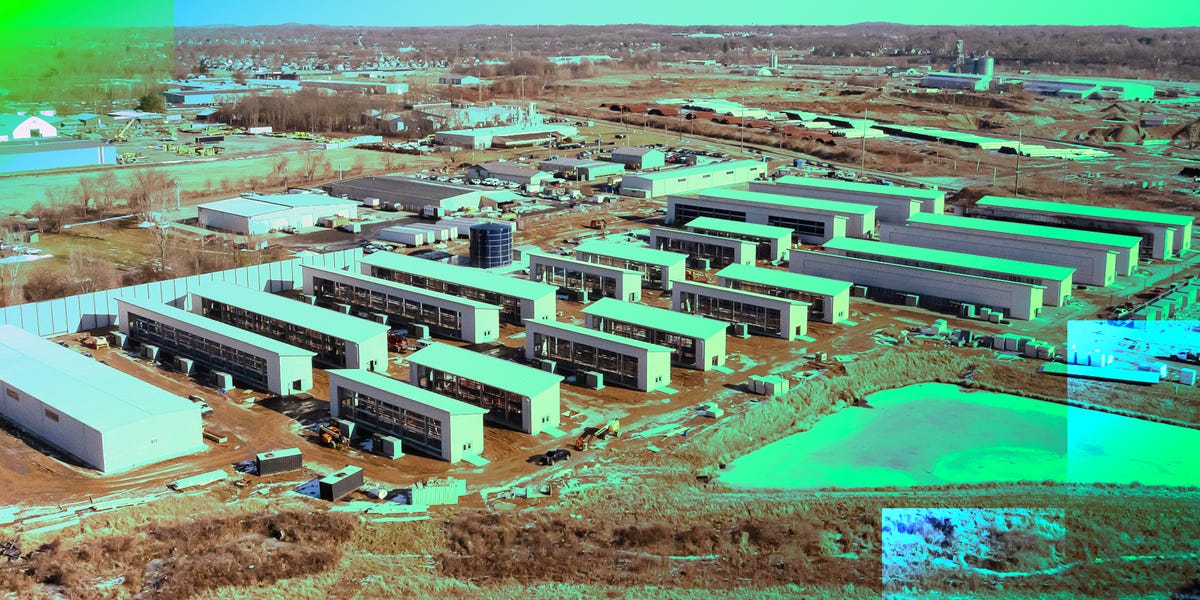
They are the biggest beneficiaries of the artificial intelligence race you’ve never heard of.
While major technology companies reveal unprecedented spending on AI infrastructure and language developer Anthropic and OpenAI near blockbuster IPOs, a group of former crypto mining companies are quietly taking over as demand for data centers soars.
Companies with names like TeraWulf, Applied Digital, Iren, Core Scientific, and Cipher Digital are making up for their short track record with an even more critical ingredient for success: access to power contracts that can quickly power power-hungry AI computing facilities.
Its legacy wattage from the cryptomining era has attracted large enterprise customers in need of high-performance computing space, allowing some of these companies to complete a remarkable transformation from the sluggish crypto market to the limitless opportunities of the AI boom.
“They’ve been more successful than anyone expected, including ourselves,” said Nick Giles, a senior research analyst at B. Riley Securities who covers several companies, most of them publicly traded.
Giles and his team estimate that the cumulative market capitalization of the 11 largest former crypto mining companies has grown from about $2.1 billion at the end of 2022 to about $48.5 billion today, which he said is a “win-win scenario” for investors.
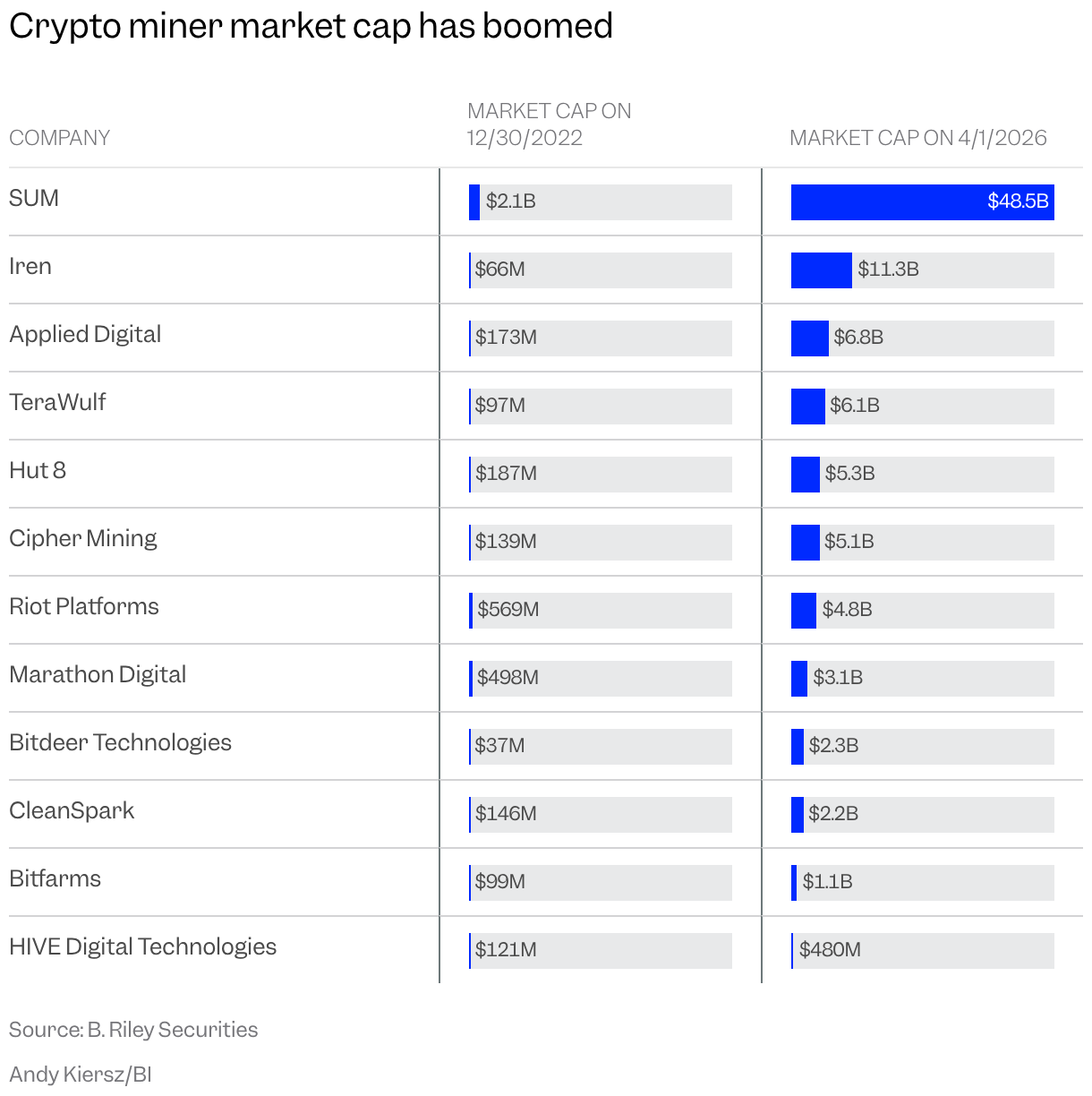
“This is an incredible valuation jump,” said Brian Dobson, managing director at Clear Street and head of technology equity research for the firm.
To justify a rapid stock market rally, these companies now need to deliver state-of-the-art AI facilities for the world’s largest and most demanding technology companies. These projects are far more expensive and complex than the mining operations we have seen in the past, and depend on successful connections to power grids that are increasingly strained by the data center boom. If all goes according to plan, the industry will cumulatively consume enough energy to light up several major U.S. cities over the next few years.
But failure to meet deadlines can result in steep fines that can undermine the economics of multibillion-dollar projects.
Become an AI power player
Cryptomining facilities similar in size to AI data centers use heavy computing to solve the algorithms that enable the minting of cryptocurrencies, and their power consumption can reach hundreds of megawatts. But top-tier data centers have far less tolerance for outages and require expensive equipment to prevent them, including backup generators and massive cooling systems to absorb the enormous waste heat of intensive AI computing.
“The theme for 2025 was everyone going out and signing big customers,” Dobson said. “2026 is the year to expand those contracts and, more importantly, execute on those contracts.”
What is unclear is whether there may be penalties in the event of delays or operational issues, or even whether the customer may decline to participate in the project. Both scenarios can be financially damaging, as developing an AI data center is costly, typically reaching billions of dollars for large campuses. Most former crypto mining companies are publicly traded, but transparency over the details of customer agreements varies.
“There will be delays and it’s always a work in progress,” Dobson said.
For example, late last year, the CEO of CoreWeave, a former crypto mining company turned $40 billion AI cloud provider, said on an earnings call that the company was “impacted by temporary delays related to construction delays by a third-party data center developer.” CEO Michael Intrater said the data center construction boom is generally “just overwhelming the supply chain.” Based on this news, the company’s stock price fell 10% at the time.
Equity analysts at Northland Securities reported that the deferred partner is likely to be Core Scientific. Intrater later said in a February earnings call that the facility delays had been resolved.
High-stakes risks and limited transparency
So far, the number of favorable deals far outweighs any signs of setback in the industry.
Applied Digital and Cipher Digital have amassed the largest data center portfolios among former crypto miners, with 5 gigawatts and 4.1 gigawatts of active capacity and planned projects, respectively. To give you an idea of how much energy that is, New York City requires about 10 gigawatts of electricity in the summer.
Both companies have hinted at big deals to come, with Cipher Digital saying it had just reached a 15-year deal with an unnamed “investment-grade hyperscale tenant,” and Applied Digital saying it was “in advanced discussions for three sites and 900 megawatts.”
But the companies have disclosed little about what happens if there is a stumble during execution.
Last summer, TeraWulf was one of the few companies to detail the penalties it could face after announcing Fluidstack’s deal with Google to expand the output of its center campus under construction in Western New York to 360 megawatts. In a subsequent public filing with the Securities and Exchange Commission, the Maryland-based company said that if the project were delayed for more than 180 days, “Fluidstack would have the right to terminate the applicable” lease, potentially voiding the agreement in which Google guaranteed $3.2 billion in rent.
Losing Google’s backstop could significantly increase borrowing and refinancing costs for the project, known as Lake Mariner.
“180 days sounds like a comfortable period, but when you’re talking about major construction, it’s not that long,” said Giles, the B-Reilly analyst.
Giles said TeraWulf is the most transparent of the former crypto miners, with few other companies having such details in their contracts. He is confident in TeraWulf’s ability to execute on his plans, and said the company, whose stock price is less than $1 in 2023 and is currently around $15, is one of his top candidates for talent.
But for now, lending markets are showing growing confidence in the rise in wealth of former crypto miners, who are extending debt to companies at increasingly favorable interest rates. For example, Cipher Digital borrowed $1.4 billion at 7.1% in November 2025 for a Texas data center it is building for Fluidstack and Google, according to a Northland Securities research report. In February, it received 6.1% interest on $2 billion it borrowed to finance another Texas facility it was building for Amazon.
Meanwhile, Applied Digital in March borrowed $2.15 billion at 6.8% for a data center it’s building for Oracle. This is lower than the 9.3% interest rate it received on a $2.35 billion loan in November 2025 for another facility being developed for CoreWeave, which has a lower credit rating than Oracle.
There is also a growing feeling that customers will be forgiving if former crypto mining companies delay providing equipment amid a national shortage of AI computing power.
“While there have been some delays in the delivery of some infrastructure, customers have not changed any terms,” said Paul Golding, senior digital infrastructure analyst at Macquarie. “Due to lack of power and infrastructure, getting elsewhere could take much longer than simply waiting for gradual catch-up.”