
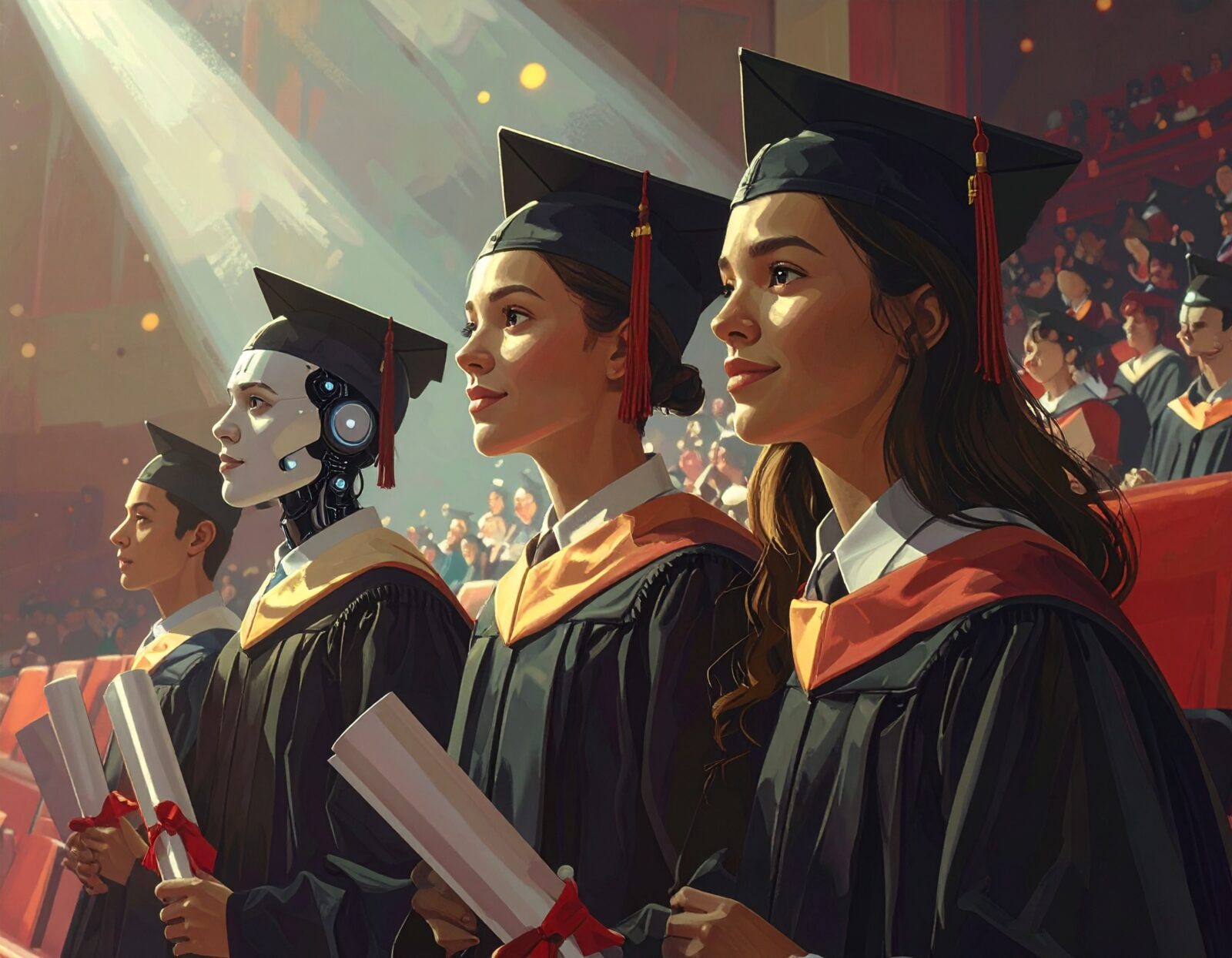
Headlines that pop up when you simply search for “job market” describe it as a “ritual of humiliation” or “hell” and “a new crisis for new employees.” The unemployment rate for new graduates in the US is an “extraordinarily high” 5.8%, with even Harvard Business School graduates taking months to find work. Inseparable from this conversation is the complexity of AI's potential as a tool to automate entry-level jobs and help employers evaluate applications. However, the widespread availability of generative AI platforms raises questions that are often overlooked. It's about how job seekers themselves use AI.
Interviews with prospective master's graduates from elite UK universities* shed some light. Contrary to popular narratives about “lazyness” and “shortcuts,” the use of AI is emerging from job seekers seeking to strategically address the digitally saturated and competitive realities of today’s job market. The main takeaways are:
They use AI to play the inevitable numbers game
Job seekers say they feel the need to apply to a large number of jobs because it is so rare to get a response amidst the competition. They submit countless applications to online portals, but rarely receive an automatic rejection email. As Franco, a 29-year-old communications student, puts it, his resume is just “one in a spreadsheet of 2,000 applicants,” especially now that “LinkedIn and job portals” have saturated the market.
This background lies at the heart of how job seekers use AI to help them respond to resumes and write cover letters, reducing the time they spend on specific applications and helping them get more applications done. Soyeon, a 24-year-old communications student, says that no matter how carefully she filled out her application and how qualified she was, she faced repeated rejections.
[Employers] They themselves are going to use AI to screen these applications… And after a few rejections, it's really frustrating because you've put so much effort and time and passion into this one application only to find out that it's only been filtered by AI… Then it starts to tilt you, you know, to just apply to as many jobs as possible instead of putting effort into one application.
Ms. Soyeon later went on to say that in consideration of AI in the recruitment system, she sometimes asks AI to tell her what kind of “keywords” to include in her application documents.
Her reflections revealed that while using AI is not a shortcut, her “passion” felt futile as she felt like she had to deal with inevitable rejections and AI scanners, especially considering that companies themselves were using AI to read their applications.
AI as a savior of emotional labor
The effort of applying for jobs and dealing with constant rejection and little human interaction has become a highly emotional process that students describe as “draining” and “torturing,” making it clear that AI is not just a way to reduce the workforce. time Not just the labor, but also the emotional side of it.
Franco felt that having to appear “passionate” about hundreds of tasks that he never even received a response to was a “mental burden” that the AI helped him manage.
You have to repeat this process for 100 job applications, 100 job openings, and rewrite your cover letter as if it were your dream. Well, I don't know if you can have 100 dreams. …I think there is definitely a mental burden… I actually think AI can be very helpful in that you don't have to mentally feel like, “Okay, I'm going to help you write this cover letter so I don't have a chance.”
In this way, the use of AI has helped alleviate the mental difficulties of being a job seeker, allowing students to apply for numerous jobs while conserving their mental energy during the grueling process.
The more passion we have, the less we use AI
Even though the job application process often requires the same materials, the use of AI has never been uniform. Job seekers are setting “passion parameters” to narrow down their use to jobs they are more passionate about.
Joseph, a 24-year-old psychology student, says this “human involvement” is “definitely more than 50%” for roles he really wants, compared to “20% to 30%” for roles he's less interested in. He makes this distinction by explaining how, when passion is involved, instead of relying on AI's “summary and unnuanced information,” he researches the company deeply, writes a cover letter from scratch, and uses it only to criticize AI. In contrast, for less desirable tasks, AI takes a more generative role in creating the first draft and then editing it.
This points to the fact that while students feel that AI is important for labor efficiency, they do not use it indiscriminately, especially when passion is involved and they want to do their best.
They understand the flaws in AI (and work around them)
In their own words, students are not carelessly “copying and pasting” AI-generated materials. They are critical of AI tools and manipulate them with their concerns in mind.
A common flaw in AI-generated materials is that they sound “robotic” or “mechanical,” with some “AI” words sounding like “explore” or “dig into.” Joseph argued that it is easy to tell which AI-generated texts are written by humans because they lack the “passion and enthusiasm” of someone who is truly hungry for work.
Nandita, a 23-year-old psychology student, described how AI's tendency to “put you on a pedestal” manifests itself by misrepresenting facts. When she asked the AI to adjust her resume, she found that her experience of “one week of observation in a psychology clinic” had been branded as “social service,” which she strongly felt was not the case. She guessed this was because the job description she gave the AI mentioned community service, which she found and fixed.
Therefore, using AI in your job search is not a passive endeavor, but requires vigilance and critical understanding to ensure that its flaws do not harm you as a job seeker.
They're working on the bigger impact of AI
The use of AI is not an unqualified endorsement of the technology. The students were all aware (and concerned) of its broader social implications.
John, a 24-year-old data science student, made a distinction between using AI in impersonal processes and using AI in human experience. I'm planning to use it as a “cover letter” for a job that I think will be vetted by AI anyway, but I'm worried about how it will be used in other parts of my life.
I think it fills in a part of people's lives that people don't realize is so fundamental to who they are as humans. One of the examples I always think about is if you need something like a cover letter. [that][OK]Because it's not very personal. …but if you can’t write a birthday card without using ChatGPT, that’s a problem.
Nandita expressed similar criticisms based on her background in psychology. While we can see AI assisting with tasks such as “administrative tasks,” we are concerned about how it will be used in treatment. She claims that AI therapists are “100% Western” and would not be able to connect with someone “from rural India.”
Our understanding of AI shows that graduates distinguish between using AI for impersonal processes, such as job hunting in the digital age, and using AI for more human-to-human situations where AI poses a threat.
Some graduates are opting out of the use of AI
Most of those interviewed used AI, but some rejected it completely. They expressed similar concerns that AI users had, such as sounding more like a “robot” than a “human.” Julia, a 23-year-old law student, specifically stated that her field requires “language and persuasiveness” with a “human tone” that cannot be replicated by AI, and that if she does not use this, she will be “differentiated” in her job search.
Mark, a 24-year-old sociology student, admitted he had the same concerns as AI users about the saturated online arms race, but instead of using AI to submit as many applications as possible, he had a different strategy in mind. It's about “talking to people in real life.” He told how he once landed a research job through connections in the smoking area of a pub.
Importantly, these job seekers faced similar challenges in the job market as AI users, but chose a different strategy to address them that emphasized human connection and voice.
conclusion
For new job seekers, the use of AI is a multi-layered strategy that directly addresses the challenges of the job market. It's not about cutting corners, it's about carefully adapting to the current situation, which requires new forms of digital literacy.
By moving away from conversations that frame job seekers as lazy or incapable of writing their own material, we need to consider how the system itself can be improved for both job seekers and companies. If employers don’t want to use AI, how can they create processes that leave room for human authenticity to be considered, rather than AI-generated materials that sustain broken hiring cycles?
*All participant names are pseudonyms.

