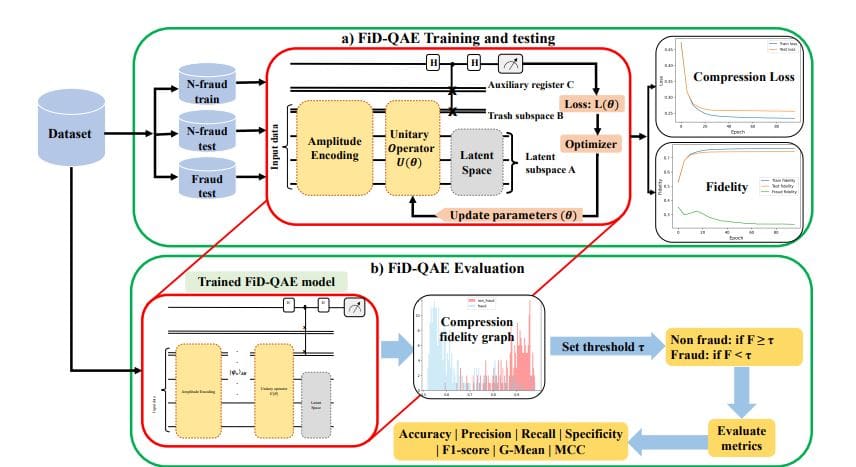
Credit card fraud is a significant and evolving threat to financial security, requiring increasingly sophisticated detection methods. Mansour El Alami, Adam Innan, and Nouhaila Innan, together with colleagues from Hassan II University in Casablanca and New York University Abu Dhabi, present a new approach to this challenge with the development of FiD-QAE, a fidelity-driven quantum autoencoder. This architecture utilizes quantum computing principles to encode transactions, identifying anomalies, and employs fidelity estimation as a key decision criterion to distinguish fraudulent from legitimate transactions. The research team demonstrates that FiD-QAE not only achieves consistent performance across different data imbalances, but also remains robust in the presence of noise, and importantly, validates the feasibility of this quantum approach on real hardware, providing a promising new direction for fraud detection in complex financial systems.
Quantum Machine Learning for Fraud Detection
Research in credit card fraud detection is increasingly focusing on the potential of quantum machine learning (QML), and various quantum models such as quantum neural networks, support vector machines, and generative adversarial networks are being investigated to improve accuracy and efficiency. Most studies have adopted a hybrid approach that combines the strengths of classical machine learning with quantum computing and leverages quantum algorithms for specific tasks such as feature selection and model training. A growing area of research includes federated learning, which enables privacy-preserving fraud detection by training models on distributed data sources without sharing sensitive raw data. Quantum federated learning is also being investigated. Recognizing the difficulty of obtaining real-world fraud data, researchers frequently rely on synthetic datasets to test and benchmark their models.
Hybrids of quantum classical models that integrate quantum feature selection and classical machine learning are attracting attention. Additionally, research on privacy-preserving federated frameworks with hybrid quantum reinforcement learning expands the possibilities for secure fraud detection. The researchers encoded transaction data into quantum states, effectively representing financial information as qubits, before compressing this data using carefully designed variational quantum circuits. This circuit efficiently reduces the dimensionality of the data while preserving the critical functionality that forms the core of the autoencoder. The compressed quantum state is evaluated using the SWAP test. The SWAP test is a quantum algorithm that precisely measures the similarity between the reconstructed state and the original state as the main criterion for anomaly detection.
The system maintained consistent performance even as the ratio of fraudulent to legitimate transactions varied and demonstrated reliability in realistic scenarios. The researchers also tested the system under simulated quantum noise that mimics the imperfections inherent in real quantum hardware and confirmed that FiD-QAE maintains accuracy even in noisy conditions. To verify the feasibility of the approach, the team implemented and tested FiD-QAE on an IBM Quantum hardware backend and confirmed that the results obtained on a real quantum device matched those predicted by simulation. This effort addresses the critical challenge of identifying rare and disproportionate fraudulent transactions that closely resemble legitimate transactions. The team designed FiD-QAE to take fidelity estimation as a key criterion for anomaly detection and encode transactions into quantum states and compress them using variational quantum circuits. A key innovation is the use of the SWAP test to distinguish between legitimate and fraudulent transactions, providing a new approach to identifying fraudulent activity.
Experiments demonstrate that FiD-QAE maintains consistent performance across different levels of data imbalance, a common problem in fraud detection. The system achieves approximately 92% accuracy and 90% accuracy in identifying fraudulent transactions, representing a significant improvement compared to existing quantum autoencoders. In particular, this study confirms the robustness of FiD-QAE under quantum noise, which is an important factor for real-world implementation. Validation on an IBM Quantum hardware backend provides results consistent with simulation results and confirms the feasibility of the approach. The team successfully implemented FiD-QAE using just four qubits, demonstrating an efficient design for practical use. The team was able to compress this information by encoding transaction data into quantum states and use quantum fidelity, a measure of state similarity, as a key criterion for identifying fraud. A comprehensive evaluation, including statistical analysis and multiple performance metrics, demonstrates the model's robustness and ability to maintain reliable performance even in the presence of imbalanced datasets and simulated quantum noise. Results show that this approach achieves a strong balance between precision and recall, effectively identifying fraudulent transactions while minimizing false positives.
Importantly, the model exhibits improved discriminatory power compared to existing methods while requiring fewer quantum resources, suggesting the possibility of practical implementation. Validation on the hardware backend confirms the feasibility of the approach and consistency with simulation results, highlighting the potential of quantum models to tackle complex financial security challenges. Future work will focus on advancing quantum autoencoder architectures and exploring their implementation on noisy medium-scale quantum hardware, with the aim of improving both the reliability and scalability of financial security systems. This study highlights the strategic role that quantum computing can play in addressing unbalanced classification tasks such as credit card fraud detection and opens promising directions for future developments in this field.