
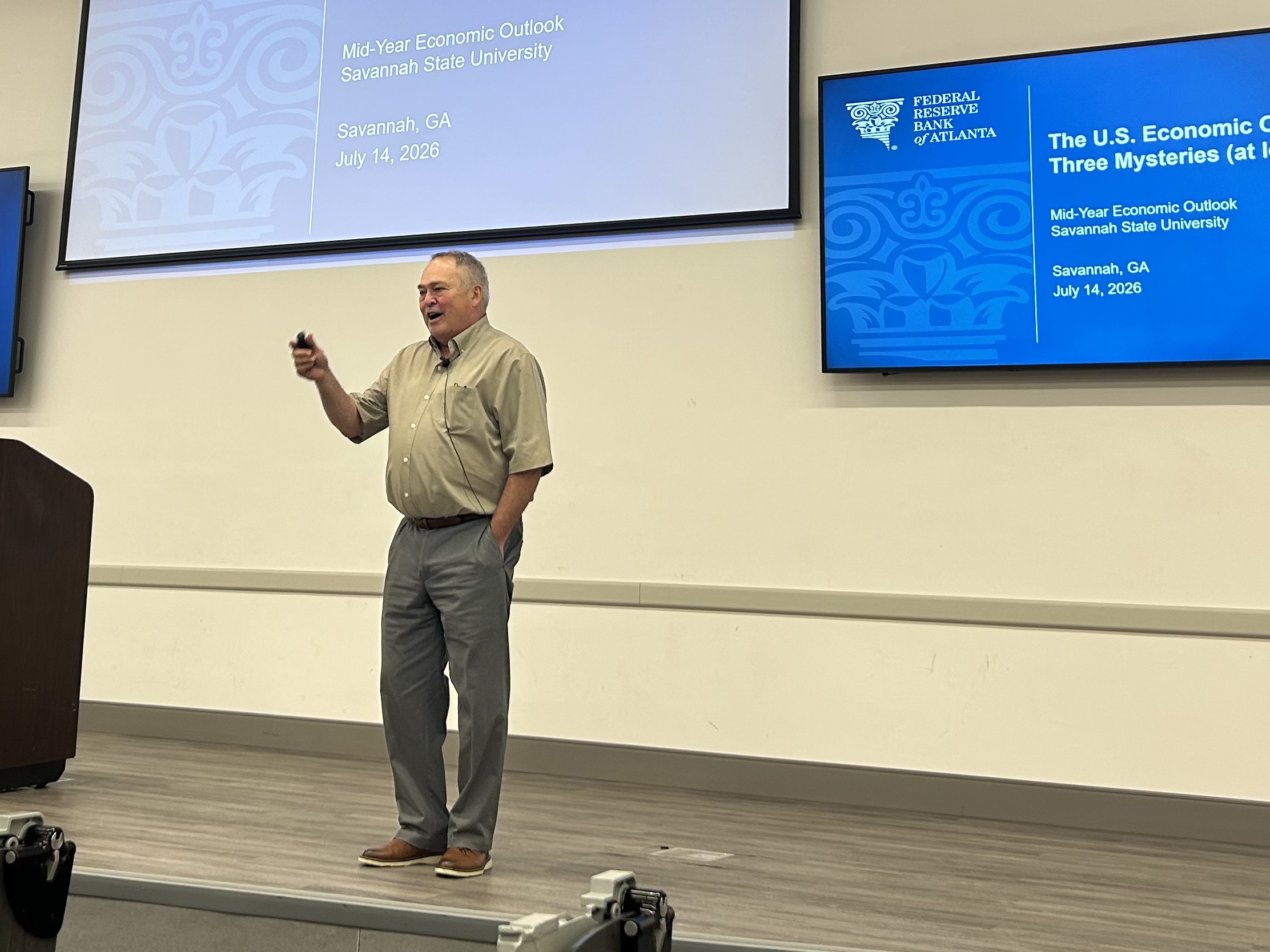
David Altig, chief economic advisor at the Federal Reserve Bank of Atlanta, returned to Savannah State University on Tuesday to share his outlook on three puzzles: a labor market facing demographic pressures, rising inflation, and the impact of artificial intelligence on employment and productivity.
Altig said new studies, surveys and data can help the Fed address these long-standing questions, but they remain unresolved since his last mid-year economic outlook speech a year ago.
“It’s surprisingly unchanged from last year,” Altig said. “This is the same kind of crazy ride with the same kinds of questions that we’ve been dealing with for a while.”
Overall, U.S. economic growth, as measured by gross domestic capital, continues to slow to a normal level of around 2%. Altig said this also reflects Savannah’s economic situation.
Economic growth is a combination of the rate of growth in labor productivity and the rate of increase in the labor force. The country is experiencing a sudden and significant decline in population growth due to stricter immigration policies. Due to aging, indigenous population growth is expected to completely stop by 2029. Altig said this could result in more jobs than available workers in the labor market, slowing employment growth and putting price pressure on the economy.
“Supply is essentially constrained by the fact that indigenous fertility (as economists like to call it) and immigration, and the situation doesn’t seem very robust,” Altig said.
Meanwhile, productivity is booming. Increased productivity can reduce costs and cushion high inflation.
However, this productivity may not be due to AI.
Economists in the Atlanta office worked with central banks in Germany and the United Kingdom to survey the use of AI by nearly 6,000 executives and their companies in four countries.
Research shows that 69% of companies are using some form of AI technology, and this number is expected to rise to 75% over the next three years.
Despite the increased use of AI in many companies, research shows that over the past three years, AI has had little to no impact on both employment and productivity. Over the next three years, some companies expect AI to change productivity and employment, but the majority still expect no impact.
“Productivity has really exploded, but the AI revolution is still not on par with us in terms of impact on productivity,” Altig says.
Altig cites a surge in corporate investment in machinery, equipment and software as a key factor in the increase in productivity. A number of federal policies have supported increased investment, including the One Big Beautiful Bill.
Altig said the eventual productivity gains from the AI revolution could supplement current growth and even lift the country out of the economic “growth challenge.” However, like many other economic indicators, these short-term models require many more years to develop and validate.

