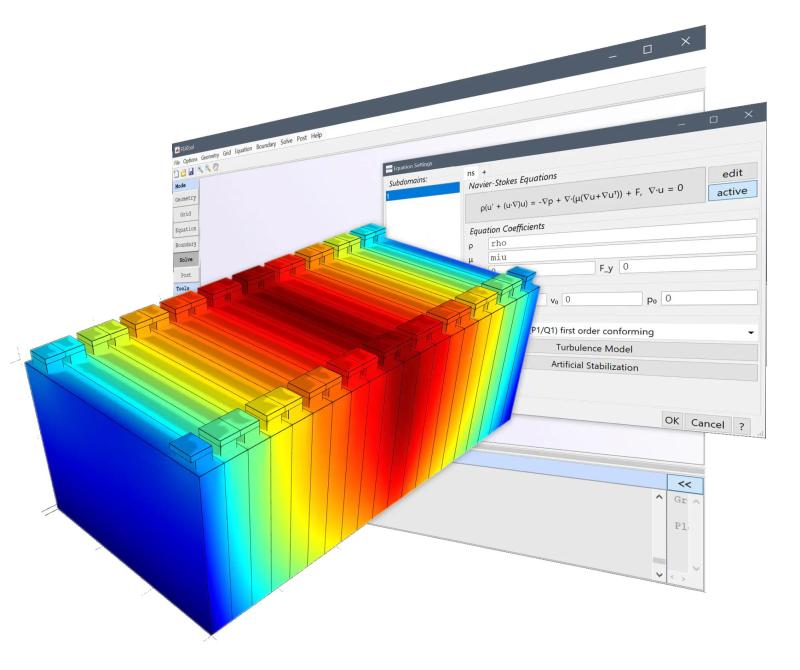
FEATool Multiphysics v1.18 – New workflow for CFD and FEA AI/ML simulations
Precise Simulation is proud to announce the release of FEATool MultiphysicsTM version 1.18. It is a step forward in state-of-the-art finite element analysis (FEA) and computational fluid dynamics (CFD) multisolver simulation software.
The latest release introduces a completely redesigned graphical user interface (GUI), making the toolbox more user-friendly and easier to use than ever. FEATool Multiphysics also has full support and integration with MATLAB and related toolboxes (optimization, control systems, machine learning, etc.) and advanced features tailored to the evolving needs of engineers and researchers in industry and academia.
* New standard for FEA, CFD, CAE AI/ML simulation workflows
One of the distinguishing features of the FEATool toolbox is its multiphysics application programming interface (API) with one-click export functionality and automatic conversion of simulation models to MATLAB and Python scripted models. It allows users to quickly define and configure simulation models in a fully integrated, easy-to-use GUI, and then export, modify, and programmatically run the simulation models automatically for large-scale parametric studies and data generation and collection for physically informed neural network (PINN), machine learning (ML), and artificial intelligence (AI) type simulation models.
Examples of using FEATool Multiphysics to derive reference data and validate machine learning CFD models can be found in several publications on deep learning (DL) CFD methodologies for flow prediction using AI and machine learning by Professor Thi-Thu-Huong Le and colleagues at the Blockchain Platform Research Center at Busan National University (PNU) in South Korea.
Another example comes from Guodong Sa and colleagues who developed a digital twin (DT) framework for smart kitchen visualization and design to facilitate improvements in kitchen and usability design. In the featured study, FEATool Multiphysics was used as a platform to program and control simulation meshes and state-of-the-art CFD flow solvers, such as OpenFOAM, to script, automate, and programmatically generate thousands of sets of simulation data to train a digital twin framework.
Also in the medical field, Professor Zhang H. and colleagues recently leveraged FEATool Multiphysics to develop a method for denoising and improving vascular blood flow imaging for medical diagnostics using Physics-Informed Neural Networks (PINNs). The data for training the PINN was automatically generated by simulating the Navier-Stokes equations for various flow conditions and geometries. For more information, see the preprint on Fluid dynamics and domain reconstruction from noisy flow images using physics-based neural networks and quasi-conformal mapping.
To learn more about new features and improvements, and to download the toolbox, please visit:
https://featool.com/news/2026/02/03/FEATool-Multiphysics-v1p18-Simulation-FEA-CFD-CAE-Workflow-Update/
accurate simulation
Tai Tung Building 17/F. Room 1703
No. 8 Fleming Road, Wan Chai
Hong Kong
Precise Simulation is a leading provider of engineering simulation solutions for industrial research and product design to technology companies, research institutes, and universities around the world. The company’s simulation software, FEATool Multiphysics, is a state-of-the-art integrated computer-aided engineering (CAE) software environment for creating advanced simulation applications and physically-based models. This software enables simulation of advanced multiphysics phenomena found in electromagnetism, structural mechanics, acoustics, fluid flow, heat transfer, and chemical applications. A particular strength of FEATool Multiphysics is its ability to interface with leading open source FEA and CFD solvers such as OpenFOAM®, FEniCS, and SU2 Code. Additionally, it has native interfaces with MATLAB® and Python, allowing users to seamlessly switch between using an easy-to-use graphical user interface (GUI) and simulation scripting and programming.
This release was published on openPR.