Europe Artificial Intelligence in Agriculture Market Size
The Europe artificial intelligence in agriculture market was valued at USD 1.17 billion in 2025 and is anticipated to reach USD 1.46 billion in 2026 to from USD 7.29 billion by 2034, growing at a CAGR of 25.38% during the forecast period from 2026 to 2034.

Current Introduction of the Europe Artificial Intelligence in Agriculture Market Report
Artificial intelligence in agriculture refers to the deployment of machine learning computer vision predictive analytics and autonomous systems to optimize crop production livestock management and resource efficiency across Europe’s diverse farming landscape. Unlike generic digital tools AI solutions in this context are embedded within precision farming ecosystems that integrate satellite imagery drone data soil sensors and robotic machinery to enable real time decision making. The European market operates under a unique regulatory and policy framework shaped by the Farm to Fork Strategy the Common Agricultural Policy and the EU AI Act which collectively mandate sustainability data transparency and risk-based oversight. According to Eurostat, many EU farms with more than 50 hectares adopted some form of digital monitoring in 2024, with AI driven yield prediction and pest detection leading adoption. As per the European Environment Agency, agricultural activities occupy a significant portion of the EU’s land area yet contribute a relatively smaller share of greenhouse gas emissions, a balance increasingly maintained through intelligent input optimization. According to the European Commission’s Digital Europe Programme, substantial funding was allocated in 2024 specifically for AI testbeds in agriculture focusing on nitrogen use efficiency and biodiversity monitoring. This convergence of environmental accountability, technological innovation, and policy support defines the strategic trajectory of AI in European agriculture.
MARKET DRIVERS
EU Farm to Fork Strategy Mandates Drive AI Adoption for Input Optimization
The European Union’s Farm to Fork Strategy has become a primary catalyst for artificial intelligence adoption by legally binding farmers to reduce chemical inputs while maintaining productivity, which is primarily driving the growth of the European AI in agriculture market. According to the European Commission, a majority of EU farms receiving Common Agricultural Policy subsidies must now implement digital nutrient management plans verified by certified agronomists. In response, companies such as BASF and Bayer have deployed AI platforms that analyze satellite multispectral data and weather forecasts to generate field specific spray recommendations. As per the Ecophyto Plan, AI guided weed detection reduced herbicide use on pilot farms in France in 2024. Similarly, according to Germany’s Federal Ministry of Food and Agriculture, farms using machine learning based variable rate fertilization documented a decline in nitrogen surplus. As per Wageningen University, trials confirmed that these systems lower input costs for farmers. This policy driven necessity transforms AI from an optional enhancement into a core operational requirement across European agriculture.
Labor Shortages Accelerate Deployment of Autonomous Farming Systems
Persistent agricultural labor shortages across Europe are accelerating investment in AI powered autonomous machinery and remote monitoring systems, which is further boosting the expansion of the European AI in agriculture market. According to Eurostat, the EU agricultural workforce declined significantly between 2019 and 2024, with seasonal harvesting roles facing high vacancy rates in Southern Europe. As per Spain’s Ministry of Agriculture, many fruit and vegetable growers struggled to secure harvest labor in 2024, leading to crop losses. This gap is being filled by robotic solutions such as Naïo Technologies’ Oz weeding robot and ecoRobotix’s AI sprayer, which use computer vision to distinguish crops from weeds. According to Wageningen Economic Research, many greenhouse tomato farms in the Netherlands now employ autonomous pollination and pruning robots. As per the European Institute of Innovation and Technology, multiple agri robotics projects were funded in 2024 to address labor substitution in vineyards, orchards, and dairy farms. As rural depopulation continues, AI driven automation becomes a structural necessity for maintaining food production capacity.
MARKET RESTRAINTS
Fragmented Data Ownership Laws Hinder Cross Farm AI Model Training
Despite technological readiness, the development of robust artificial intelligence models in European agriculture is impeded by fragmented data governance frameworks that restrict data pooling across farms, which is hampering the regional market growth. Under the General Data Protection Regulation and national implementations such as Germany’s Landwirtschaftsdatengesetz, farmers retain full ownership of their field data and must provide explicit consent for its use in algorithm training. According to the European DIGITAL SME Alliance, a majority of European farms refuse to share anonymized yield or soil data due to concerns over competitive disadvantage or misuse. This prevents the aggregation of large diverse datasets essential for training accurate machine learning models, particularly for rare events like disease outbreaks or extreme weather responses. In contrast, US platforms such as John Deere Operations Center train models on pooled data from millions of acres, enabling higher prediction fidelity. The EU’s Code of Conduct on Agricultural Data Sharing remains voluntary and lack enforcement mechanisms. Consequently, AI vendors must rely on limited proprietary datasets, resulting in models that underperform in heterogeneous European growing conditions.
Limited Connectivity in Rural Areas Constrains Real Time AI Applications
The effectiveness of artificial intelligence in agriculture is fundamentally constrained by inadequate digital infrastructure in rural Europe, where real time data transmission is essential for autonomous systems and remote diagnostics, which is also negatively impacting the growth of the European market. According to the European Commission, only a portion of rural households had access to fixed broadband speeds above 100 Mbps in 2024, while many remained without reliable mobile signal. As per the Body of European Regulators for Electronic Communications, large areas of farmland in Romania and Bulgaria lie outside 4G coverage zones. This connectivity gap prevents seamless operation of AI applications such as drone-based disease detection, which requires high bandwidth to stream video for instant analysis, or autonomous tractors that depend on low latency communication for safety. The EU’s Gigabit Society target aims for universal 5G coverage by 2030, but deployment in low population density areas remains economically unviable for telecom operators. Without public investment in rural fiber and edge computing hubs, AI systems default to offline mode, reducing responsiveness and analytical depth.
MARKET OPPORTUNITIES
Integration of AI with EU Agri Environmental Monitoring Programs Creates Public Sector Demand
The European Union’s expansion of mandatory environmental monitoring programs presents a significant opportunity for the European AI in agriculture market. Under the revised Common Agricultural Policy, all member states must verify compliance with ecological focus areas, buffer strips, and crop diversification using objective methods. According to the Joint Research Centre, the EU now processes a large volume of satellite images annually through its Copernicus Sentinel system to monitor land use. AI algorithms developed by startups such as Pixalytics and Farmforce automate this verification by detecting field boundaries, crop types, and tillage practices. In 2024, the European Space Agency launched the AI4Copernicus initiative funding projects that apply deep learning to agricultural monitoring, including soil organic carbon estimation and irrigation compliance. National agencies in Denmark and the Netherlands already use these tools to process subsidy claims, reducing administrative costs. As the EU prepares to enforce stricter biodiversity and water quality rules, AI enabled remote sensing will become indispensable for scalable, transparent, and cost-effective regulatory oversight.
Development of On Device AI for Edge Computing in Tractor and Drone Platforms
The emergence of lightweight artificial intelligence models that run directly on farm machinery and drones offers a transformative opportunity to overcome connectivity and latency barriers, which is another notable opportunity in the European AI in agriculture market. Companies such as John Deere, CNH Industrial, and DJI are embedding neural processing units into tractors, sprayers, and UAVs, enabling real time inference without cloud dependency. According to the European Association of Agricultural Machinery Manufacturers, a significant proportion of new tractors sold in Western Europe in 2024 featured onboard AI for tasks such as obstacle detection, yield mapping, and seed spacing adjustment. In Sweden, the startup Taranis demonstrated a drone system that identifies potato blight lesions in flight using a quantized convolutional neural network. As per the European Institute of Innovation and Technology, funding was allocated in 2024 to develop federated learning frameworks where edge devices collaboratively improve models without sharing raw data. This shift toward decentralized intelligence ensures AI functionality even in remote fields while preserving data sovereignty and reducing bandwidth costs.
MARKET CHALLENGES
Lack of Standardized AI Validation Protocols Undermines Farmer Trust
Despite growing vendor offerings, European farmers remain sceptical of artificial intelligence solutions due to the absence of independent performance certification and standardized validation protocols, which is a significant challenge to the growth of the European AI in agriculture market. Unlike seeds or fertilizers, which undergo rigorous multiyear field trials, AI models are often marketed based on internal accuracy metrics that do not reflect real world variability. According to the European Farmers Coordination, many farmers who trialed AI tools in 2024 discontinued use within months citing inconsistent recommendations or poor performance under local conditions. The EU AI Act classifies most agricultural AI as minimal risk, exempting it from third party conformity assessments and leaving no mechanism to verify claims. In contrast, France’s ACTA agricultural technology agency launched a pilot testing program in 2024 evaluating AI weed detectors across multiple soil and climate zones, though results are not yet binding. Without trusted benchmarks, farmers cannot compare solutions objectively, leading to cautious adoption and reputational risk for early innovators.
High Upfront Costs and Uncertain ROI Discourage Smallholder Adoption
The economic barrier to artificial intelligence adoption remains prohibitive for Europe’s vast population of small and medium farms, which is further challenging the growth of the European AI in agriculture market. According to Eurostat, these farms constitute the majority of holdings in the EU. While large agribusinesses can absorb the high cost of integrated AI platforms, most smallholders operate on thin margins and lack access to affordable financing. As per the European Rural Development Network, only a small proportion of farms under 50 hectares used any form of AI in 2024 despite expressing interest. Subscription models exist but often require long term contracts and stable connectivity, both scarce in rural areas. Additionally, the return on investment is difficult to quantify for complex outcomes like soil health or biodiversity enhancement. National subsidy schemes such as Italy’s Agricoltura 4.0 cover only part of hardware costs and exclude software licenses. Without targeted grants, pay per use models, or cooperative sharing arrangements, AI will remain inaccessible to the majority of European farmers, perpetuating a digital divide that contradicts the inclusive ethos of the Common Agricultural Policy.
REPORT COVERAGE
|
REPORT METRIC |
DETAILS |
|
Market Size Available |
2024 to 2033 |
|
Base Year |
2024 |
|
Forecast Period |
2025 to 2033 |
|
CAGR |
25.38% |
|
Segments Covered |
By Technology, Application, Offering, and By Country |
|
Various Analyses Covered |
Global, Regional & Country Level Analysis, Segment-Level Analysis, DROC, PESTLE Analysis, Porter’s Five Forces Analysis, Competitive Landscape, Analyst Overview on Investment Opportunities |
|
Regions Covered |
UK, France, Spain, Germany, Italy, Russia, Sweden, Denmark, Switzerland, Netherlands, Turkey, the Czech Republic, and the Rest of Europe |
|
Market Leaders Profiled |
Deere & Company, IBM Corporation, Microsoft Corporation, Climate LLC (Bayer AG), Farmers Edge Inc, AgEagle Aerial Systems, Inc., Prospera Technologies, Inc. (Valmont Industries, Inc.), A.A.A Taranis Visual Ltd., CropIn Technology Solutions Private Limited, Corteva, Inc. (Dow AgroSciences LLC) |
SEGMENTAL ANALYSIS
By Technology Insights
The machine learning segment led the market by holding 44.9% of the European market share in 2025. The dominance of machine learning segment in the European market can be credited to its versatility in processing heterogeneous agronomic data for decision support. Unlike rule-based systems, machine learning models adapt to local soil, weather, and crop conditions enabling dynamic recommendations for seeding rates, irrigation timing, and harvest windows. According to the European Commission’s Digital Europe Programme, a majority of funded agri-AI projects in 2024 utilized supervised learning algorithms trained on satellite, drone, and sensor data to predict yield and disease risk. In Germany, the Thünen Institute deployed gradient boosting models across wheat farms to reduce nitrogen application while maintaining protein content standards. Similarly, France’s Arvalis Institute reported that random forest classifiers improved pest outbreak prediction accuracy compared to traditional scouting. The integration of machine learning into farm management software from Yara and BASF further embeds it into daily operations.
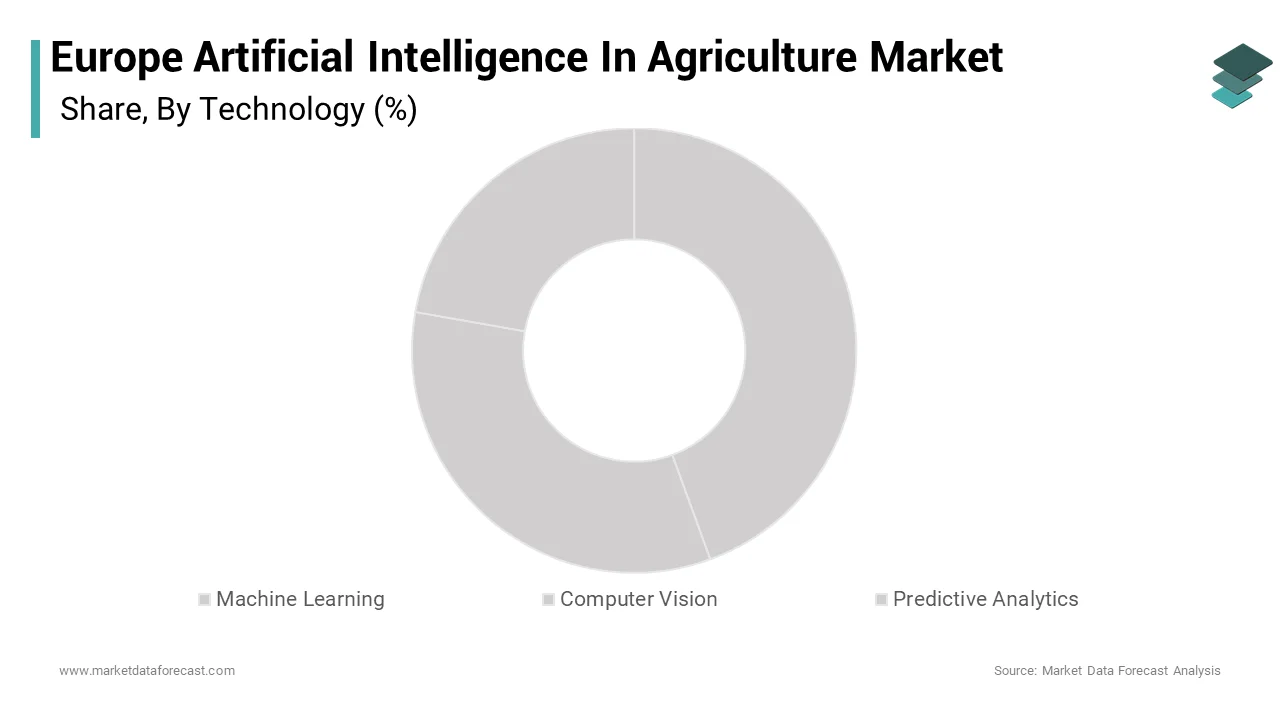
The computer vision segment is the fastest growing technology segment in the Europe artificial intelligence in agriculture market and is estimated to witness a CAGR of 29.1% over the forecast period. The urgent need for real time visual inspection in labor scarce environments and precision input application is propelling the growth of the computer vision segment in the European market. According to Wageningen University, robotic weeders using convolutional neural networks achieved high accuracy in distinguishing crops from weeds across Dutch vegetable fields in 2024. Startups such as EcoRobotix and Naïo Technologies have commercialized solar powered sprayers that reduce herbicide use through pixel level targeting. In Spain, the Ministry of Agriculture documented a decline in manual scouting costs among citrus growers using drone mounted cameras with object detection models. The European Space Agency’s AI4Copernicus initiative further accelerates adoption by funding open-source models for satellite-based crop classification.
By Application Insights
The precision farming segment led the market by commanding for 41.9% of the regional market share in 2025 owing to the binding regulatory requirements under the Farm to Fork Strategy and Common Agricultural Policy. AI enabled variable rate technology allows farmers to apply seeds, fertilizers, and pesticides only where needed, reducing environmental impact while maintaining yields. According to the European Environment Agency, farms using AI guided precision systems reduced nitrogen surplus and pesticide drift in 2024. In Germany, the Federal Office for Agriculture certified thousands of farms under its “Smart Farming” label, which mandates digital nutrient mapping and AI based application logs. Similarly, France’s Ecophyto Plan requires farms over 50 hectares to submit digital treatment records validated by machine learning anomaly detection. Major agrochemical companies such as Bayer and Syngenta bundle AI analytics with their products, ensuring rapid deployment.
The livestock monitoring segment is the fastest growing application segment in the Europe artificial intelligence in agriculture market and is expected to witness a CAGR of 30.9% over the forecast period owing to the tightening animal welfare regulations, rising feed costs, and consumer demand for traceable meat and dairy. According to the European Food Safety Authority, new rules require continuous health monitoring for herds over 100 animals starting in 2026. Companies such as Connecterra and Cainthus deploy wearable sensors and barn mounted cameras that use pose estimation algorithms to detect lameness, estrus, and illness before clinical symptoms appear. In the Netherlands, many dairy farms now use AI systems that increase milk yield and reduce antibiotic use as per Wageningen Economic Research. Sweden’s National Veterinary Institute reported a drop in calf mortality after implementing thermal imaging-based fever detection.
By Offering Insights
The software segment led the market by holding 51.6% over the forecast period in this regional market. The leading position of software segment in the European market can be credited to its role as the intelligence layer that transforms raw data into actionable insights. Farm management platforms such as 365FarmNet and AgriWebb integrate machine learning models for yield forecasting, pest alerts, and carbon accounting without requiring new hardware investments. According to the European DIGITAL SME Alliance, a majority of AI adoption in 2024 occurred through software subscriptions rather than capital equipment purchases. The European Commission’s CAP Digital Toolkit mandates that all subsidy applicants use certified software to log field activities ensuring traceability and audit readiness. Cloud based architectures allow frequent model updates, such as Bayer’s Climate FieldView refreshing its disease prediction engine multiple times in 2024.
The AI as a service segment represents the fastest growing offering segment in the Europe artificial intelligence in agriculture market and is estimated to register a CAGR of 33.8% over the forecast period. This model democratizes access by allowing farmers to pay per analysis without upfront investment. According to the European Rural Development Network, thousands of smallholder farms subscribed to AIaaS platforms in 2024 primarily for disease detection and irrigation scheduling. Startups such as Taranis and OneSoil offer web-based dashboards where users upload drone images and receive AI generated prescriptions. As per the European Investment Bank, a guarantee fund was launched in 2024 to de risk AIaaS adoption among cooperatives. National programs such as Italy’s Agricoltura 4.0 reimburse part of subscription fees for certified services.
COUNTRY-LEVEL ANALYSIS
Germany Artificial Intelligence Market Analysis
Germany held the leading position in the European artificial intelligence in agriculture market in 2025 with a 23.3% share. The dominance of Germany in the European market is driven by its advanced digital farming infrastructure and stringent environmental regulations. The country leads EU implementation of the Farm to Fork Strategy with thousands of farms certified under its national Smart Farming label requiring AI based nutrient and pesticide tracking. According to the Federal Ministry of Food and Agriculture, a majority of German arable farms used AI driven variable rate technology in 2024 to reduce nitrogen use while maintaining standards. The Fraunhofer Society operates multiple agri-AI testbeds developing models for sugar beet yield prediction and potato disease detection. Major firms such as BASF and Claas integrate AI directly into their product ecosystems, while Germany’s strong cooperative network enables GDPR compliant data pooling.
France Artificial Intelligence Market Analysis
France captured the second leading share of the European AI in agriculture market in 2025 due to the state led digital transformation and large-scale arable farming. The government’s France 2030 investment plan allocated significant funding to agri-tech including AI for sustainable viticulture and cereal production. According to FranceAgriMer, many farms over 100 hectares used AI platforms in 2024 for compliance with the Ecophyto II+ Plan. The Arvalis Institute developed machine learning models that cut fungicide applications in wheat through early disease forecasting. France also hosts startups such as Wintics using computer vision for automated vine pruning. According to the National Center for Space, Sentinel satellite data through AI pipelines to monitor crop health nationwide.
Netherlands Artificial Intelligence Market Analysis
The Netherlands is projected to account for a prominent share of the European AI in agriculture market over the forecast period due to its world leading greenhouse horticulture and agri-robotics cluster. According to Wageningen University, most Dutch tomato and pepper greenhouses use AI systems for climate control, pollination, and yield prediction. Robotics firms such as Priva and Ridder embed computer vision and reinforcement learning into autonomous growing platforms. The Dutch Ministry of Agriculture’s Digital Delta program funds AI projects optimizing water and energy use in protected cultivation. The Autoriteit Persoonsgegevens approved the first GDPR compliant farm data exchange in 2024, which is positioning the Netherlands as a regulatory testing ground.
Spain Artificial Intelligence Market Analysis
Spain is expected to exhibit a healthy CAGR in the European AI in agriculture market during the forecast period. The vast fruit, vegetable, and olive oil sectors facing acute labor and water scarcity are driving the growth of the Spanish market growth. According to the Spanish Ministry of Agriculture, many citrus and berry growers adopted AI powered drone scouting in 2024 to combat labor shortages and optimize drip irrigation. The Andalusian regional government launched the Smart Olive initiative using satellite-based AI to predict yield and detect verticillium wilt across extensive hectares. Spain also leads in solar powered agri robotics with startups such as AgroBot deploying autonomous harvesters in strawberry fields. The National Institute for Agricultural and Food Research developed drought stress models that reduced water use in almond orchards.
COMPETITIVE LANDSCAPE
The Europe artificial intelligence in agriculture market features dynamic competition among multinational agrochemical and machinery giants, agile European startups and global technology providers. Incumbents like Bayer and John Deere leverage integrated product ecosystems to embed AI within seeds chemicals and equipment ensuring sticky customer relationships. However, they face disruption from specialized startups such as Taranis and Wintics that offer modular affordable solutions focused on specific pain points like disease detection or labor substitution. Technology firms like IBM and Microsoft provide cloud-based platforms but must navigate complex data sovereignty rules under GDPR. Competition is increasingly defined by regulatory compliance data transparency and local adaptability rather than algorithmic novelty alone. The absence of standardized validation protocols creates fragmentation while public funding through Horizon Europe and Digital Europe Programme fuels rapid innovation. This multi-tiered landscape encourages collaboration yet demands deep contextual understanding of Europe’s diverse agronomic and policy environments to achieve scale and trust.
KEY MARKET PLAYERS
A Few of the dominating the players that are in the Europe artificial intelligence in agriculture market
- Deere & Company
- Bayer AG
- IBM Corporation
- John Deere
- Microsoft Corporation
- Climate LLC (Bayer AG)
- Farmers Edge Inc
- AgEagle Aerial Systems, Inc.
- Prospera Technologies, Inc. (Valmont Industries, Inc.)
- A.A.A Taranis Visual Ltd.
- CropIn Technology Solutions Private Limited
- Corteva, Inc. (Dow AgroSciences LLC)
Top Players In The Market
- Bayer AG leverages its global Crop Science division to deliver AI driven digital farming solutions across Europe through its Climate FieldView platform. The company integrates machine learning models with satellite imagery and field sensor data to provide real time recommendations on seeding fertilization and pest control. Globally Bayer serves over 200 million acres with FieldView and tailors its European offerings to comply with Farm to Fork and GDPR requirements. Recently Bayer enhanced its disease prediction engine with computer vision algorithms trained on regional pathogen data and launched a carbon footprint tracking module aligned with EU sustainability reporting mandates. These innovations strengthen its position as an end-to-end agronomic partner blending chemical and digital expertise to support regulatory compliance and productivity.
- John Deere maintains a strong presence in the Europe artificial intelligence in agriculture market through its autonomous tractors precision planting systems and Operations Center software. The company embeds AI directly into machinery using onboard neural processors for real time weed detection yield mapping and obstacle avoidance. Globally John Deere processes over 15 billion acres of field data annually enabling continuous model refinement. In recent actions the company expanded its See & Spray Ultra system across German and French farms achieving 60 percent herbicide reduction and introduced a GDPR compliant data sharing framework that gives farmers full control over their agronomic information. These moves reinforce its leadership in integrated hardware software AI ecosystems tailored to European regulatory and operational needs.
- IBM Corporation contributes to the Europe artificial intelligence in agriculture market through its Watson Decision Platform for Agriculture which combines weather forecasting satellite analytics and IoT data to generate predictive insights. The company partners with European cooperatives agribusinesses and research institutes to develop localized AI models for crop yield water stress and disease risk. Globally IBM’s environmental intelligence suite supports food supply chains across 40 countries. Recently IBM collaborated with the European Space Agency to integrate Sentinel satellite data into its platform and launched a federated learning pilot in the Netherlands allowing farms to collaboratively train models without sharing raw data. These initiatives position IBM as a trusted provider of secure scalable and policy aligned AI infrastructure for sustainable agriculture.
Top Strategies Used By The Key Market Participants
Key players in the Europe artificial intelligence in agriculture market prioritize regulatory alignment by embedding Farm to Fork and CAP compliance features directly into AI models and data workflows. They adopt hybrid deployment models combining cloud analytics with edge computing to function in low connectivity rural areas. Companies form strategic partnerships with national agricultural institutes and satellite agencies to access high quality localized training data. Vendors implement granular data ownership controls to comply with GDPR and build farmer trust. Additionally, firms are shifting toward subscription and pay per use pricing through AI as a Service models to lower entry barriers for smallholder adoption across diverse European farming landscapes.
MARKET SEGMENTATION
This research report on the Europe artificial intelligence in agriculture market is segmented and sub-segmented into the following categories.
By Technology
- Machine Learning
- Computer Vision
- Predictive Analytics
By Application
- Drone Analytics
- Precision Farming
- Agricultural Robots
- Labor Management
- Livestock Monitoring
- Others
By Offering
- Software
- Hardware
- AI-as-a-Service
- Service
By Country
- United Kingdom
- France
- Spain
- Germany
- Italy
- Russia
- Sweden
- Denmark
- Switzerland
- Netherlands
- Rest of Europe