

Everyone talks about artificial intelligence and how we are ready to do it. As businesses adopt and integrate AI to stay competitive and drive innovation, the demand for emerging talent continues to grow. This raises doubts. Do Indian graduates have the skills they need to thrive in today's AI-driven workplace?
Latest Indian Graduate Skills Index 2025 Report by Mercer | Mettl shows that the overall employment potential of Indian graduates has dropped slightly, down from 44.3% in 2023 to 42.6%. However, this decline was primarily due to a decline in employment potential for non-technical roles, while technical roles experienced an upward trend.
In particular, 46% of graduates are currently employed in AI and machine learning positions, indicating a significant improvement in proficiency in these technical skills.
The report also predicts that the Indian AI market will reach $1.7-2.2 billion by 2027, growing at a CAGR of 25-35%.
In the report, Siddhartha Gupta, president of Mercer India, said, “The technical capabilities of AI and data analytics are no longer a niche requirement. They have become fundamental in a variety of fields. Graduates should adopt a mindset of continuous learning and be equipped with tools to navigate this evolving landscape.”
What does the Indian graduate scene look like?
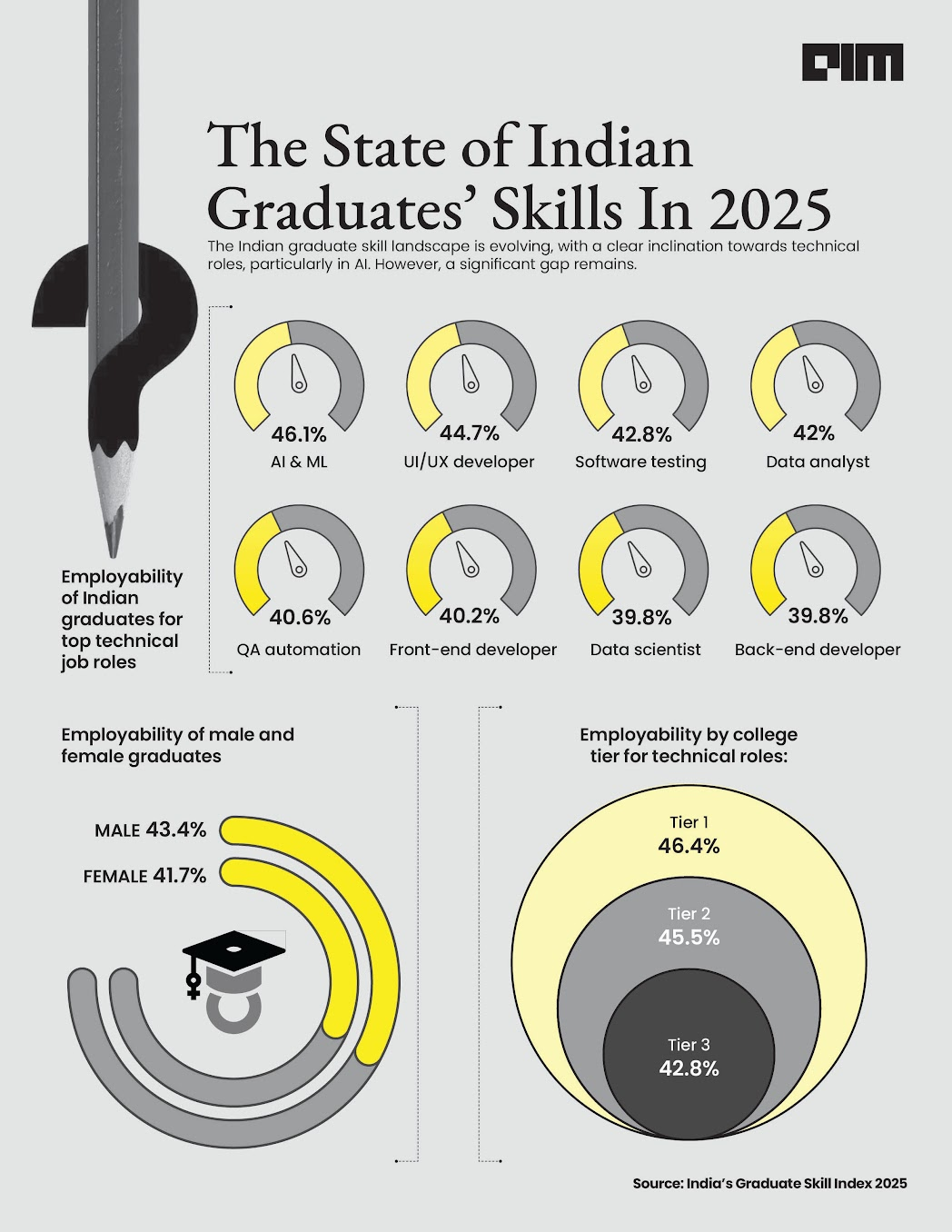
Several factors have contributed to the decline in employment potential for non-technical roles, such as unstructured learning pathways of non-technical skills and rapid changes in employer expectations.
In terms of technical skills, UI/UX skills are second closest to AI-ML, with backend developer skills getting backseats (as is clear in the infographic above). The report further reveals that the employability gap between technical and non-technical roles differs between university groups.
Tier 1 colleges show the highest employment potential for both types of roles, while Tier 2 and Tier 3 colleges show high proficiency in technical roles, but lag behind non-technical skills.
This disparity underscores the need for a more comprehensive approach to skill development that meets the diverse needs of graduates from a wide range of educational backgrounds. However, the difference is not that big. That means it could be good for Tier 2 and Tier 3 universities.
Additionally, male graduates have slightly higher employment potential rates overall and across technical roles than female counterparts. However, female graduates show higher employment potential in certain non-technical roles, such as digital marketing and HR.
“Around 43.4% of male graduates applying for employment are employed, while the employment chances are 41.7% of women,” the report states.
Interestingly, 70% of current Indian university students look forward to joining IT companies. The IT industry has seen a slump in the number of graduates recruited, but industry experts are hoping to make a change in the near future.
But what is the reason behind this gap?
In an interview with target“The talent pool here is very limited even if IIT fires around 10,000 engineers a year,” stressed Ankit Anand, founding partner at Riceberg Ventures.
In a report on CS alumni in India, the developer said earlier target Despite the saturated market, he struggled to find work due to his inadequate skills. He said the university had to undertake an unpaid internship for more than a year because it had not taught the skills it had requested by its employer.
Therefore, close collaboration between the industry and academia is important to improve the skill sets of Indian alumni.
Beware of the gaps
Graduate Skills Index 2025 Report draws an elaborate picture of the landscape of employment potential for Indian graduates. While increasing proficiency in AI-ML skills is encouraging, the decline in non-technical skills and the persistent gap between technical and non-technical roles raises concerns.
Soft skills are one of the contributing factors to ensure better opportunities in the Ai-Augmented world of work. To prepare for the future of work, educational institutions, industry leaders and policymakers need to work together to develop a skilled, yet adaptable and resilient workforce.
This focus should be on strengthening the curriculum for technical and non-technical skills development, promoting a culture of continuous learning and high-class skills, monitoring the requirements for skills in demand, and updating the curriculum accordingly.
Additionally, businesses can make a difference by helping fresh graduates mature quickly. Sami Atiya of ABB, a supplier and manufacturer of industrial robots, shared insights into ABB's hackathons and training programmes, including a recent initiative in India that trained 2,000 employees with AI and created over 200 new AI use cases.
Digitally savvy young people in India can access online resources, courses and distance learning materials on Aupskill. This could mean better skill opportunities. By addressing these challenges and investing in the development of a balanced workforce, India can ensure that graduates are prepared not only for employment but for the future.


