
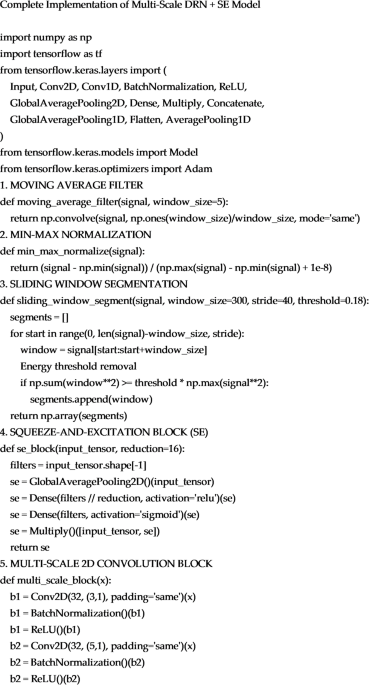
In recent years, hand gesture recognition (HGR) using EMG data has attracted much attention to improve human-machine interaction. However, it remains difficult to effectively model multiscale temporal variations and distinguishable channel-by-channel features in EMG signals. Although recent deep learning-based HGR methods have shown promising performance, many struggle to jointly capture the multiscale time dependence and per-channel feature associations inherent in EMG signals. Deep learning (DL) techniques offer several advantages over machine learning (ML) techniques, including promising classification performance. In this study, a DL-based multiscale deep residual network (DRN) with an SE model that utilizes EMG signals to recognize hand gestures is proposed. The proposed architecture integrates multiscale residual learning with squeeze and excitation-based channel retuning, allowing the network to learn both temporal patterns and the importance of gesture-specific features at different scales. First, we utilize the EMG-EPN-612 dataset to train and evaluate our research model. The research model includes data collection, preprocessing, feature extraction process, and classification tasks. Standard EMG preprocessing such as moving average filtering, min-max normalization, and sliding window segmentation is applied, followed by gesture classification using multiscale DRN integrated with the SE module to capture temporal patterns and channel-wise dependencies. The dataset is split into two parts, one containing 75% of the data for training and the other containing 25% of the data for testing. The improved performance can be attributed to the ability of the proposed model to effectively capture discriminative multiscale temporal features and adaptively highlight informative EMG channels. The proposed model not only achieved 99.24% accuracy, 99.15% precision, 99.17% f1 score, 99.10% specificity, and 99.20% recall, but also overcame the compared models.


