This study demonstrated that locally deployed AI-enhanced educational videos significantly improve perceptual teaching clarity and objective knowledge acquisition in pediatric surgical education compared to standard faculty-recorded videos, resulting in consistent improvements across learner levels and topics while significantly reducing costs. This approach eliminates green screen infrastructure and its technical challenges.
The observed improvements closed critical gaps. Exposure in pediatric surgery remains severely limited, with residents completing only 33.8 designated cases (3.7% of volume), down from 47.7, and ACGME requiring only 20 cases.1, 2. In many medical schools, pediatric surgery is taught within the undergraduate general surgery curriculum, making video-based resources essential. Education 4.0 emphasizes student-centered learning with technology, making video-based education essential.
The magnitude of knowledge improvement (7.3 percentage points, Cohen’s d = 0.76) compares favorably with previous meta-analyses that showed large effects in dentistry ( d = 2.18) and moderate effects in medicine ( d = 0.67).9. Research has demonstrated significant improvements in formalized learning with video-based instruction, with interactive videos achieving improvements of 49-70%, depending on the format.8. Our results suggest that AI enhancements provide added value beyond standard recording. The very large effect size for perceived clarity (d = 1.24) may reflect the separation of visual presentation as the only manipulated variable, with identical content across groups.
This is consistent with cognitive theories of multimedia learning, which posit that multimedia learning uses separate channels for processing words and images and uses limited working memory, which requires appropriate cognitive processing.10. Three important goals are to reduce extraneous processing, manage important processing, and encourage generative processing. Enhanced visual presentations have the potential to increase engagement without changing content delivery, consistent with student-centered principles that emphasize learner autonomy and technology integration. Dual coding theory suggests that content presented through verbal and visual channels improves information processing. AI educational video assistants designed using these principles received positive reviews for engagement, organization, clarity, and ease of use.twenty one.
The findings are particularly relevant for programs that lack specialized media resources. Locally deployed open source AI tools offer practical solutions that maintain faculty autonomy, avoid recurring subscriptions, and maintain organizational control. The 72-94% cost savings are particularly relevant in resource-constrained environments where traditional infrastructure is not available. The most expensive element of video-based educational modules is the time cost, which varies widely depending on the level of clinical seniority of those involved.twenty two.
This is consistent with the goals of Education 4.0. The practical solution includes session recording to DVD, reaching more than 140 surgical trainees in four countries.twenty three. The United Nations Global Surgical Learning Hub delivers e-learning courses to more than 11,000 learners in 190 countries, 55% of whom are from low-income or lower-middle income countries.twenty four. Our approach complements these efforts by enabling local production without studio or green screen infrastructure.
GGUF quantization technology delivers professional enhancements using consumer hardware19. GGUF Q8 quantization reduces computational requirements and allows operation on standard consumer laptops with modest VRAM (6GB), making this technology particularly accessible for pediatric surgical education in low- and middle-income countries. A frame-based workflow with AI processing limited to background regions preserved presenter authenticity while avoiding the technical limitations of green screen recording. This approach reduced lighting and color matching constraints and allowed for visually consistent backgrounds without specialized studio infrastructure.
Additional innovations included exterior painting to extend the spatial boundaries, creating an expansive studio from a limited space. AI processing in HD resolution with 4K output. Green screen infrastructure and reduced replacement costs. AI audio enhancement using free tools. Collectively, these reduce the barriers to high-quality production. Commercially available technology allows you to use your smartphone camera to capture high-quality content at minimal costtwenty five. Our method bridges this gap by combining low-cost recordings with AI-based enhancements.
The American College of Surgeons’ interdisciplinary consensus establishes that to encourage adoption by surgeons, AI methods and AI-powered metrics require strong evidence of effectiveness (90% agreement), and that benchmarking against expert ratings is essential for assessing skills (90% agreement), which is susceptible to biases inherent in subjective human opinion (85% agreement).26. Only 44% of published AI models in pediatric surgery were interpretable, only 6% were both interpretable and externally validated, and only 40% were at high risk of bias.27. Our approach limits AI processing to background replacement while preserving all authentic presenter features through selective masking, as verified by a board-certified pediatric surgeon.
In this study, the AI acted strictly as a visual enhancement tool rather than a content generator. Anatomical accuracy and presenter authenticity were maintained by restricting processing to background elements, and all materials were reviewed by a board-certified pediatric surgeon. This controlled use of AI is consistent with current consensus recommendations for responsible implementation in surgical education.
From a practical implementation perspective, AI-enhanced production required more faculty time (7-10 hours vs. 2-4 hours) but eliminated professional services costs ($2,000-$8,500) and green screen infrastructure. The high cost of producing high-quality video films for educational purposes has historically discouraged the use of this method.28. This tradeoff favors AI enhancement when faculty time is institutionally subsidized, making this approach attractive to academic centers where faculty contributions are valued but external funding is limited. Valuing faculty time at the institution’s rate ($100 to $200 per hour) does not change the cost advantage.
The main cost components of video-based education include faculty time (median >$170 per physician), equipment (median >$170), and learner time (median $525 per physician).29. Programs that prioritize efficiency can save time by embracing functional backgrounds over sleek ones. The main barriers to effective AI integration are not sophistication of the technology, but rather deficiencies in critical infrastructure, such as institutional implementation structures, sustainable funding, and rigorous research methodologies.30. Our approach addresses technical and cost barriers while recognizing that successful implementation requires an organizational support structure.
The transition from language models to multimodal visual AI represents a significant paradigm shift12. Multimodal AI with Contrastive Language Image Pretraining (CLIP) enables advanced manipulation of educational media that previously required a professional studio. Generative AI transforms educational content into multimodal formats and has the potential to improve comprehension through alignment with cognitive theories of multimedia learning13. The FLUX.1-Fill and FLUX.1-dev models represent state-of-the-art repair technology, where Fill handles repair tasks and dev provides fine-grained control and quality optimization. This allows for accurate background replacement while preserving presenter authenticity, a key requirement that can be compromised with fully automated approaches.15.
AI holds great promise for the personalization of medical professional education, and its applications are on the rise, especially in surgical education.31. The affordances of AI (expressiveness, interactivity, multimodality) map onto educational experiences such as interactive tutoring, but meaningful use requires a critical awareness of AI’s operational limits, ethical boundaries, and technological mechanisms.
Although video-based education and AI-assisted learning have each demonstrated educational value;7the specific use of locally deployed AI for visual enhancement of lecture videos in pediatric surgery has not been previously evaluated. Therefore, this discovery provides preliminary evidence for this application.
The greatest promise lies in a hybrid model in which AI augments rather than replaces teacher instruction. When implemented thoughtfully and ethically, AI has the potential to be a powerful adjunct to surgical education, complementing rather than replacing the critical educator-learner relationship.32. AI cannot replace the critical role of educators, but must be used as a complementary tool with a robust governance framework.
Restrictions
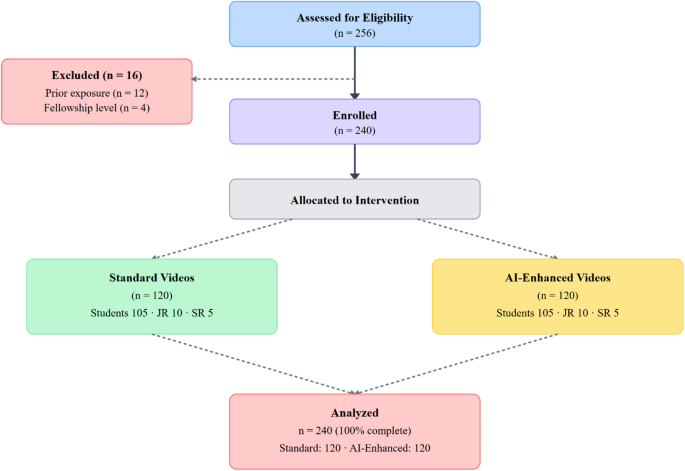
This study has some limitations. First, despite a good balance of baseline characteristics and multivariable adjustment performed, the quasi-experimental, nonrandomized, posttest-only design introduces potential selection bias and limits causal inferences. Second, results were assessed immediately after video viewing. Therefore, long-term knowledge retention and transfer to clinical performance were not assessed. Third, although the knowledge assessment instruments were mapped to learning objectives and reviewed by faculty, they were not formally psychometrically validated. Although this may limit the interpretation of absolute score levels, relative differences between groups are still informative. Fourth, the observed increases in clarity may partially reflect the effects of improved production quality and novelty, not just instructional advantages. Fifth, this study was conducted at a single academic institution with a large undergraduate population, which may limit generalizability to other training settings and learner populations. Finally, this intervention evaluated lecture-based instructional videos and did not address pragmatic or procedural video instruction, where different instructional dynamics may apply.