
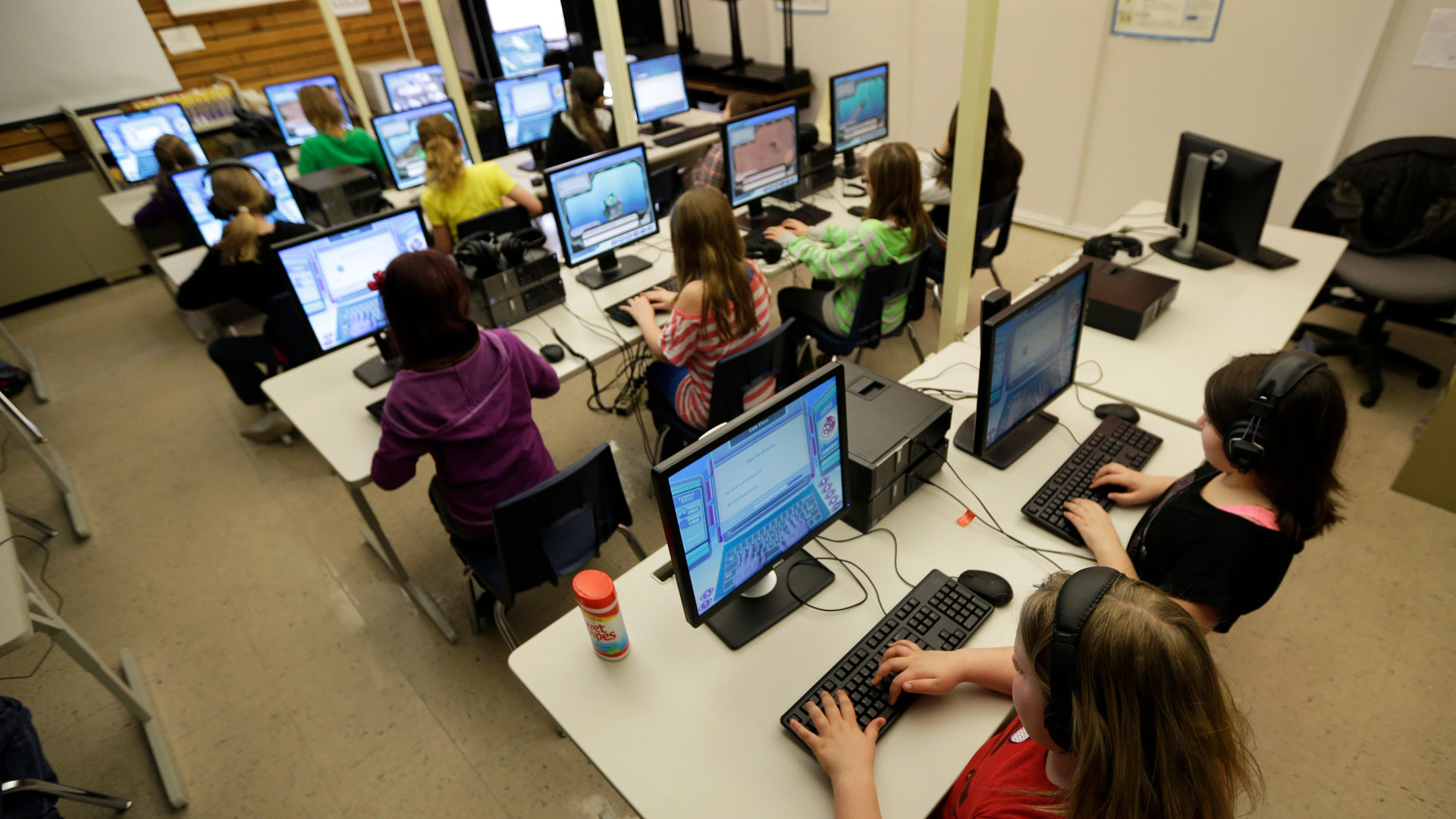
 Credit: (AP Photo/Charlie Neighborgal)
 One Friday evening in January 2025, I received a phone call. My school board leaders were panicking. News has surfaced that a local charter school is finalizing a deal to start a nursing program at the former Muhlenberg Hospital in Plainfield.
Concerns were immediate. Expansion of programs by competing schools may lead to a decline in general enrollment. However, I looked at this challenge differently and communicated that to the board. This was a good thing, a forced feature. This was an opportunity to innovate and enhance Plainfield Public Schools’ offerings, particularly in career and technical education.
I was committed to designing solutions that expand student opportunities, deepen learning, and increase the district’s competitiveness through better experiences, not marketing.
 Credit: (Lashon K. Hasan)
That’s when I discovered spatial computing tools such as the Apple Vision Pro headset, which is powered by artificial intelligence. The more I learned, the more I realized that this was not just a Plainfield story, but a harbinger of the next generation of educational inequality.
Students are already encountering generative AI in their daily lives. The question is whether schools will guide its ethical and rigorous use or treat AI as contraband and leave learning to chance. This is bigger than any other district. This is a workforce and competitiveness issue for New Jersey.
The World Economic Forum’s Future of Work Report 2025 notes that technology-driven roles are growing rapidly and predicts that AI and information processing technologies will transform business by 2030. According to the report, employers expect significant changes to the way work is done. It also warns that the skills gap remains a key barrier to change.
The impact on education is direct. Without building AI fluency at scale, opportunities will be concentrated where guidance and access already exists.

AI doesn’t stay on the screen either. Spatial computing, where digital information is overlaid on physical space, drives learning towards immersive simulations, digital twins, and 3D environments that mirror modern industry. Universities and employers are moving rapidly. Purdue University launches Spatial Computing Hub. Stanford Medicine and UC San Diego Health are investigating clinical applications. Companies like Nvidia are driving digital twin workflows that bring immersive analytics to everyday work.
The pipeline is moving, and K-12 schools cannot afford to treat immersive technology as an optional enhancement.
When I visited Purdue’s hub in April 2026, one design choice stood out. That is, this space is not a closed laboratory or a showcase for outsiders. It operates much like the computer labs many of us remember from the early internet days: open, staffed, and intentionally set up to lower the barrier for people to get started. Equally important, this is not a centralized “we’ll build it for you” model. Faculty are encouraged to design solutions to problems they identify in their areas of expertise, supported by gateways to reduce friction and increase competency.
This lesson applies directly to New Jersey schools.
If we want technology to narrow the divide rather than widen it, we need to move from viewing educators as passive consumers of packaged products to empowering them as creators of learning experiences. In my work leading Plainfield Public Schools, I have seen how quickly vision can become reality when you combine purpose, professional learning, and access, not hype.

This is where the discussion often goes sideways. People discuss screen time, distraction, and novelty. These concerns are valid, but misplaced. Not all screen time is created equal. Creation trumps consumption. When students use AI and immersive environments to draft, test, revise, simulate, build, and explain, technology becomes a tool for deeper thinking, not a shortcut.
So what should New Jersey school districts do, especially when budgets are tight and every initiative is competing for funding? Start with five practical and scalable moves.
- Set clear standards: Teach before punishing. Adopt an “AI for Learning” policy with grade-specific expectations, disclosure requirements, and guardrails. Include an appeals process to ensure inconsistent enforcement does not result in unfair discipline.
- Guaranteed access during class. Fairness cannot depend on home devices or Wi-Fi. Use libraries, labs, and after-school programs as supervised access points to ensure that all students receive guided practice.
- Build a pathway for teachers and creators. We train educators to go beyond just “using tools” to design standards-aligned, AI-supported lessons and immersive learning experiences. We start with a small group of teachers and leaders and scale through professional learning communities and shared lesson banks.
- Modernize your assessments to increase rigor. It requires a draft, checkpoints, reflections, and a brief oral argument. Through performance validation, inference, and repetition, students demonstrate learning in an AI-rich world.
- Measure equity and impact. Track access, participation, training, and student growth. If there are gaps in your data, adjust them immediately.
New Jersey has always been competitive economically, academically, and culturally. The next competition will be about skill. It’s about who can think analytically, communicate clearly, and use technology with judgment.

AI and spatial computing are not “freebies.” These are rapidly becoming fundamental tools for learning and work, and the question is whether to build access and guidance at scale or recognize the opportunity to enhance it by postcode.
That’s why the country’s current efforts are so important. By submitting expectations for AI and information literacy to the State Board of Education, New Jersey is demonstrating that these competencies will be included in learning standards, not just discipline and equipment rules. If the statewide guidance works well, districts could move from reactive bans to consistent guidance. That means teaching students how to verify information, how to properly cite and disclose the use of AI, and how to develop the analytical habits needed in a world where falsification is easy and judgment is poor.
School districts don’t have to wait to start making adjustments.
Under my leadership, Plainfield schools adopted an artificial intelligence policy that provides a practical framework for others to build upon, defines responsible use, sets expectations for transparency and academic integrity, and clarifies roles for staff and students. Equally important, it positions AI as a learning problem: a tool that enhances rather than replaces thinking. These policy foundations, combined with training and equitable access, can help schools clearly and consistently implement the state’s direction.
New Jersey could lead this moment. We can make AI and spatial computing an advantage for our postcodes, or we can build structures that are literate for all.


