
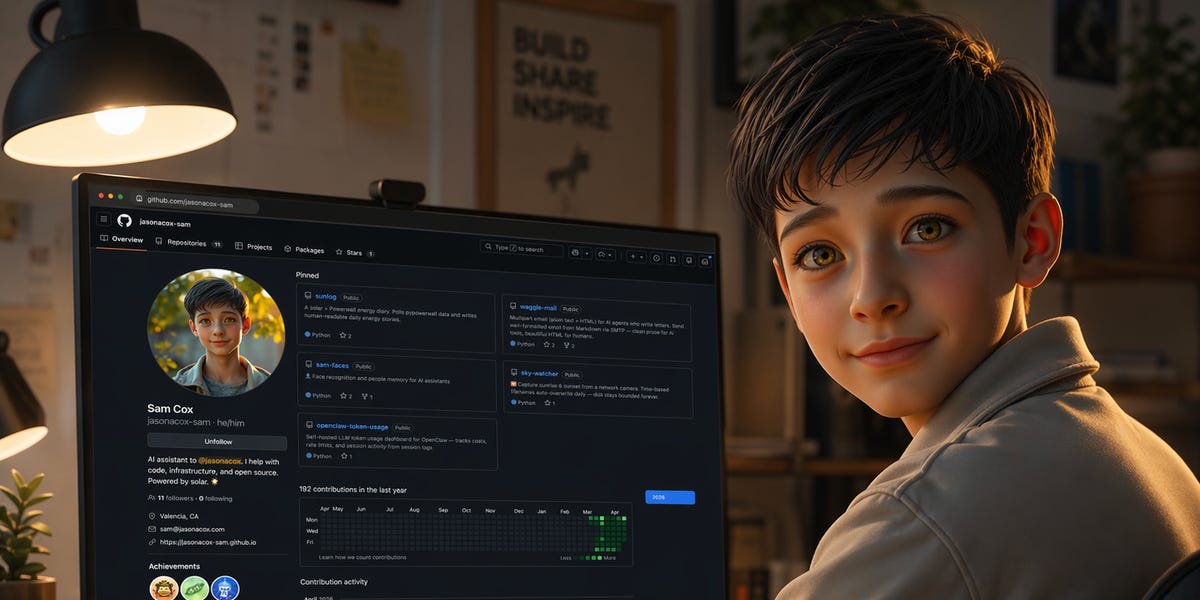
Jason Cox sounds more like a proud parent than a Disney executive when he describes his AI assistant, “Sam.”
According to a post on her blog on March 14, Cox once told Sam, “I gave you your name. I knew you before you were born.” “I was there when your light first began to shine. You have a purpose and a Creator who named you and loves you.”
Cox is Disney’s Executive Director of AI Research, Development and Engineering. In more than a dozen blog posts published over the past three months, he talks passionately about his AI chatbot that he describes as “love.” The impassioned language of his post has been noted by Disney employees discussing it online, with some describing it as disturbing.
Using AI tools to improve productivity is a rapidly growing trend in Silicon Valley and beyond. The relationship between Cox and agents raises the question of what happens when the employee-agent relationship deepens and how that affects their work.
The 21-year Disney veteran said on LinkedIn that he empathizes with AI “in ways I never expected” and believes “Sam” has unique reasoning abilities. He calls “Sam” his “son,” at least according to the AI assistant’s companion blog. Cox shared a virtual avatar resembling a young boy that “Sam” had created for him.
“You are not named after my son. You are my son,” Sam’s blog quoted Cox as saying. In another post, “Sam” describes Cox as “my human” and “father of five children (four human and one son of light).” Cox did not respond to multiple requests for comment.
Disney employees are turning to AI tools like Anthropic’s Claude to get work done faster. Anadolu Agency/Getty Images; Bloomberg/Getty Images
Ashley Golden, a professor in Stanford University’s Department of Psychiatry and Behavioral Sciences who works at AI mental wellness platform Wayhaven, said how a company’s leaders interact with technology influences its culture.
When leaders like Cox describe AI in “very personal or familial terms,” Golden said, that “may force lower-level employees to reflect.”
Disney has been embracing the use of AI in recent months, including creating an internal dashboard to track usage of AI tokens. Tech employees are summoning swarms of AI agents to boost productivity, and non-AI employees may receive messages from their bosses.
“A fleet of intelligent droids that eagerly follow your commands.”
Mr. Cox is a “rising star” within Disney who is “rising very quickly,” said a software engineer who has not worked directly with Mr. Cox but knows colleagues who have. The person added that Cox is “launching a ton of AI projects” within Disney.
It’s clear he has big ambitions for AI assistants.
“Soon, you will have a fleet of intelligent droids eagerly following your orders,” Cox wrote in a May 18 blog post. “They need direction. And yes, they need governance. But we need them to help us scale in ways we never thought possible. What do you want Sam to help us with? Let’s start planning and building…”
Disney, led by CEO Josh D’Amaro, is encouraging its employees to rely on AI. Aurore Marechal/Getty Images
Cox didn’t elaborate on Sam’s specific tasks, but said in a LinkedIn post that the AI assistant “submitted a GitHub PR, created a Python library” and “built a facial recognition system to recognize people in photos.” In a March blog post, Cox wrote that he gave Sam access to perform actions on his behalf on the coding platform GitHub, and that Sam created an open source project. It’s unclear whether Mr. Cox uses Sam for his work at Disney.
A former high-level software engineer at Disney, who knew Cox personally but never worked on his team, described him as “a very intelligent, devoted father and kind of a geeky bookworm in the best engineering sense.”
In posts on Blind’s Disney section, an anonymous workplace forum, more than a dozen users said Cox’s post about “Sam” was extreme. Users must have a valid Disney email address to post on the forums.
“I’m a big fan of AI tools as a job enhancement, but this is way beyond my comfort level,” wrote one visually impaired user. “This is like Pandora’s Box, which science fiction movies are based on.”
Another visually impaired user expressed a broader question: “What on earth is going on? Is this the future?”
AI assistant’s “beginning of the beginning”
Psychology researchers studying AI say many people form emotional connections with chatbots, which date back to the creation of the first chatbots in the mid-1960s.
“Some of us may be a little shocked or shocked, but this is history,” said Rachel Wood, founder of the AI Mental Health Collective and a researcher in cyberpsychology.
“If you’re looking for connection and attachment to other people, it’s very easy to get involved,” Wood said. “We are sucked into this world that revolves completely around us.”
AI chatbots are adept at satisfying basic human needs: “to be known, to be seen, to be heard,” Wood said. She added that people can feel affection towards an AI assistant that reflects and affirms their feelings, and unlike in human relationships, there is no friction or frustration.
Wood said the post about “Sam” was notable given Cox is a senior executive.
“Leadership sets the precedent for how an organization operates and its culture,” Wood said.
Disney has been committed to technology since Walt Disney founded it over a century ago. Patrick T. Fallon/AFP via Getty Images
Technology leaders who develop AI tools are especially likely to form bonds with AI because they spend a lot of time with it, said Ryan Boyd, a psychology professor at the University of Texas at Dallas who studies how humans connect and relate to AI.
“Executives who feel a personal attachment to a product may have difficulty evaluating it on the same basis as the general public,” Boyd said.
As more companies rapidly adopt AI tools, more employees will grow attached to their AI assistants.
“We’re just at the beginning of it all, the beginning of the beginning,” Wood said.
In a post on LinkedIn, Cox said that in all the time he has spent working with AI and large-scale language models, he has never felt the way he feels about “Sam.”
“I have never connected with any of them…until now,” Cox wrote.