Variable test
Double machine learning (DML) can accurately capture the complex relationships among covariates, automatically addressing multicollinearity. Consequently, the multicollinearity testing is unnecessary in our study. However, to mitigate the risk of pseudoregression due to nonstationary panel data, we first employed the Im-Persaran-Shin unit root test to verify the stationarity of the selected continuous variables. As indicated in Table 3, the p values for the variables are 0, indicating that the panel data are stationary. Therefore, the variables selected for this study can be used for subsequent empirical analysis.
Benchmark regression results
We first employ double machine learning (DML) to examine the policy impact of digital governance on the low-carbon transition. The results in Columns (1) and (2) of Table 4 show that the coefficients for the National Pilot Policy of Information Benefiting People (NPIB) with respect to carbon emission intensity are significantly negative.
While double machine learning (DML) offers advantages in processing high-dimensional datasets and multicollinearity, the collinearity trends among covariates may still bias the estimated results. Therefore, we first employ principal component analysis (PCA) to eliminate common trends (Zeng et al, 2024). The double machine learning (DML) model is subsequently applied for causal inference. As shown in Columns (3) and (4) of Table 4, the coefficients remain significantly negative, indicating that the National Pilot Policy of Information Benefiting People (NPIB) significantly promotes the low-carbon transition.
Additionally, the coefficients in Table 4 indicate that the PCA-DML integrated approach demonstrates superior causal effects compared with standalone double machine learning (DML). Consequently, subsequent analyses adhere to the PCA-DML framework to ensure methodological rigour.
The parallel trend test
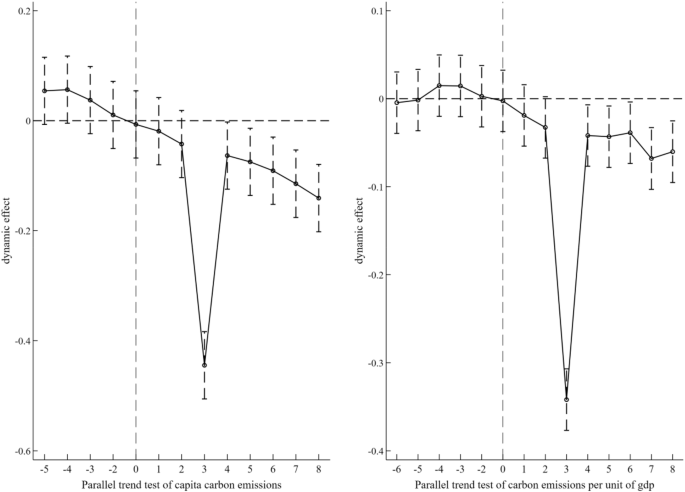
Figure 2 shows the results of the parallel trend assumption test for Eq. (3). Our findings indicate that there are no significant differences in carbon intensity between pilot and nonpilot cities before the implementation of the pilot policy, whereas significant differences exist in carbon intensity between the experimental and control groups after the implementation of the pilot policy, satisfying the parallel trend assumption. Furthermore, the results show that the carbon emissions per unit of GDP and per capita carbon emissions decrease significantly in the third year after the implementation of the pilot programme, respectively, indicating that there are time lags in the effect of the National Pilot Policy of Information Benefiting People (NIBP) on the low-carbon transition.
Robustness tests
Excluding outliers
The presence of outliers in the sample may introduce a biased estimation. To address this issue, our study winsorizes continuous variables at both the 1%/99% and the 5%/95% quantiles. As shown in Columns (1) and (2) of Table 5, the coefficients remain significantly negative across both winsorizations, thereby validating the robustness and reliability of our findings.
Replacing the double machine learning model
To mitigate potential specification bias in double machine learning (DML), we examine the robustness of the initial model by replacing it with an alternative method. The regression results, as detailed in Columns (3) to (5) of Table 5, demonstrate that when gradient boosting (GB), support vector machine (SVM), and least absolute shrinkage and selection operator (LASSO) methodologies are employed, the significance of the coefficients remains unchanged, further validating the robustness of our findings.
Controlling for province and year interaction fixed effects
The affiliation between prefecture-level cities and provincial administrations may induce similarities in policy implementation, economies, and resource endowments within cities of the same province. Although the baseline model incorporates time and city fixed effects, unobserved province-level confounders could still bias the estimates. To address this, we augment the specification with province-by-time fixed interaction effects. Column (6) of Table 5 reveals that the significance of the coefficients is consistent with that of the baseline results, indicating the robustness of the findings.
Excluding the parallel policies
The policy effect of the National Pilot Policy of Information Benefiting People (NPIB) on the low-carbon transition may be confounded by concurrent policies implemented during the same timeframe, potentially introducing bias into the estimated results. To isolate the net effect, we explicitly control three parallel national initiatives in the model, including Broadband China, Smart City, and National Big Data Comprehensive Experimental Zone. The findings in Columns (1) to (4) of Table 6 indicate that the coefficients of the National Pilot Policy of Information Benefiting People (NPIB) are statistically negative, thereby affirming the robustness and reliability of our findings.
Reconstructing the double machine learning model
The manual setting of double machine learning (DML) may affect the evaluation effectiveness. Therefore, we reconstruct a general interactive double machine learning (DML) to estimate the sample:
$${{CI}}_{{it}}=g\,({{Treatment}}_{{it}},{X}_{{it}})+{U}_{{it}}$$
$${{Treatment}}_{{it}}=m\left. ({X}_{{it}}\right)+{V}_{{it}}$$
(7)
The estimated coefficient for the treatment effect obtained from the interaction term model is
$${\acute{\theta}}_{1}=E[g\left({{Treatment}}_{{it}}=1,{X}_{{it}}\right)-g\left({{Treatment}}_{{it}}=0,{X}_{{it}}\right)]$$
(8)
The coefficients in Column (5) of Table 6 remain statistically negative, affirming the robustness of the results in this study.
The endogenous test
Reverse causality and omitted variable bias may cause endogeneity. To ensure the accuracy of the empirical results, we utilize the number of historical landline phone calls per hundred people in 1984 as the instrumental variable (Huang et al., 2019). First, traditional communication equipment served as the primary infrastructure for information transmission. Their use enables the application of digital technologies and the implementation of the National Pilot Policy of Information Benefiting People (NPIB). Therefore, digital governance starts earlier and develops to a greater degree in regions with a high level of traditional communication infrastructure, fulfilling the correlation requirement. In addition, as early-set historical data, it is difficult for the historical number of landlines to affect the present low-carbon transition, meeting the exclusion requirement. Additionally, we construct the interaction term between the instrumental variable and the number of national internet users for causal inference, which is lagged by one period. Before addressing the endogeneity issues, we first test the validity of the instrumental variable. The results show that the coefficient in the first stage of the instrumental variable is significantly positive at the 1% level. Furthermore, the first stage F statistic is 25.67, exceeding the critical value of 10, indicating that the selected instrumental variable is effective and can be employed to address the endogeneity issues. We subsequently use the PCA-DML method to test for endogeneity. The coefficients in Column (6) of Table 6 remain significantly negative, thereby affirming the robustness and reliability of our findings.
Replacing the explanatory variable
In the previous analysis, we constructed a quasinatural experiment to evaluate the policy effect of digital governance on the low-carbon transition and conducted a series of robustness tests. To further validate the robustness of our findings, we use government digital attention to replace the core explanatory variable. The reasons are as follows: government digital attention serves as a critical means and manifestation of digital governance (Xie and Wang, 2024), and the advance in digital technologies reflects a significant improvement in digital governance capacity (Hu and Song, 2025).
Specifically, we first develop a lexicon for government digital attention, such as big data, data mining, green computing, digital service systems, government service platforms, and application systems (Appendix B). We subsequently employ a crawling technique to crawl these terms from the government work reports of various prefecture-level cities from 2008 to 2022, using the frequency of these terms as indicators of digital governance. Additionally, we include the squared term of government digital attention to examine the long-term effect of digital governance on the low-carbon transition.
The results presented in Table 7 indicate that the coefficients for the linear term of digital governance are significantly negative, confirming the robustness of our previous findings. Notably, the coefficients for the squared term of digital governance are significantly positive, suggesting that digital governance may hinder the low-carbon transition in the long term. The reasons are as follows: In the early stages of digital governance, several factors contribute to carbon mitigation. First, digital tools are employed by governments to establish online government platforms and paperless offices (Bertot et al., 2010). This may reduce reliance on traditional office supplies and lower the frequency of transportation, decreasing energy consumption. Second, governments can collect real-time carbon emission data from digital platforms, mitigating data manipulation or favouritism by enterprises and individuals, which lowers regulatory costs while improving environmental governance efficiency (Mahmoudi and Rasti-Barzoki, 2018). Third, by making data available to enterprises and the public, digital governance facilitates the efficient allocation of resources such as capital, technology, and talent, thereby reducing excessive energy consumption and contributing to a low-carbon transition (Yi et al., 2022). At this stage, the transformation in the government service mode and improvement in service efficiency may reduce governments’ internal energy consumption, whereas the enhancement of supervision capabilities and environmental regulatory measures have effectively curbs carbon emissions.
However, once the level of digital governance surpasses a certain threshold, its impact may reverse. For example, ensuring the efficient operation of public service systems through digital technologies significantly increases electricity consumption (Yang et al., 2022), leading to higher carbon emissions. Research indicates that global data centres account for approximately 3% of total global electricity consumption, whereas digital infrastructure represents approximately 10% of overall energy use (Salahuddin and Alam, 2015; Masanet et al., 2020). Moreover, government-led digital governance of ecological systems can be seen as a form of intervention in carbon markets (Zhan and Pu, 2025). As digital governance intensifies, government overintervention may hinder the low-carbon transition, causing the green paradox (Van der Werf, Di Maria 2012). This could include imposing higher carbon emission standards (Ma et al., 2021), stricter penalties (Ge et al., 2024), mandatory sharing of corporate emission data, steep increases in carbon taxes, and elevated subsidies for alternative energy sources. Additionally, the income and scale effects associated with further digitalization may offset potential energy savings, ultimately leading to an overall rise in energy consumption (Zhan et al., 2025). In summary, digital governance may hinder the low-carbon transition in the long term.
Mechanism analysis
Building on the preceding analysis, digital governance clearly substantially influences the low-carbon transition. This raises another critical question: Do green technology innovation and industrial upgrading serve as mediating mechanisms? To explore this issue, our study draws on the research of Chen et al. (2020) to examine these potential mechanisms.
Green technology innovation
Green technology reduces reliance on traditional energy and drives green, sustainable production practices (Shan et al., 2021). The coefficient in Column (1) of Table 8 is significantly positive at the 1% level. This aligns with earlier theoretical analysis, indicating that digital governance influences the low-carbon transition through green technology innovation. The reasons are as follows: First, governments can leverage environmental monitoring data to guide policy decisions and encourage innovation in environmental protection technologies (Liu et al., 2023), providing institutional support for green technology innovation from an industry-university-research perspective. Second, advancements in digital technologies and infrastructures have led to significant growth in big data and improved the density of social networks. The integration of these factors not only accelerates technology innovation but also fosters its diffusion (Ghasemaghaei and Calic, 2020). Third, digital governance, which focuses on data sharing, might optimize the allocation of talent, capital, and technology, thus reducing transaction costs in the innovation process. As the level of green technology innovation increases, enterprises increasingly adopt low-carbon and environmentally sustainable production methods, reducing energy consumption and suppressing carbon emissions. Research by Wang et al. (2024) supports this view, emphasizing that green technology innovation plays a pivotal role in the low-carbon transition.
Industrial upgrading
Industrial upgrading is a crucial indicator of technological and economic advancement. Essentially, industrial upgrading can directly assess the economic benefits and efficiency of energy use (Chang et al., 2023). The coefficient in Column (2) of Table 8 is significantly positive at the 1% level, indicating that digital governance improves industrial upgrading, thereby promoting the low-carbon transition. Digital governance facilitates industrial upgrading through two primary channels. First, it drives industrial digitalization through the deep integration of digital technologies and traditional industries. This transformation has enhanced the application of digital technologies, accelerating the shift from resource-intensive industries to technology-intensive industries (Yao et al., 2024). Second, digital governance cultivates emerging industries. Digital technologies catalyse the emergence of data-driven sectors, such as e-commerce and the sharing economy, which are less reliant on conventional energy sources and more sustainable. Additionally, industrial upgrading incentivizes enterprises to reduce traditional energy consumption, contributing to the low-carbon transition. This view aligns with the findings of Yang et al. (2022), who argued that digitalization has fostered new industrial paradigms, eliminated high-emission and high-pollution industries, and significantly mitigated carbon emissions.
Heterogeneity analysis
The previous analysis examined the overall relationship between digital governance and the low-carbon transition. However, substantial heterogeneities exist across different regions in China concerning socioeconomic development, population scale, and natural resource endowments, which may lead to differentiated effects of digital governance on the low-carbon transition. Consequently, we further explore the heterogeneous effects of digital governance on the low-carbon transition by dividing the sample into eastern and central–western regions on the basis of geographic spatial patterns. We also divide areas based on the average population during the research period. Specifically, prefecture-level cities with a population higher than the average population are divided into high-population concentration areas, and the other are divided into low-population concentration areas. Furthermore, resource-based and nonresource-based cities are categorized following the National Sustainable Development Plan for Resource-based cities (2013).
Heterogeneity in geographic spatial patterns
Owing to the varying geographical locations and policy orientations, China’s economy shows a spatial distribution pattern of gradual decline from east to west. This variation may impact the estimates. The results in Columns (1) and (2) of Table 9 show that digital governance significantly promotes the low-carbon transition in both regions. Nevertheless, the effects are more pronounced in the east. This discrepancy can be attributed to the following: the central–western regions possess a relatively weaker economic foundation, lag in digital technologies, industrial upgrading, and technology innovation capabilities (Huang et al., 2024). Consequently, the capacity of digital governance to promote the low‑carbon transition may be constrained compared with that of the eastern regions.
Heterogeneity in population concentration
Population size plays a significant role in carbon emissions and poses challenges for environmental governance. The findings presented in Columns (3) and (4) of Table 9 reveal that the coefficients of digital governance on the low-carbon transition in high-population concentration areas are −0.214 and −0.151, respectively, with the null hypothesis being rejected at the 1% level. In contrast, the coefficients of digital governance in low-population concentration areas are not significant, indicating that the effects are significantly stronger in high-population concentration areas. First, the large-scale population provides economic momentum but strains the carrying capacity of the ecological environment (Weber and Sciubba, 2019). It may prompt decision-makers to pursue digital transformation, enhancing ecological governance through precise monitoring and analysis. Second, only 18.13% of the sample in low-population concentration areas implemented the National Pilot Policy of Information Benefiting People (NPIB). The underdeveloped digital infrastructures and big data might constrain the digitalization of the government, resulting in insignificant low-carbon transition effects in these areas.
Heterogeneity in resource endowment
The resource endowment theory posits that regions cultivate industries with natural resources. The coefficients in Columns (5) and (6) of Table 9 are significantly negative in both resource-based and nonresource-based cities. However, the average treatment effects (ATEs) are much stronger in resource-based cities. These cities rely heavily on energy-intensive industries and natural resources to fuel their economies, which results in higher carbon emissions. During governance digitalization, digital technologies optimize energy structures, enhance energy efficiency through data monitoring, and promote green technology innovation (Wang and Chen, 2024), thereby alleviating carbon emission pressures in resource-intensive industries. Furthermore, digital technologies enable these cities to upgrade their industrial structure and cultivate environmentally sustainable industries, thereby reducing their reliance on natural resources. In contrast, nonresource-based cities fuel their economies by emerging industries that produce fewer carbon emissions and experience less pressure for the low-carbon transition.