

Dave Yost said laws on child pornography don’t address AI creation
Former Attorney General Dave Yost said Ohio’s laws surrounding child pornography don’t address AI creation at all.
- Law enforcement agencies report a rise in cases involving AI to create illegal content, including child pornography.
- Ohio lawmakers are considering a bill to update state laws to specifically include AI-generated images of minors.
- Experts say the rapid evolution and widespread availability of AI tools make it difficult to regulate and remove harmful content.
Celebrities and those in the public eye almost expect to be targeted by people creating deepfake images or videos online. But a Hilliard woman was not prepared when an ex-boyfriend began sending harassing messages generated by artificial intelligence.
Her ex, James Strahler, kept reaching out and didn’t stop there. Strahler sent images and messages to her coworkers and her boss. The woman filed a police report, and federal prosecutors charged Strahler with multiple crimes under a new law targeting revenge porn and the use of AI to create pornographic images and videos.
In April, Strahler became the first person prosecutors believe to be convicted under the 2025 law and is awaiting sentencing. They say Strahler admitted using AI and real images to harass multiple women and admitted to creating more than 700 images involving real or animated children.
Artificial intelligence technologies aren’t necessarily new; spellcheck became automatic in Microsoft Word in 2003. But what once was limited to annoying robocalls has rapidly evolved into using applications to remove a person’s clothing in a photograph or creating something entirely new, experts say.
The technology is becoming easier to access every day, moving at a speed that makes keeping up difficult for law enforcement trying to stop those intent on creating illegal content that will live in an online landscape that allows images to pop back up like a game of Whack-A-Mole.
Federal laws now allow prosecutors to charge someone who creates or distributes child pornography with AI technologies. Strahler might be the first, but investigators say he will not be the last person charged or convicted under these laws.
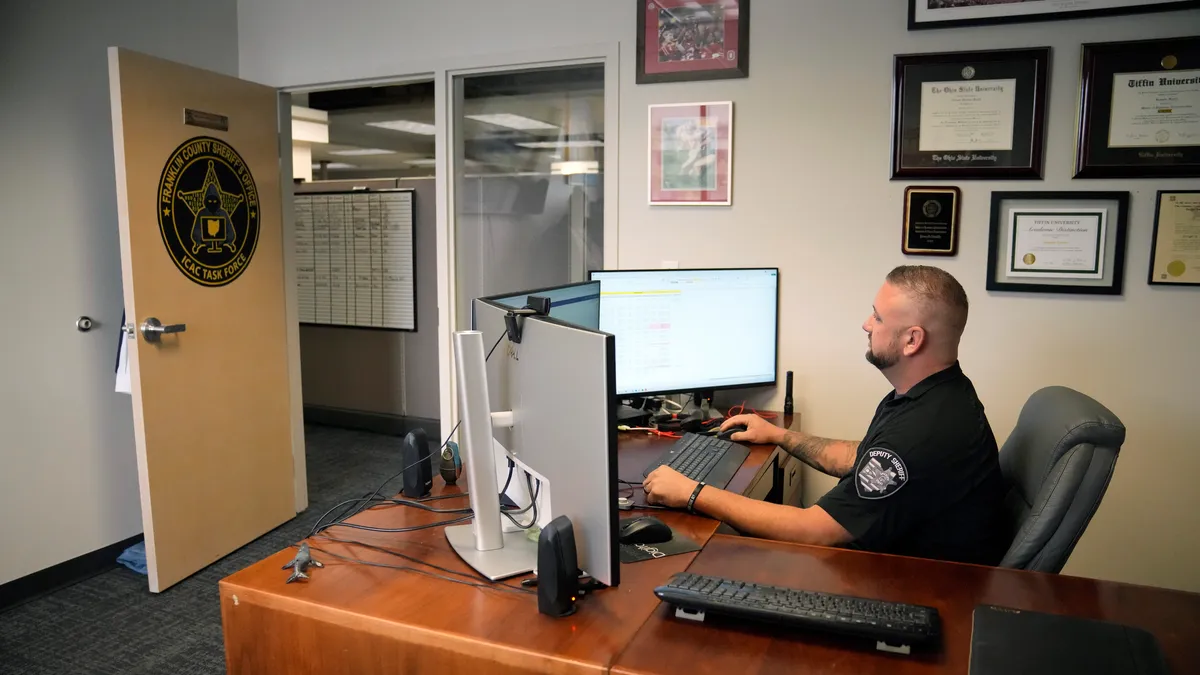
Detectives from the local Internet Crimes Against Children Task Force say they have seen a rise within the past two to three years in the amount of cases involving AI, as well as the sophistication of AI tools.
AI porn creation isn’t victimless crime, detectives say
Earlier versions of the AI tools used by most creators placed a watermark or other identifier on the images to indicate that they were artificially generated, experts say. With time, the quality and quantity of tools have increased.
Franklin County Sheriff’s Chief Deputy Rick Minerd, who oversees the office’s investigations bureau – including the task force – compared using AI to create pornography to drug dealers making synthetic drugs with different molecular makeups that provide the same high but in a legal gray area.
“It’s the exploitation of children, period. There’s no two ways about it,” he said. “Whether it’s a real child in a sexual, sexually compromising position or it’s a child’s face or whatever in an image that does that, it’s still being done for the same purposes, and that is to cause harm to people.”
AI has given law enforcement officials more tools to help with their work, Minerd said. Investigators can use AI tools to find potential facial matches in videos or to transcribe phone calls from jail inmates. That ease of access, though, also applies to criminals.
“The same thing can be said for the criminal world. The more that they use it, the more ease they find,” Minerd said. “These child digital monsters, really, they rationalize the behavior as well that I’m not really victimizing a child if I’m creating an image that’s still satisfying whatever sexual, deviant need they have.”
Many of the AI tools, especially those on the dark web and found through other illicit means, will follow whatever prompts the user provides to photographs that obviously contain children. Some tools, task force detectives said, allow a person to take a real photograph and alter it by asking the AI tool to remove the clothing of the person in the photograph.
Austin Pittman, 35, of Hilliard, will spend 14 years in federal prison for doing just that. Prosecutors said in court documents that Pittman took photographs of children and used AI to create nude images that he then distributed.
“When they convince themselves that it’s a victimless crime, they’re not doing any harm, then it’s easy to justify the crime,” task force member Josh Salter said. “It’s a long game, a taboo thing that they look at. It’s never enough, never enough, until they finally physically hurt a child. So it’s not just a nothing.”
Proposed Ohio law could make AI prosecutions easier
Ohio’s laws surrounding child pornography don’t address AI creation at all, a problem likely not considered at the time the laws were written and creating more challenges in legal battles over the definition of obscenity, former Attorney General Dave Yost said.
“Nobody’s wise enough to write laws about technology. It moves so quickly that the things that you’re worried about today are almost certainly not going to be what you’re worried about six months from now,” he said. “It’s not like there is an explosion of these things, but I think everybody sees a coming explosion because the tools are so powerful and have gotten so sophisticated.”
The Dispatch spoke with Yost before he announced he would be leaving his position as Ohio’s top law enforcement officer after nearly 7½ years, departing in June.
“I don’t even know if [the law] can be adequate until we’ve had a pretty broad discussion about what exactly is obscenity,” Yost said. “Legally, obscenity is not protected by the First Amendment, but we have stretched the definition of obscenity … about the only things that are still taboo are bestiality and actual child pornography.”
Task force detectives said they would like to see specific language in Ohio law that would allow people to be charged for AI-generated and AI-assisted child pornography.
Senate Bill 163, introduced by Sens. Louis Blessing, R-Colerain, and Terry Johnson, R-McDermott, remains in a House committee after passing in the Ohio Senate. The bill would require AI-generated images and videos traced to being created in Ohio to have a distinctive watermark identifying them as such.
The bill would also add language to Ohio’s child pornography laws to include AI-generated images of a minor. Previous language focused on photos or videos, which creates a legal gray area for AI-generated content.
Prosecutions can target creators and those who send or receive images; however, the people behind the tools remain largely immune because they’re based in countries like Belarus and Russia that won’t extradite people charged with crimes to the United States.
The proposed law would classify a depiction of a minor as “a visual representation that appears to depict an actual minor that a reasonable person would believe depicts or represents an actual minor but may or may not depict an actual minor.”
The bill has passed the Ohio Senate but remains under debate in an Ohio House committee. If it doesn’t pass by the end of the two-year session in December, the bill would have to be reintroduced and restart the legislative process from scratch.
In testimony provided in support of the bill, a Bloom-Carroll student described her experience. She said she learned a classmate had created AI-generated images of her and a friend and sent them to other classmates. The student responsible was identified but never charged with a crime, according to the girl’s testimony, because of the way Ohio’s law is written.
The girl wrote in her testimony that this frustrated both her and her family – in part because her father is a detective on the task force investigating these types of cases.
“The idea of not taking on the case for AI is also providing an out for individuals who are using real life images,” she wrote. “It is too late to do right by me, but it is not too late for other future victims. I do not know what to see my cousins and friends’ siblings go through the same thing I had to go through.”
Ecosystem of AI apps makes stopping porn use difficult
Minerd said the tools that exist, combined with people who are intent on creating pornographic content, make it nearly impossible to stop images from finding their way online – and taking them down.
But as Yost pointed out, the technological landscape offers unique challenges in that regard too.
“That image is out there, and could be easily replicated, will live forever,” Yost said. “It’s no longer a dark room and camera and printing press problem. It’s a click to send problem.”
Nina Jankowicz, an author and activist, said the distribution of artificially created or altered images needs to be taken as seriously as any other kind of physical assault. Jankowicz is the founder and CEO of the American Sunlight Project and has written two books about AI. Time Magazine named her one of the 100 most influential people in AI.
Jankowicz also led the short-lived Disinformation Governance Board created by former President Joe Biden and has been a target of AI-generated images herself.
She described the experience as being surreal, even for someone with the resources and knowledge that she has about what to do and how to approach the situation. Children and parents who aren’t aware – and those who have been targeted by someone close to them like a classmate or a romantic partner – can experience even deeper hurts.
“For somebody with a not fully developed brain to have the most private parts of their body, the most private acts a person can engage in, displayed for their peers, or for the world, as it may be, it’s profoundly, profoundly damaging,” Jankowicz said.
Federally, the Take It Down Act became law in 2025. Much of it focuses on nonconsensual intimate imagery, commonly referred to as revenge porn. Under the law, platforms are required to have a method for requesting that images or videos be removed and for those items to be removed within 48 hours.
Despite good intentions, Jankowicz said, its effectiveness can be likened to playing Whack-A-Mole.
“You can’t put bumpers on the bowling alley now. There was a point when these platforms weren’t accessible and in all of our pockets that we might have been able to and that’s not true anymore,” she said. “It unfortunately has become so ubiquitous that even if … all of the other models either put in robust safeguards or decided tomorrow that they weren’t gonna allow this sort of content to be generative … even if they did that tomorrow, there’s still this huge, huge ecosystem of nudifying apps.”
The Take It Down Act also allows prosecutors to go after those who create pornographic images of children. Strahler’s conviction came under this law.
The federal law differs from Ohio law, which defines child pornography as any material that features a minor. AI-generated imagery could be interpreted as a legal gray area within that definition and make prosecutions challenging.
Federal law defines it as any visual depiction, which also covers AI-generated and AI-assisted imagery or videos.
Jankowicz also suggested a possible strategy for reducing the availability of some of the applications, targeting payment processors, app stores and websites that host the images.
“If you incentivize all of the parts of the infrastructure not to host this content, not to allow their servers to provide the power for it to be made, etc., etc., then you start to choke things off at multiple points,” she said.
AI can be used to help investigations but could age poorly
Task force detectives and their colleagues around the country are also utilizing tools to identify images and have them removed. A database that uses unique alphanumeric codes identifies photographs or images that have been repeatedly seen by detectives and flags it as being child sexual abuse material.
Detectives say they enter those codes into an electronic system that sends alerts several times a year to electronic service providers, like internet providers and networks that house cloud storage. Those providers, in turn, use the codes to find and eliminate any matching images. Detectives also say the databases include fields for information about whether an image was generated with AI.
Right now, those databases are sufficient, but as technology gets better, they may become obsolete, said Chris Cline, a detective with the task force.
“The easier these tools are to get and the easier these videos are to create, the more and more we’re going to be seeing stuff for the first time,” he said. “Some of the tools that we use to auto-identify the [material], I don’t want to say it’s going to become obsolete, but they’re going to become less important.”
While technology has its downside, it can also be used as a tool, the task force team said, even by them. Detectives can quickly identify and search phone contents, messages and emails to be more efficient in their work, for instance.
“We’re not going to stop AI because it’s a tool. We’re just going to have to stop the individuals trying to use it for the nefarious purposes,” Cline said.
Reporter Bethany Bruner can be reached at bbruner@dispatch.com.