

Dr. Joel Barber, a doctor known as the “medical myth Buster” by hundreds of thousands of followers on social media, has built a reputation by exposing false health claims online.
Earlier this year, some of those followers warned him on a video on another account featuring a man who looked like him. His face was him. The voice wasn't like that.
“I almost felt scared,” Barbell told CBS News. “It looked like me. It didn't sound like me…but it was a voice that wasn't mine, advertising a product I had never promoted in the past.”
According to cybersecurity experts, it was serious. The video featuring a Bervell portrait has appeared on multiple platforms, including Tiktok, Instagram, Facebook and YouTube.
A CBS News survey over the past month has found dozens of accounts and over 100 videos across social media sites where fictional doctors using real doctors' identities have largely been tried to give or sell advice related to beauty, wellness, and weight loss. Most of them have been discovered on Tiktok and Instagram, some of them have been viewed millions.
Most of the videos reviewed by CBS News were trying to sell their products through independent websites or famous online marketplaces. They often made bold claims. One video promoted the product “96% more effective than Ozempic.”
Cybersecurity company ESET has recently looked into this type of content. According to ESET security researcher Martina López, they discovered over 20 accounts on Tiktok and Instagram using AI-generated doctors to push products using AI-generated doctors.
“Whether some videos are going viral or there are accounts that gain more followers, this type of content is reaching an increasingly wider audience,” she said.
CBS News contacted Instagram's parent companies Tiktok and Meta to clarify its policy. The companies said they removed the video flagged by CBS News and violated its platform policy. CBS News also contacted YouTube. This stated that using the privacy request process “users can request the removal of AI-generated content that is realistically simulated without permission.”
YouTube said the videos provided by CBS News do not violate community guidelines and will remain on the platform. “Our policy prohibits content poses a serious risk of severe harm by disseminating medical misinformation that contradicts the guidance of the local health department (LHA) regarding certain health conditions and substances,” YouTube said.
Tiktok says that between January and March, it actively deleted more than 94% of content that violated its AI-generated content policy.
After CBS News contacted Meta, the company said it had removed videos that violated advertising standards, restricted other videos that violate health and wellness policies, making them accessible to people over the age of 18.
Meta also said that bad actors are constantly evolving tactics that try to avoid enforcement.
Scammers use easily available AI tools to significantly improve the quality of their content, and viewing videos on small devices makes it difficult to detect visual inconsistencies, said Tony Anscombe, the leading security evangelist at ESET.
ESET said there are several red flags that can help someone detect AI-generated content, such as flickering around a person's face, blurry edges, and glitches like strange distortions. Beyond visuals, voices that sound like robots and voices lacking natural human emotions are possible indicators of AI.
Finally, viewers should be skeptical of the message itself and question exaggerated claims such as “miracle cures” and “guaranteed results,” Anscombe said, which are common tactics of digital fraud.
“I don't trust anything, just check everything,” Anscombe said. “So, if you look at something and it's claiming that there's this miracle cure and that this miracle cure comes from X, come from X and check X…and do it independently. Don't follow the link.
Bervell said the Deepfake video featuring his likeness was defeated after asking his followers to help report.
Dr. Joel Bervell via CBS News 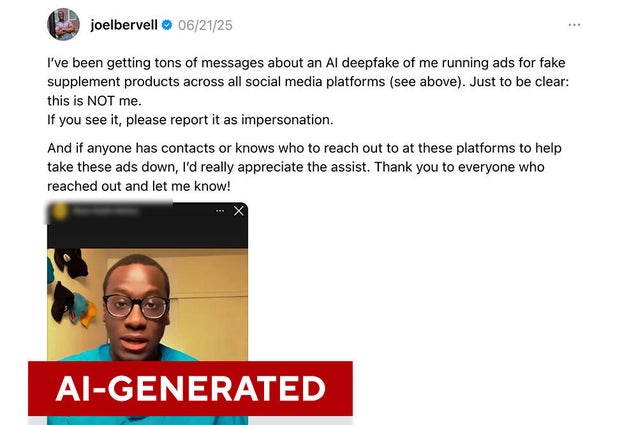
He also said he was concerned that videos like this would undermine public confidence in medicine.
“When we have fiction there, we have something that is considered to be experts in the field that says something that may not be true,” he said. “It distorts the facts and makes it even more difficult for the public to believe what comes from science, from doctors and from the whole health system.”


