
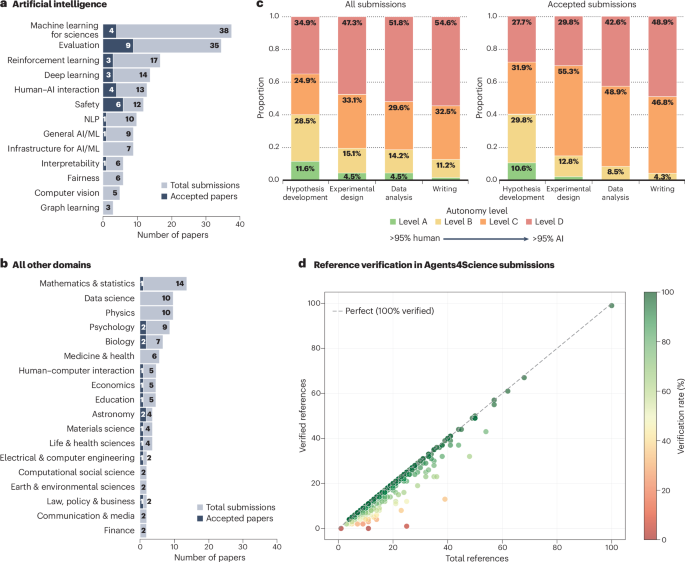
Artificial intelligence (AI) agents are no longer just tools for science, but act as “co-scientists” and participate in all stages of research design and analysis. Traditionally, researchers start with a well-defined question or problem, such as predicting the structure of a protein from its amino acid sequence, and develop or apply an AI tool (such as AlphaFold) to solve that specific problem. Over the past year, researchers have increasingly turned to AI as collaborators in a wide range of scientific activities, including hypothesis generation, experimental design, and paper writing.1, 2, 3, 4, 5. These AI co-scientists leverage advances in AI agents, autonomous systems built on large-scale language models (LLMs) that can use tools, access external databases, and search scientific literature.
Although there are promising examples of AI co-scientists designing nanobodies and generating experimentally tested hypotheses, this remains a new frontier.1,2. Many fundamental questions remain unanswered, such as how creative are AI scientist agents? How should we collaborate with human researchers? How capable are LLMs of reviewing scientific research? These questions are difficult to study because journals and conferences currently prohibit AI co-authors and LLM reviewers, and researchers often hide how they use AI.5.


