

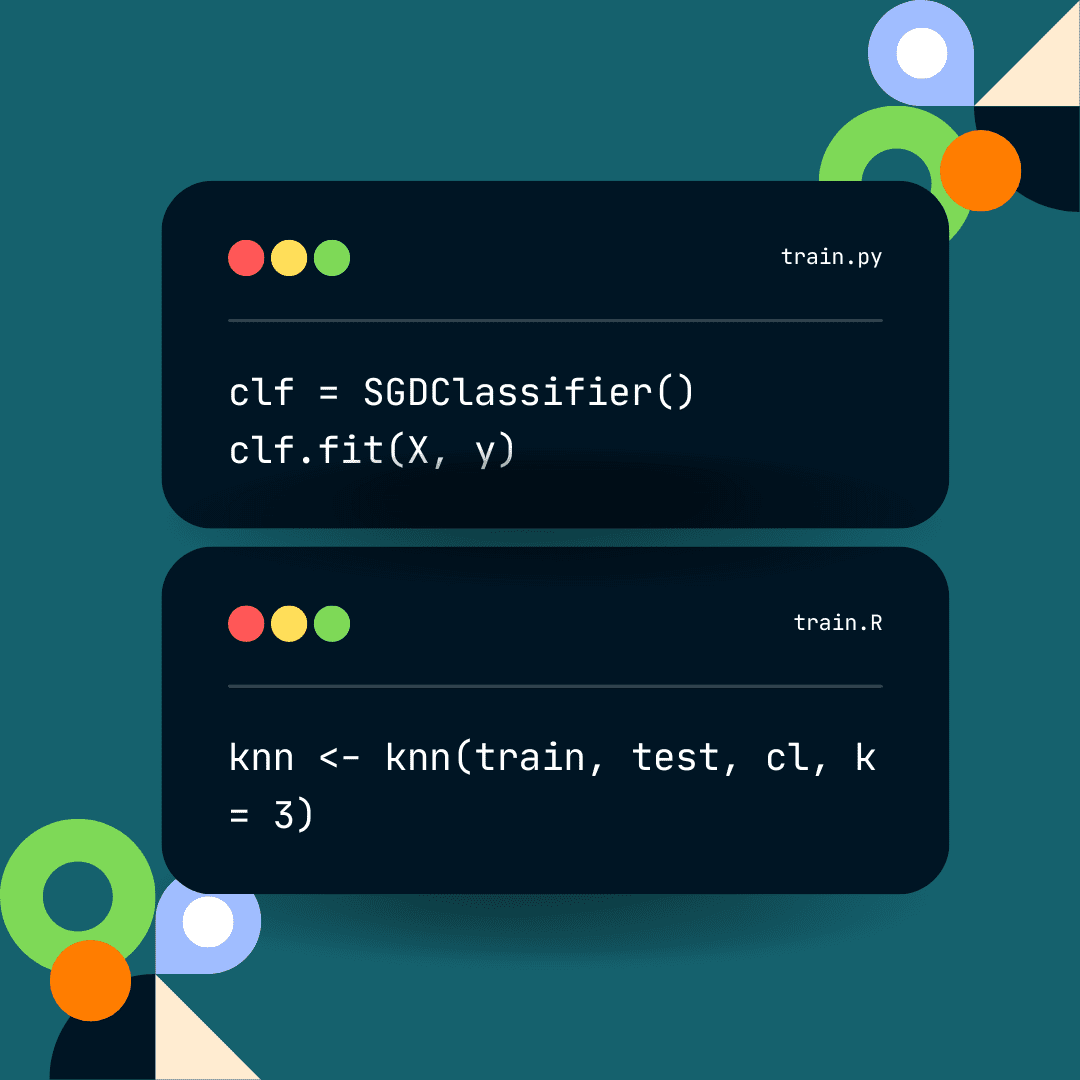
Image by editor
Python and R are two of the most popular programming languages in machine learning. Both are open source and accessible, but Python is a general-purpose language while R is a statistical programming language. This makes it ideal for a variety of data roles and applications such as data mining.
The two programming languages also promote reusability so novice machine learning engineers and hobbyists don’t have to write code from scratch. To build a project with these, we need to integrate the appropriate modules and algorithms. All you need to know is where to look. To help you out, we’ve put together a list of the most commonly used machine learning algorithms in Python and R. Be sure to bookmark this guide and refer to it when you get stuck.
As the name suggests, machine learning is ultimately about teaching computer systems to function autonomously. This can be facilitated through supervised or unsupervised learning.
One way to do the latter is to use the k-means clustering algorithm. It attempts to find patterns in a data set by grouping (clustering) similar data points.
In the R programming language, k-means clustering is usually K-means function. Unfortunately Python doesn’t seem to offer such an easy out-of-the-box solution. K-means clustering in Python is typically performed using the sklearn.cluster.KMeans class from the sci-kit-learn library in combination with the matplotlib.pyplot library.
The K-means clustering algorithm is one of the most widely used algorithms in unsupervised machine learning, and sooner or later you may come across or need to use this algorithm. So this is one of the first things he should learn and master.
Decision tree algorithms are preferred for accessibility and usability reasons. It is a supervised machine learning algorithm primarily used for classification. For example, businesses can use this to decide how to handle difficult customers through chatbots.
Decision trees teach machines how to make choices from previous experience. One of the reasons it’s popular among new machine learning engineers is that it can be modeled and represented visually as charts and diagrams. This quality makes it attractive to those with traditional programming skills.
There are two main types of decision trees.
- Continuous Variable Decision Tree: Refers to a decision tree with an unlimited target variable.
- Categorical variable decision tree: Refers to a decision tree that contains a qualified grouped target variable.
The packages and classes most relevant to R programming decision trees include:
- data set
- catools
- Party
- dplyr
- Magritte
Again, we need to look outside the Python module to implement this algorithm. Similar to the K-means clustering algorithm, sci-kit-learn contains many modules for decision trees, sklearn.tree being the most relevant. You can also use the Graphviz module to programmatically render a graphical representation of your decision tree.
Linear regression is another commonly used supervised machine learning algorithm. The goal of linear regression analysis is to estimate a result or value based on a variable or set of variables.
As with most algorithms, the best way to visualize this is with a graph with two axes. The Y-axis represents the dependent variable and the X-axis holds the independent variable. The goal of linear regression analysis is to form or find a relationship between these two variables.
If an increase in the independent variable causes an increase in the dependent variable (similar to exponential growth), this is known as a positive relationship. On the other hand, if the value of the dependent variable decreases as the value of the independent variable increases (similar to exponential decay), this is known as a negative relationship.
Determine the relationship using the straight line of best fit. This relationship can be expressed using a linear equation of slope and intercept. y=mx+b.
But how do you make linear regression easier in R and Python? The packages most relevant to linear regression analysis in the R programming language are:
- ggplot2
- dplyr
- broom
- ggpubr
of gugu The package is used for creating and plotting graphs, dplyr and broom Used for data manipulation and display. sklearn.linear_model It can be used to build linear regression models in Python. You can also add NumPY to handle large matrices and arrays.
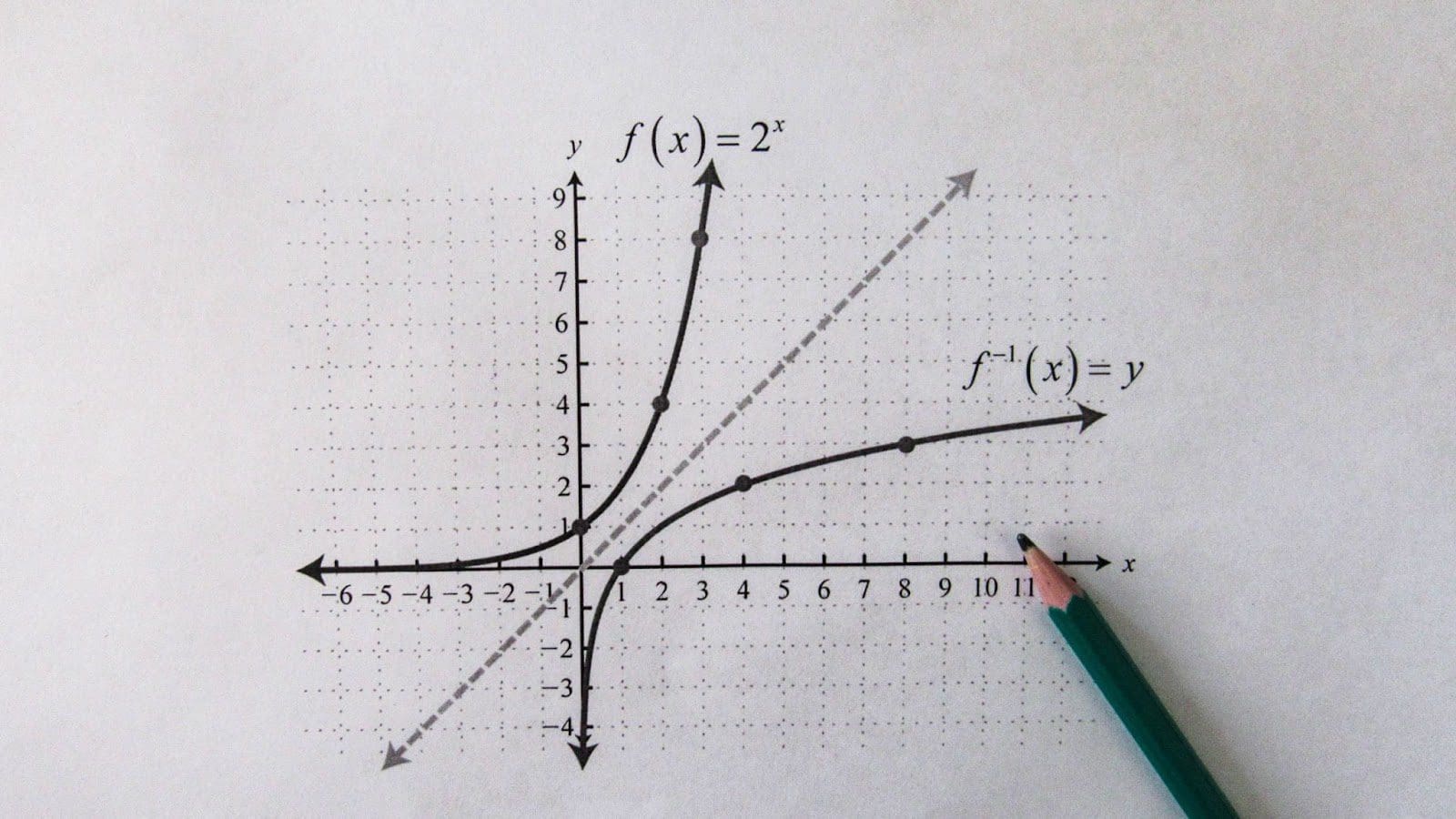
Photo by Pexels
Similar to linear regression, logistic regression allows you to predict the value of a variable based on another variable (set). However, linear regression uses metric values whereas logistic regression uses discrete variables. These are binary variables that can have only one of two values (yes or no, 0 or 1, true or false, etc.).
In the real world, this can be used to determine the likelihood that a person will purchase a product (retail) or contract a disease (medical). For example, age, height, and weight can be used as independent variables (x). And the binary result becomes the dependent variable (y). Therefore, x is the domain of real numbers and y contains discrete values.
The purpose of logistic regression is to estimate (predict) the probability of an outcome or occurrence. Since the y values are binary, we cannot use a linear equation and must instead use an activation function.
The sigmoid function is used to represent logistic regression.
f(x) = L / 1+e^(-x)
again
y = 1/(1+e^-(a+b1x1+b2x2+b3x3+…))
The Python packages and modules most relevant to logistic regression are:
- matplotlib.pyplot
- sklearn.linear_model
- sklearn.metrics
The procedure for generating a logistic regression using R is much simpler and can be done using the glm() function.
Support vector machine (SVM) algorithms are primarily used for classification, but can also be used for regression-based tasks. SVM is one of the simplest approaches to classification.
In SVM, the objects that need to be classified are represented as points in n-dimensional space. Each coordinate of this point is called its feature. SVM tries to classify objects by first drawing a hyperplane such that all points in each category are on either side.
There may be multiple hyperplanes, but SVM tries to find the hyperplane that best separates the two categories. This is mostly achieved by finding the maximum distance between categories known as the margin. Points that directly touch or overlap the margins are called support vectors.
Since SVM is a supervised machine learning technique, it requires training data. You can implement this machine learning algorithm in Python using sklearn’s dedicated SVM module. SVMs in R are typically handled using contour and plot functions.
Many of these algorithms demonstrate how machine learning relies heavily on probability and statistics. Although R predates modern machine learning engineering, R is relevant to machine learning engineering because it is a statistical programming language. Therefore, many of these algorithms are quick and easy to build or implement.
Since Python is a multi-paradigm general-purpose programming language, it has a wide range of use cases. Sci-kit–learn is the definitive library for Python machine learning modules. If you want to know more about the above algorithms and more, please visit the library’s official website.
Nahla Davis Software developer and technical writer. Before devoting herself to technical writing full-time, she worked as a lead programmer in an experiential branding organization of 5,000, with clients such as Samsung, Time her Warner, Netflix and Sony among others. is ready.


