CommBank iQ is deploying AI to its core bank data assets, citing security, governance, and risk concerns as the technology is used almost everywhere except in the core.
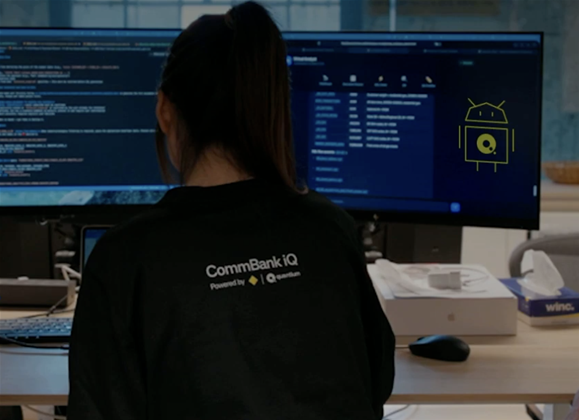
Former CEO Makenna Ralston said at Snowflake Summit 26 in San Francisco last month that the bank is using AI to interact with core banking behavioral data sets to get answers to customers faster, while also “fundamentally changing” analytical workflows behind the scenes.
CommBank iQ, a joint venture with Quantium, commercializes CBA’s anonymized transaction dataset and uses it as the basis for insights into consumer spending behavior.
Ralston, who will remain at Quantium but is headed to London, said CommBank iQ has hit roadblocks in its AI ambitions over the past year.
A year ago, Ralston was “confident” that going “all in” on AI would unlock the power of his team and allow CommBank iQ to “put our insights in the hands of more diverse leaders to make better decisions.”
But Ralston said CBA’s business model around data, its “crown jewel,” ultimately prevented the company from using AI tools available on its core data assets due to security, governance and risk considerations.
“We support banks’ security posture, and rightfully so. We touch and talk about the crown jewel of that organization: bank customer data,” she said.
“we [also] It operates under a joint venture governance structure. Managing risk, compliance, and governance on the best of days is complex.
“For all of these reasons, it meant that all the things that we were excited about, all the AI tools that were coming out, everything was great, but none of it was able to actually touch our data.
“So what was happening was that our teams were getting smarter at working with data. They were using AI every day for all the other work that didn’t involve touching data: AI for strategy work, AI for customer communications, AI for all the work that was part of knowledge work but wasn’t a core asset.
“The problem was our AI tools and the excitement of AI… [the] work.
“The promise of AI for us was not being realized in a way that actually restructured the core of what we do.”
Ralston said this limitation was felt across the CommBank iQ business in its responsiveness to customer explanations.
“Our analysts were following the same long workflow every time a report came in from a client. [and] Our client teams weren’t able to answer some of these insight questions yet in the room with the client because they had to go back and ask questions,” Ralston said.
“Despite all of the investment and innovation we have made in AI, all of these talented people have been drawn into mundane, day-to-day analytical work.
“AI hadn’t changed any of that yet. It was just happening at the edges.”
The company was also at capacity and had no choice but to turn down work.
“New work came in. Exciting work, good clients, good problems to solve. We really wanted to be a part of this. Certainly the kind of pipeline moment that you normally celebrate as CEOs, but we just couldn’t live up to it. The team was simply maxed out,” Ralston said.
“We have a great team, but… when a very finite and exciting job came along, it hit a fully operational team. As CEO, I had to turn it down because they had zero headroom.”
What has changed with CommBank iQ is an improvement to the AI tools native to Snowflake, the ecosystem we use for core data analysis.
“Something has really changed, not in our strategy, but in Snowflake’s roadmap. The new generation of Snowflake capabilities brings, for the first time, the power of material AI to the core of what matters to us, where it matters to us,” Ralston said.
“So Snowflake’s roadmap met our reality exactly when we needed it, meaning we now have a real opportunity to rewire our business to scale.
Specifically, Ralston launched two recently rebranded Snowflake AI tools: CoWork, formerly known as Snowflake Intelligence, and CoCo, formerly known as Cortex Code.
While CoWork is an agent that can query datasets, CoCo is often used as a backend for building data pipelines and machine learning models.
Ralston said CommBank iQ was given early access to two AI tools.
“in particular, [Snowflake] This allowed us to test early and work with them on the roadmap journey,” she said.
NSW Tourism Insights
While there are efficiencies behind the scenes, what excites Ralston most is what AI will mean for the information company’s customers and the staff in customer-facing roles.
AI is “completely reshaping the way we work,” she said.
“Our clients don’t really care about analytics. Analytics is just a translation layer between data and answers, and historically that translation layer has taken too long,” she said.
“Think about it: A client asks a question, a client lead writes it up, and goes to an analyst. The analyst writes the code, runs the query, and returns an answer. The client lead then turns it into an insight, story, or presentation that is returned to the customer.
“That means the only questions that are asked are the ones that are worth waiting for. That means the little questions, weird questions, and half-baked ideas that turn out to be more important than what the strategy deck says to ask go unanswered because they aren’t asked.”
Ralston said CoWork allows non-technical users to query an organization’s fundamental data “right in the room with the customer, in natural language.”
“We are using New South Wales, Australia’s largest state, as a testing ground for Snowflake Cowork for visitor economic insights,” Mr Ralston said.
“The team had only been implementing the tool for a month, and during that time we had real government clients asking us, ‘What’s going on with this unusual spike in transaction growth?’ What on earth does this mean? ”
“They knew it was school holidays, so normally there would be more tourists, but they didn’t really know why this year was different or what was causing it.” “Honestly, it was a pretty trivial question. In the past, the head of the client would pick it up, give it to an analyst, compile it, and then come back maybe a week later, or after the client stopped caring.”
“But Snowflake’s non-technical client lead answered that question directly in the room.”
Mr Ralston said the growth was due to school holidays and the opening of new tourism projects.
That insight gave government clients “an opportunity to go and talk to that business, think about financing that business, and incorporate them into the catalog of experiences that they’re offering as a tourism leader in that sector,” she said.
“This is a really actionable insight. Small questions, strange questions, were answered in a room in less than a week,” she said.
“Multiply that with all the questions that all of our clients ask every day that were previously in the queue, and you start to see what democratizing access to data really looks like.”
Ralston said early on that this was a “powerful preview of what’s to come.”
“Our job now is to take this and apply the business logic to all other industries so that this functionality applies appropriately across our business,” she said.
“We’re working on it now.”
virtual agent
More ambitiously, CommBank iQ is building a “virtual analyst” on top of CoCo. Ralston described it as “a digital team member that handles route analysis workflows end-to-end.”
“If you give them a scope and consider the client’s problems, they will deliver,” she said.
“This is not a tool that my analysts use. This is their new teammate.
“We are now moving to a hybrid human-AI model in business. [with] Humans and AI each do exactly what they are supposed to do.
“Analysts set the overview, make decisions, and maintain customer relationships. Virtual analysts do the work that analysts used to do at night and on weekends.”
Ralston said the virtual analysts could be operational as early as this month, starting out on one team and then scaling out from there.
“We’re not quite there yet,” she says.
“We are still testing the edge, but it will take weeks, not months, to rebuild the way it fully works with this Snowflake feature.
“This was a dream we had last year. We couldn’t have it.”