

The latest research by Citi shows that the application of AI in China is at a critical stage, moving from “broad adoption” to “deep penetration.” Although only 5% of users are heavy users, spending more than 2 hours per day, their key characteristics in efficiency gains (about 20%) and willingness to pay indicate that an inflection point in economy-wide efficiency gains is near. Today, 58% of users prefer free services, but those willing to pay for advanced features are seeing ARPU outpacing traditional content subscriptions, accelerating the commercialization potential of AI.
According to a new study by Citi Research, AI applications in China are at a critical transition stage of “widespread adoption but shallow uptake,” but the behavioral patterns of heavy users are already showing a clear acceleration, and the tipping point for AI to be deeply integrated into economic life is approaching, and its real impact on efficiency gains, labor markets, and corporate profitability is expected to accelerate.
According to information from Wind Trading Platform, a specialized survey conducted by Citi Research’s Innovation Lab among 1,800 respondents in March 2026 found that 70% of respondents use AI chatbots daily, with an average usage time of 49 minutes. However, only 5% of respondents are heavy users for more than 2 hours per day. According to Citi’s preliminary estimates, AI will generate 4.3% efficiency gains for respondents, which translates to approximately 1.8% for the economy as a whole.
 The study also revealed that China’s AI chatbot market is highly concentrated on major internet platforms. DouBao, owned by ByteDance, topped the list with a user penetration rate of 79% and a Net Promoter Score (NPS) of 54.4, far ahead of competitors such as Tencent Yuanbao (42%/28.3) and DeepSeek (37%/36.1). Citi noted that AI’s diverse applications will encourage users to adopt multiple products in different scenarios, reducing the risk that a single platform will achieve a “winner-takes-all” advantage over market concerns and that the competitive landscape will remain fragmented in the long term.
At the policy level, the Ministry of Industry and Information Technology (MIIT) announced Interim Measures for the Management of Anthropomorphic AI Interactive Services on April 10, emphasizing the principle of “human-centeredness” and explicitly addressing the abuse of algorithms. AI governance frameworks are rapidly taking shape. Citi expects that fiscal reform, including consumption tax, and the deepening of tax reform will make significant progress within this year, and the AI dividend mechanism will be gradually established.
Widespread adoption exceeds depth of use, with the hallmark of “shallow use.”
According to a February 2026 report by the China Internet Network Information Center (CNNIC), by the end of 2025, the number of Internet users in China will reach 1.13 billion and the Internet penetration rate will rise to 80%. Generative AI’s user base grew 142% year over year to 602 million people. However, the average monthly usage time was only about 183 minutes (about 6 minutes per day), which was a very small percentage of the average daily online time of 4.6 hours.
Earnings data supports the same conclusion. According to Xinhua News Agency, citing MIIT data, the revenue of AI core industries in 2025 will be approximately 1.2 trillion yuan, accounting for only 0.9% of the annual GDP of 140 trillion yuan. Even including cloud computing and big data, the amount reached only 1.6 trillion yuan, or about 1.2%.
Citi’s micro-level research closely aligns with the macro-level data above. Of the 1,800 respondents who have used an AI chatbot at least once in the past month, 83% used it for less than an hour each day, and just 5% used it for more than two hours. This clearly shows a pattern of high penetration and low usage.
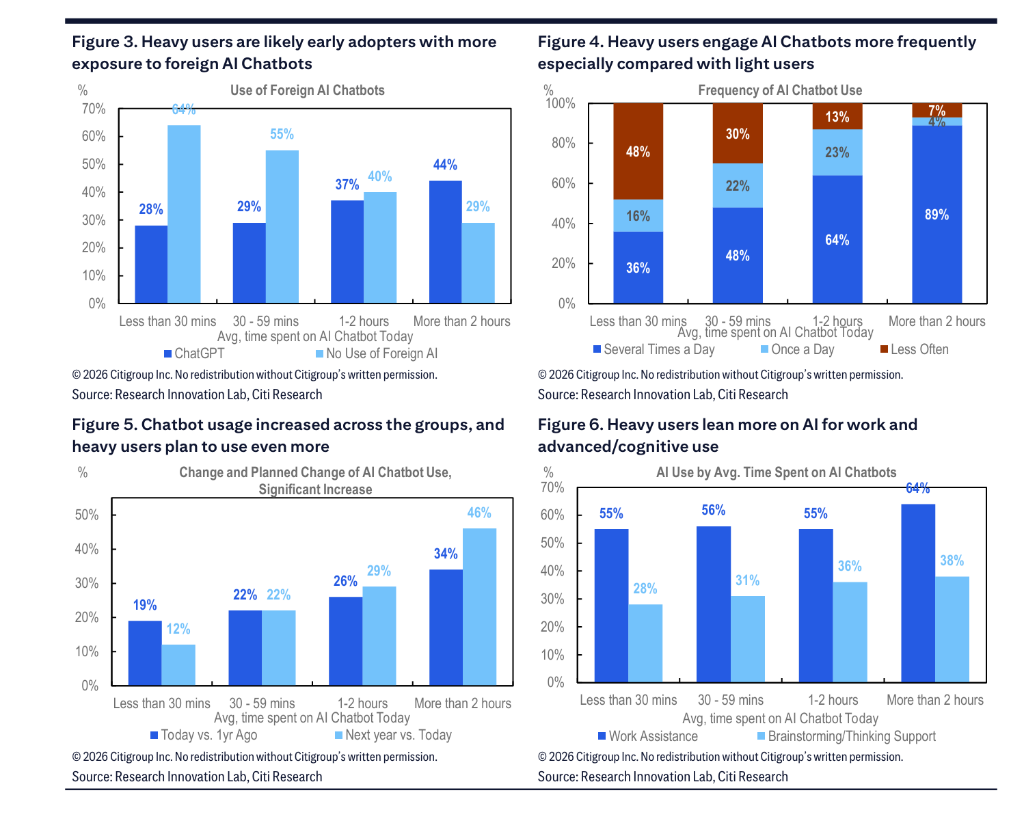
Heavy user behavior indicates nearing an inflection point
Citi believes that although overall depth of usage remains low, some behavioral characteristics of heavy users are already indicating an inflection point of acceleration.
In terms of usage frequency, 89% of heavy users use AI chatbots multiple times daily, with an average of more than 2 hours per day. On the other hand, about half of light users who use the device for less than 30 minutes a day do not use it even once a day. When it comes to forward-looking intentions, 46% of heavy users plan to significantly increase their usage next year, compared to just 19% of light users.
The differences in usage scenarios are also worth noting. 64% of heavy users use AI to assist with their work, and 38% use AI for creative thinking and brainstorming, indicating a much higher level of application complexity compared to light users. Citi notes that heavy users have significantly more exposure to foreign AI products (such as ChatGPT), suggesting that they started using AI earlier and are typical early adopters.
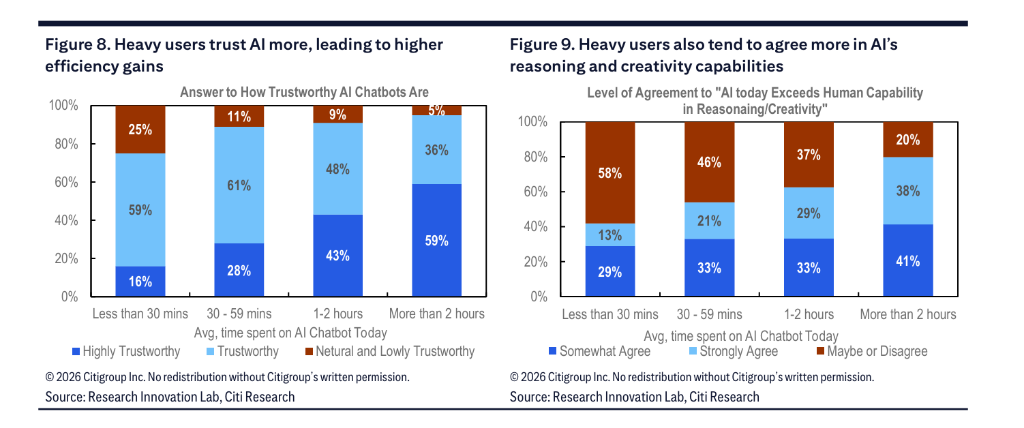
These data points corroborate each other and support Citi’s view that China’s AI adoption is evolving along a J-curve and reaching an upward inflection point.
Preliminary estimate: economy-wide productivity growth of about 1.8%.
Given that AI adoption is still in its infancy, Citi uses users’ “level of trust” in AI-generated answers as a proxy for efficiency gains. The higher the trust level, the more time you save. Poor reliability results in wasted time revalidating results.
Based on this framework, AI chatbots save respondents an average of 30.4 minutes per day, which equates to 4.3% of their waking time. When combined with a 42.8% generative AI market penetration rate, Citi extrapolates these efficiency gains to the economy as a whole, estimating a potential productivity gain of approximately 1.8%.
The benefits for heavy users are even greater. Estimates show that users who spend more than 2 hours per day save more than 2 hours each day, which accounts for about 20% of their waking hours. Meanwhile, 38% of heavy users believe AI has surpassed human capabilities in reasoning and creativity, compared to just 13% of light users (less than 30 minutes a day). Citi claims that productivity gains will accelerate rather than increase linearly as usage increases, reliability improves, and application scenarios progress in a positive feedback loop.
Large platform advantages and specialized positioning determine competitive survival.
According to Citi research, China’s AI chatbot market is dominated by major internet platforms, but there are already significant differences between products in functionality and competitive positioning.
ByteDance’s DouBao topped the list with 79% user penetration, 63% “Most Frequently Used Product” share, and achieved an NPS of 54.4. Tencent’s YuanBao ranks second with 42% adoption and 28.3 NPS. DeepSeek stands out with a 37% adoption rate and an NPS of 36.1, especially considering the limited sales and marketing investment. Alibaba’s Qwen and Baidu’s Wenxin (Ernie) follow with numbers of 24%/15.3 and 23%/18.4, respectively.
In terms of user-selected drivers, DouBao wins in speed and ease of use (both recognized by 62% of users), YuanBao wins in reliability (57%), DeepSeek scores in accuracy (66%) and logical reasoning ability (58%), while Tongyi leads in creative and emotional tasks (creativity score is 4.32) and is the best of the five products).
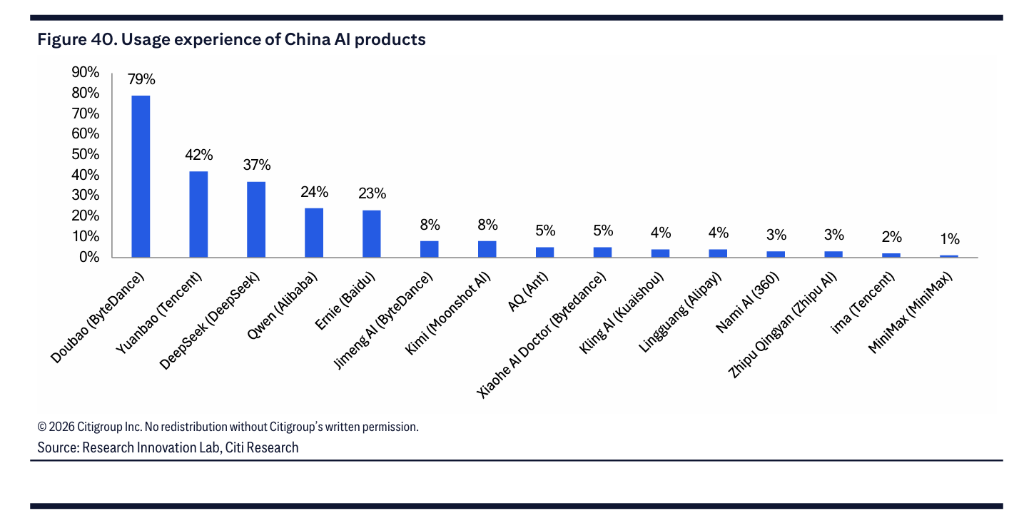
Citi believes that the diversification of AI applications means that users will choose different products based on different needs, making it less likely that a single product will be a “one-size-fits-all AI gateway.” This leaves room for platforms such as Alibaba and Tencent to expand AI applications within their respective ecosystems, indicating that future competition will intensify in vertical and agent-based directions.
Additionally, 45% of respondents had used foreign AI products, with ChatGPT having the highest usage rate (30%), followed by Google’s Gemini (13%) and Meta’s Meta AI (8%). The main reasons for using foreign products were “wanting a different answer” (45%), wanting better functionality (44%), and wanting higher accuracy (43%). The penetration rate of foreign products is particularly noticeable among users in top cities and iPhone users.
The impact on labor remains at an emotional level, and its formal introduction into the workplace has been significantly delayed.
Citi’s previous macro analysis estimated that AI could impact about 31% of jobs in China, with about 9.6% (about 70 million people) facing direct substitution risk. However, this study shows that the practical manifestation of these potential risks remains limited at this stage.
On an emotional level, 69% of respondents believe that AI will replace many human jobs in the future, but individual judgments are much more optimistic than collective judgments, with only 40% expressing personal concern about their jobs being affected. Additionally, 59% believe AI will help expand income opportunities, reflecting expectations of complementary effects dominating labor market sentiment, with overall optimism exceeding Citi’s previous forecast.
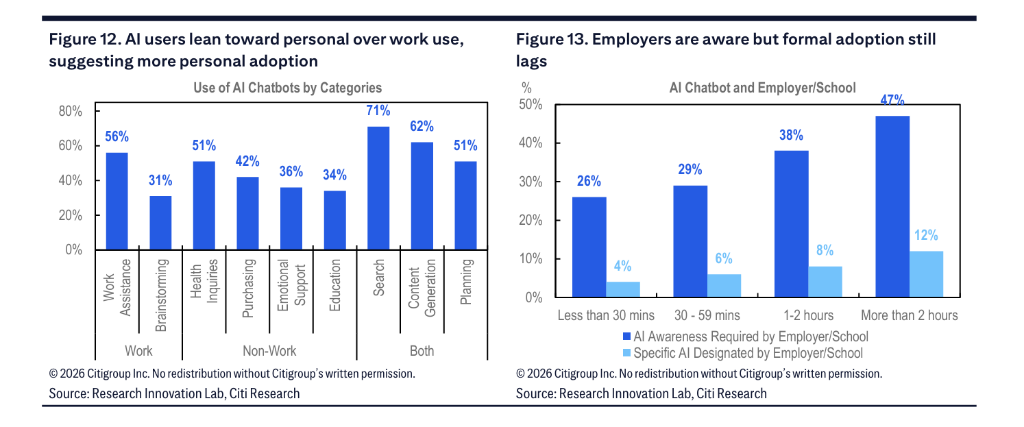
Usage scenario data confirms that AI is still primarily used for personal purposes. General search (71%) and health counseling (51%) dominate for personal use, while job support (56%) and brainstorming (31%) rank high, although formal adoption on the part of employers has lagged significantly. Only 6% of respondents’ organizations or schools have specified a dedicated AI tool, and even among heavy users, this number is only 12%.
By age group, young people aged 18 to 24 were the most worried about employment, with 58% worried that their jobs would be replaced by AI, the highest of any age group. However, this group has the lowest AI usage, with only 3% being heavy users for more than 2 hours each day. Citi notes that this is consistent with macro research findings. This means that younger individuals and entry-level jobs are more exposed to AI, leading to more concentrated job insecurity.
ARPU for premium features exceeds content subscriptions, creating monetization opportunities.
Research shows that 58% of users want to keep free usage, which is consistent with historical monetization patterns in the internet industry. However, Citi believes the fact that 45% of respondents are willing to pay for advanced features indicates significant monetization potential.
Willingness to pay increases as you get older, as you move up the city hierarchy, and as the proportion of iPhone users increases. Among those willing to pay, 63% cited “access to more advanced models” as a key factor, followed by multimodal features (file analysis, image generation, advanced voice interaction, 53%), and faster response times (51%).
The average acceptable monthly subscription price is RMB 48.3, which is higher than subscriptions for common digital content such as music and videos, and comparable to the average monthly spending level of online gamers. Citi believes this indicates that users applying AI to complex tasks have a strong appetite for moving to paid services, and that the reasonable price point for subscriptions to AI services is higher than current market perception.

