Large-scale language models (LLMs) have transformed many AI applications, but the computational power required increases operational costs during the inference stage. As LLM size and complexity increase, LLM efficiency remains a major challenge. A key issue is the computational cost of running these models, especially during the inference stage. This problem is exacerbated by the model's dense activation pattern, which requires large amounts of computational resources.
Existing research includes approaches such as quantization, particularly studied in BinaryBERT, and pruning techniques to increase model efficiency. A mixture of Expert (MoE) frameworks, represented by GShard and Switch Transformers, dynamically allocate computational resources. Large models promote activation sparsity through methods such as ReLU. In hardware-aware optimization, custom GPU kernels play an important role in applying theoretical sparsity in practice, and real-time computations in neural network operations, as shown in the work of Kim et al. The importance of software and hardware synergy, leading to volume savings, is highlighted.

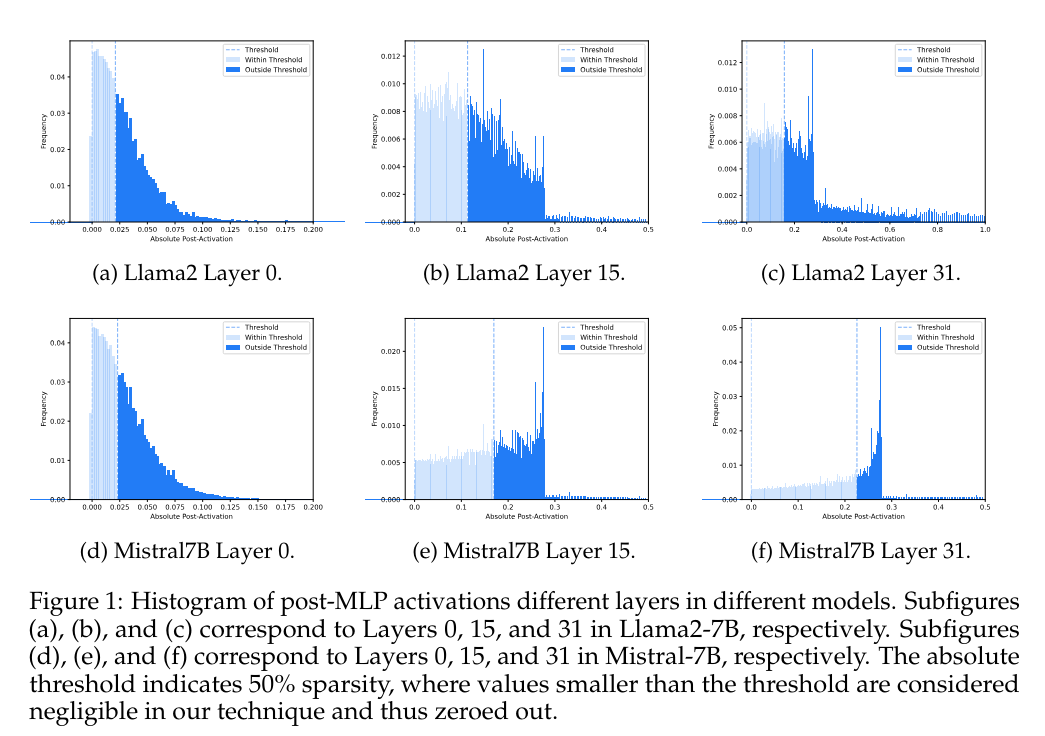
Researchers from the University of Oxford, University College London, and Stanford University have introduced a new framework, Contextually Aware Thresholding for Sparsity (CATS), to improve the operational efficiency of LLMs. Unlike traditional methods that often impair model performance, CATS strategically applies nonlinear activation functions that dynamically adjust neuron activation based on input context. This targeted approach to sparsity significantly reduces computational overhead while maintaining high accuracy levels.
CATS employs a two-step methodology that first accurately determines the relevance of neurons through a context-dependent threshold. This method was rigorously tested on popular LLMs such as Mistral-7B and Llama2-7B using datasets such as RefinedWeb. The practical application of sparsity was facilitated by a custom GPU kernel tuned to efficiently and effectively optimize sparse activations during model inference. CATS's direct focus on contextual relevance and hardware-specific optimization sets it apart from traditional sparsity approaches and certainly makes it a valuable tool for real-world AI deployments. I am.
Implementing CATS resulted in visible and impressive improvements in computational efficiency and model performance. In tests conducted using Mistral-7B and Llama2-7B, CATS achieves up to 50% activation sparsity while maintaining performance within his 1-2% of the full activation baseline. did. Specifically, CATS reduced real-time inference time by approximately 15%, significantly increasing efficiency. These results demonstrate that CATS effectively balances the trade-off between sparsity and performance, making it a viable option for reducing the operational costs of deploying large language models without sacrificing accuracy. This proves that we are providing a solution.

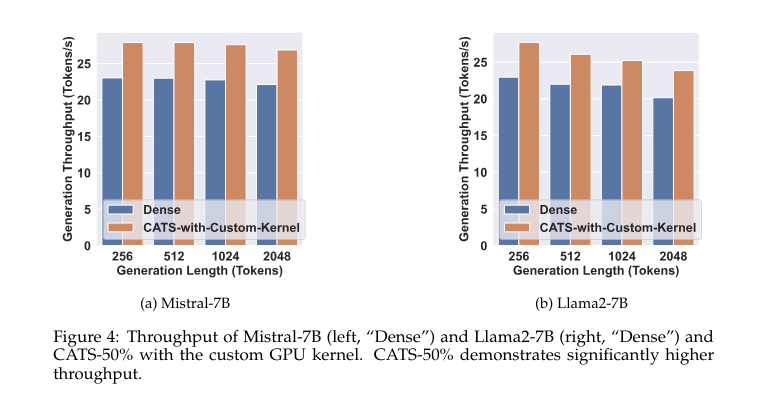
In conclusion, the CATS framework represents an important step forward in LLM optimization. By incorporating context-sensitive activation functions, CATS effectively reduces computational demands while maintaining model performance. Successfully applied to models such as Mistral-7B and Llama2-7B, the ability to achieve significant efficiency gains without sacrificing performance shows its potential as a scalable solution for cost-effective AI deployment. is emphasized. This study provides a practical approach to address the resource-intensive nature of modern AI models and is a valuable contribution to the field.
Please check paper. All credit for this study goes to the researchers of this project.Don't forget to follow us twitter.Please join us telegram channel, Discord channeland linkedin groupsHmm.
If you like what we do, you'll love Newsletter..
Don't forget to join us 40,000+ ML subreddits


Nikhil is an intern consultant at Marktechpost. He is pursuing an integrated double degree in materials from the Indian Institute of Technology, Kharagpur. Nikhil is an AI/ML enthusiast and is constantly researching applications in areas such as biomaterials and biomedicine. With a strong background in materials science, he explores new advances and creates opportunities to contribute.