“Ministry in the Age of AI” conference at Sacred Heart provides lay pastors and priests with a shallow introduction to artificial intelligence
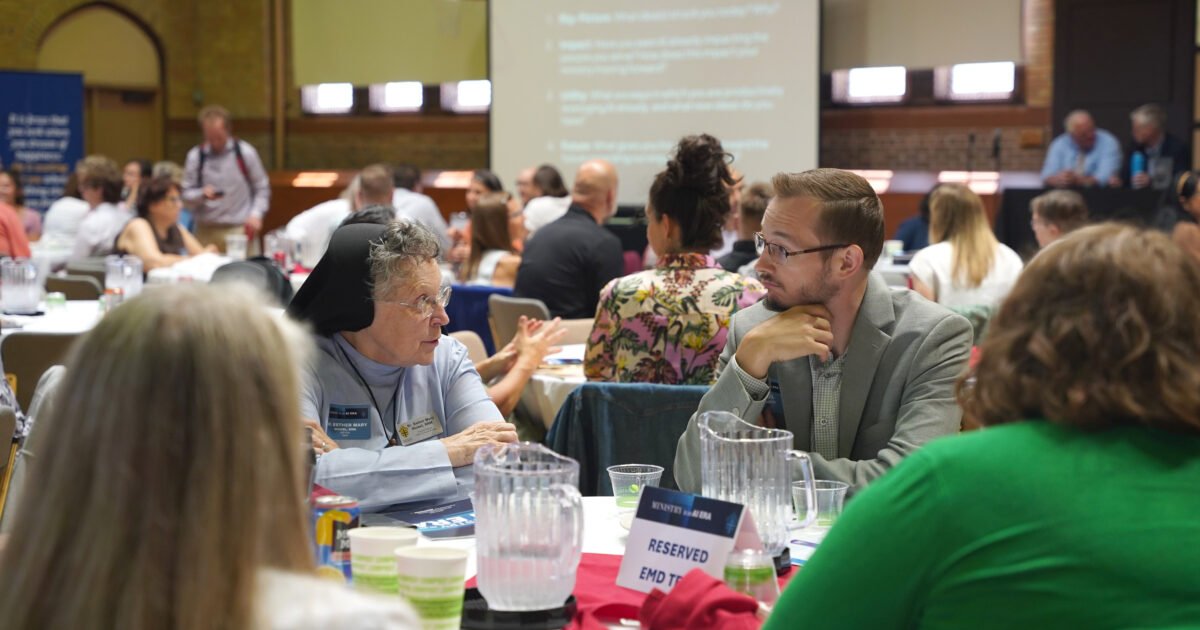
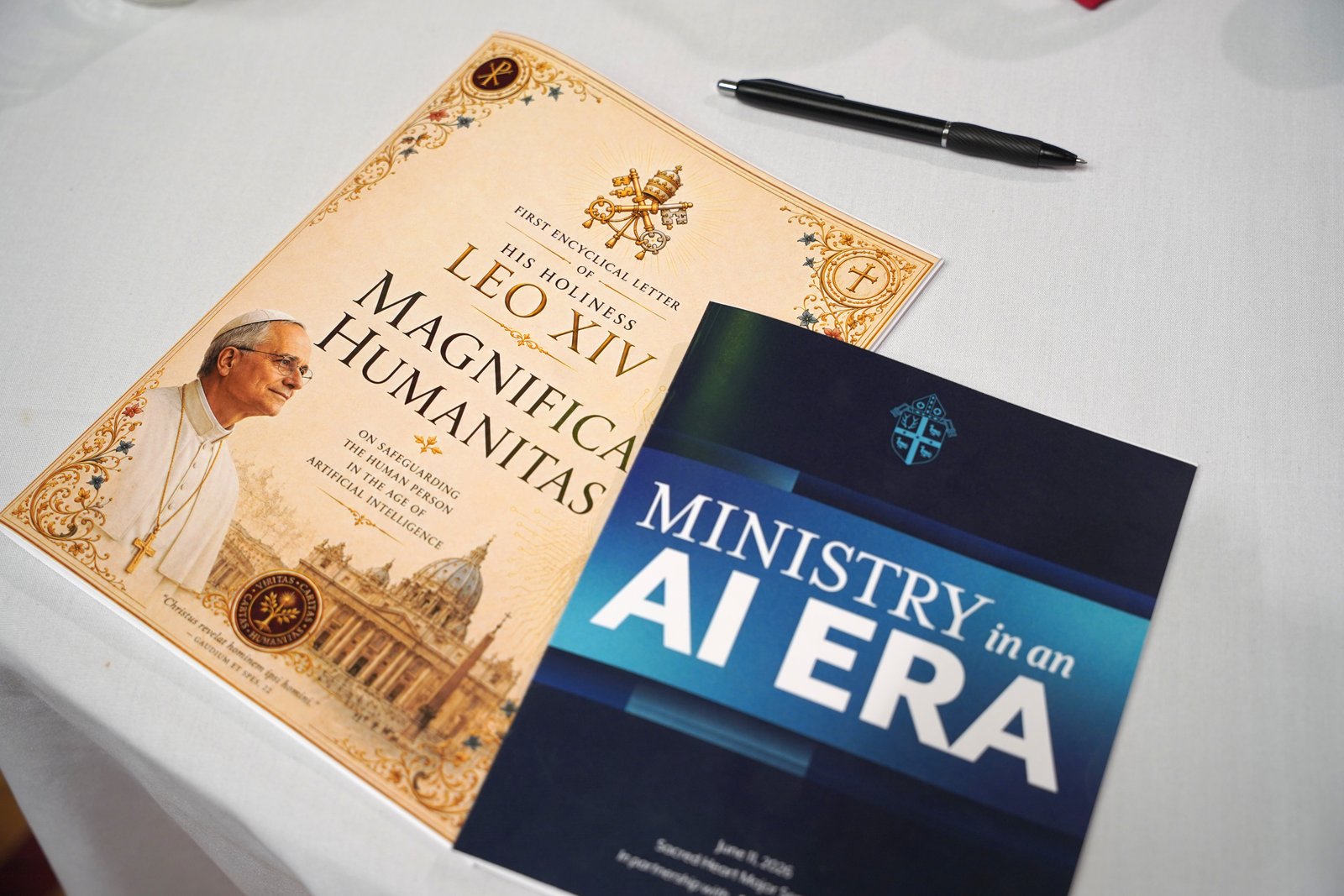
detroit — Following Pope Leo XIV’s landmark encyclical, Magnifica Humanitasduring a June 11 conference at Sacred Heart Major Seminary, clergy and lay leaders came together to address questions surrounding Catholic ministry and artificial intelligence.
The conference, titled “Ministry in the Age of AI,” was hosted by the Archdiocese of Detroit in partnership with Magisterium AI, the world’s leading Catholic artificial intelligence chatbot, and aimed to help pastors better understand AI and, perhaps more importantly, what it means to cherish the inherent dignity of God’s creation in light of Pope Leo’s encyclical announcement.
Related: AI conversations Catholic families are already having
John Brahier, Director of Partnerships at Longbeard, the company behind Magisterium AI, gave the opening keynote. Brahier said artificial intelligence is no longer seen as something that will impact ministries “in the near future,” but rather as something that is currently impacting ministries.
A guide to Pope Leo
Many popular apps and websites already use AI, so it’s important for people to understand what artificial intelligence is, and perhaps more importantly, what it isn’t, Brahier said.
“The Church believes that AI is better thought of as a product of human intelligence, rather than another form of intelligence itself,” Blahier said. “I think that’s the right direction for us, as Catholics, to bring to this conversation. It’s not a completely different form of intelligence, but it’s a product of God-given human intelligence.”
Blahier referred to Pope Francis’ comments and Pope Leo’s subsequent encyclical on AI, noting that both popes have taught that AI, like other forms of technology through the ages, is ultimately a tool for human use.
“Whether it’s a simple tool like a knife or an incredibly complex digital tool like a cell phone, computer or AI, the important thing is that throughout human history we’ve been having these kinds of discussions about how to use and leverage these tools,” Brahier said.
A central theme of the conference was dispelling the misconceptions of artificial intelligence as “artificial” or “intelligence” and how believers can think about AI through a Catholic context.
Breakout session speakers included Brendan Newell, a principal engineer at Microsoft who specializes in AI cybersecurity; Darren O’Brien is a Chartered Psychologist and mental health professional with over 27 years’ experience supporting young people and families at risk. Paul Spanky, director of data and technology strategy for the Archdiocese of Detroit. Edmundo Reyes, founder and partner of Digital Continent, a media production and creative services agency, and former director of communications for the Archdiocese of Detroit. Stephanie Quesnel is a senior research analyst and project leader at Data Driven Detroit, a local data brokerage, and author of the upcoming children’s book Created, Not Coded: A Catholic Family’s Guide to Artificial Intelligence.

Longbeard Director of Partnerships John Brahier (right) moderates a panel discussion featuring licensed psychologist and mental health expert Darren O’Brien (left to right). Brendan Newell, a principal engineer at Microsoft who specializes in AI cybersecurity. and Dr. Marcus Peter, director of theology at Ave Maria Radio and the Cresta Institute.
Dr. Marcus Peter, Director of Theology at Ave Maria Radio and the Cresta Institute, spoke about Pope Leo’s encyclical, pointing out that while many define it as an encyclical “about AI,” it is actually a document about human dignity.
“This is not an AI document. It’s an anthropological document,” Peter says. “This is a renewal of the Church’s language and a continuation of the tradition of John Paul II and Benedict XVI. Pope Leo is approaching this new industrial age, this new mechanical age, from a human perspective.”
In his encyclical, Peter said he listed only a few “absolute matters” that Catholics should consider, including condemning the use of artificial intelligence to wage war, its use in perpetuating human trafficking and modern forms of slavery, and the dangers of children having unrestricted and unsupervised access to smartphones.
Rather, most of the encyclical sets out broad principles for how to talk and think about artificial intelligence in the context of human dignity, Peter added.
Peter said the world needs technical experts, doctors, legal scholars and economists to talk and think about AI, but the “key” voice that should lead the way is the church.
“We are the only church, the only institution, the only institution that has within itself the structure for thinking about human dignity, so that it is clear how humans should flourish,” Peter said.

Stephanie Quesnel (left), author of the new children’s book “Created, Not Coded: A Catholic Family’s Guide to Artificial Intelligence,” is pictured with fellow conference speaker Brendan Newell, a principal engineer at Microsoft who specializes in AI cybersecurity. Darren O’Brien is a Chartered Psychologist and mental health professional with over 27 years’ experience supporting young people and families at risk. and Dr. Marcus Peter, director of theology at Ave Maria Radio and the Cresta Institute.
Criticism of Pope Leo’s encyclical from some in the AI industry misses the point by focusing too much on technical understanding, Peter said.
“This is a document from a spiritual father who saw the confusion in his children. He sat them down and said, ‘We don’t know what’s going to happen,'” Peter said. “In fact, he makes it clear. He says it’s very difficult to pinpoint just one definition of artificial intelligence, and he’s right. …Artificial intelligence is not artificial intelligence or intelligence. Leo is looking at how we think about artificial intelligence.”
Jeffrey Quesnelle, co-founder and chief technology officer of Nous Research, developer of the Hermes Agent, an open source autonomous AI agent, spoke on the topic “The Next Year of AI – Where We Are Going.”
Quesnel said AI is not something Catholics should fear, but rather is part of the universe God created.
“In a sense, artificial intelligence logo“We know that the church says that God injected that rationality into the universe, and this machine, whatever you want to call it, is borrowing that rationality in some way,” said Quesnel, a parishioner at Little Flower Basilica National Basilica in Royal Oak.
Artificial intelligence’s performance depends on data and information provided by rational actors, but its computational power will likely exceed human processing and processing capabilities, Quesnel said.
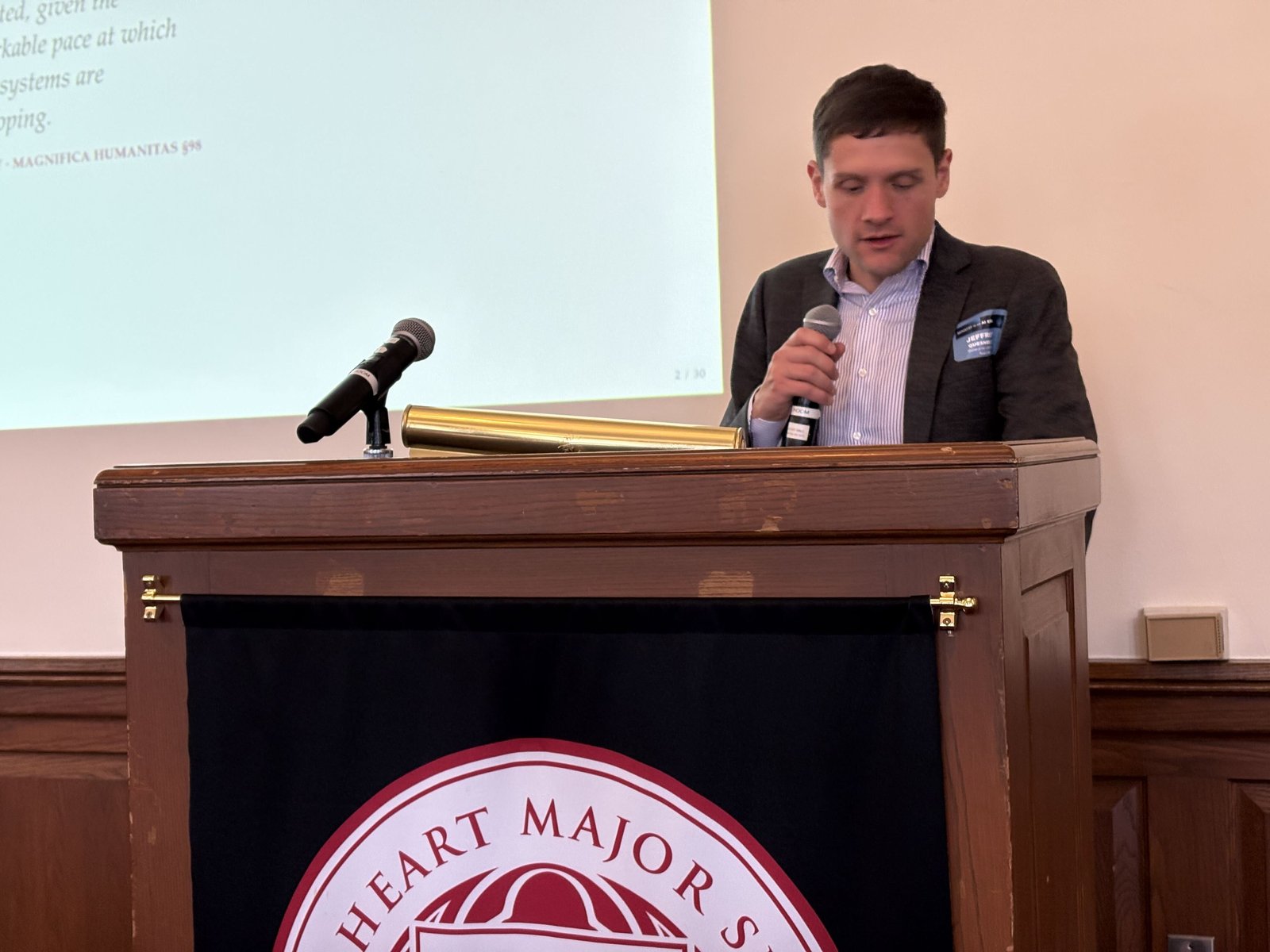
Jeffrey Quesnel, co-founder and chief technology officer of Nous Research and parishioner of Little Flower Basilica National Basilica in Royal Oak, will speak about the future of artificial intelligence at the Ministry in the Age of AI conference on June 11 at Sacred Heart Major Seminary in Detroit. (Photo by Daniel Meloy | Detroit Catholic)
“If something is empirically verifiable and quantifiable, and humans do it, then within the next year and a half these AI models could outperform humans at that particular task,” Quesnel said.
However, that doesn’t mean that AI is “better” at reasoning than humans. In fact, AI is not “reasoning” at all.
This is where Catholic social teaching comes into play, Quesnel said. The Church declares that the inherent dignity of human beings is based not on their productivity but on their God-given identity.
“The Pope says in paragraph 51: Magnifica Humanitas), “I think this ideology is particularly insidious because it suggests that everyone needs to earn or justify their worth, and that we attribute greater value to those who are more efficient or effective,” Quesnel said. It doesn’t really matter whether the AI is better at that particular job. Your true dignity is based on the dignity given to you by God when you were created in His image. ”