
The New Orleans Jazz Museum archives trace the genre’s history back to the first jazz song recorded for commercial release, “The Livery Stable Blues.”
Its soundtrack is well preserved, and the trombone and piano medleys come through vividly to the delight of jazz historians and aficionados alike. But not all centuries-old crafts have been this successful. Newspaper clippings get wrinkled, sheet music gets dirty, and old records get distorted over time.
“[Archives] It’s falling apart, it’s disappearing, and we’re losing our history,” said Katherine Elkins, a humanities professor at Kenyon College.
Deteriorating archives are putting historical documents across the country at risk. A group of students and faculty at Kenyon College in rural north-central Ohio think artificial intelligence could be the key to their rescue.
Kenyon is Schmidt Sciences Humanities and AI Virtual Institute (HAVI) To advance research in the humanities. Their goal is to build open AI systems that can preserve endangered archives from small and underrepresented communities, like the New Orleans Jazz Museum’s collection.
How AI can preserve history
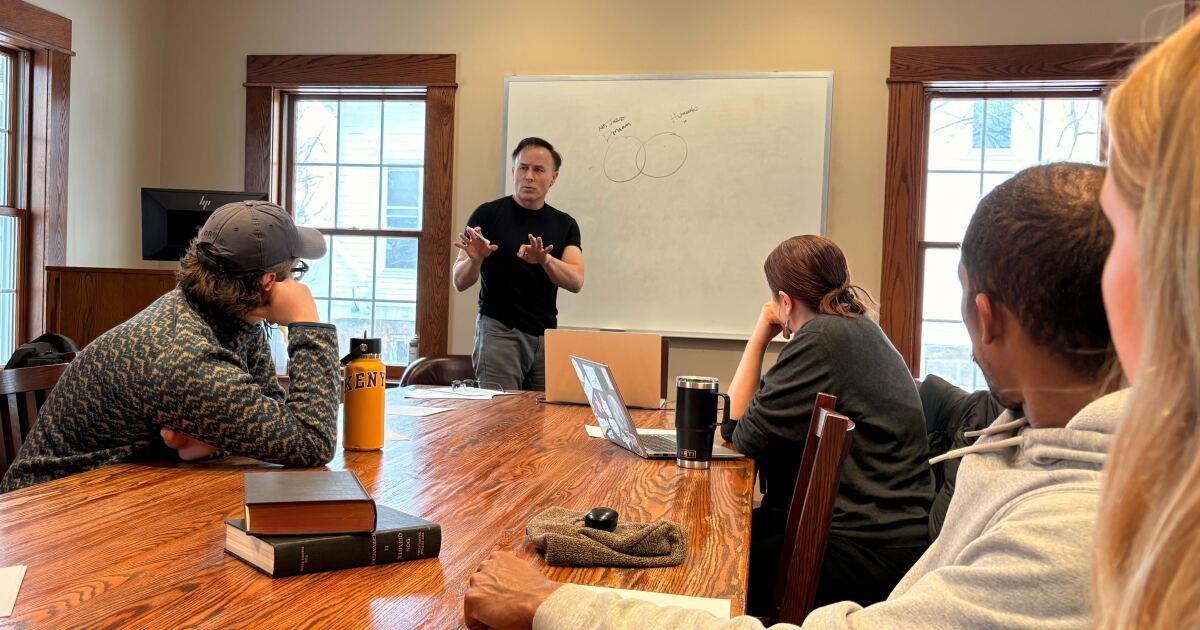
The group’s first meeting in January felt more like a startup than an auditorium. Instructor John Chun, one of the leaders of the AI project, was furiously filling the whiteboard as questions and ideas flew around the room.
Elkins said many small museums and newspapers cannot afford specialized preservation equipment to ensure the preservation of their archives. So the team has an 18-month plan to use artificial intelligence to create a handheld tool that can digitize and restore fragile artifacts using just a smartphone photo.
One of the reasons the team chose New Orleans’ jazz history as a test case for building their tool is because of its complexity. Artifacts exist in every medium, including soundtracks, photographs, and videos. Some of the documents are in Creole and Cajun French, languages that don’t yet have a lot of digital data for artificial intelligence models to train on.
“Enabling our AI systems to represent all languages, communities, and historical pasts opens up these archives,” she said.
Possibility of new discoveries
Elkins said that representation is especially important because the tool does more than restore aging sheet music or jazz club posters. It also allows AI to find connections between archives.
“Previously, archives stored each of these separately: digital, sound, and video,” she explained. “Now we have an AI model that can process all of this together. So this is a complete game changer.”

Kendall Crawford
/
ohio newsroom
Elkins’ vision is that tasks that previously took researchers years to sift through will now take minutes. With just a few key presses, they were able to trace how a melody traveled from a handwritten score to a recording years later.
Adrian Mangene, a senior at Kenyon majoring in neuroscience, sees potential for museums across the country.
“There has always been a huge gulf between STEM and the humanities. I think one of the things that AI has enabled us to do is bridge that gap and think about these problems from so many different angles. And the second one is revolutionary,” he said.
human-centered approach
AI tools will not completely remove humans from the humanities. Hannah Sussman, a project assistant and recent Kenyon graduate, said input from jazz experts, for example, will keep the program’s operation in check.
These so-called “stakeholders” work to determine the accuracy of the system’s conclusions and to catch any illusions or errors that the AI may cause.
“It would be impossible to have an AI analyze it and accept it as a kind of truth,” Sussman said.

Kendall Crawford
/
ohio newsroom
She said the tool simply speeds up the tedious parts of archival work, allowing social researchers like her to delve deeper into collections across the country.
Artificial intelligence creates the connections, but humans still decide what they mean.
“When you have students who are trained in the humanities and think critically about both the data itself, but also the social impact of the data, how the data is used, and the ethical elements, it really allows them to use AI in the best possible way,” she said.


