
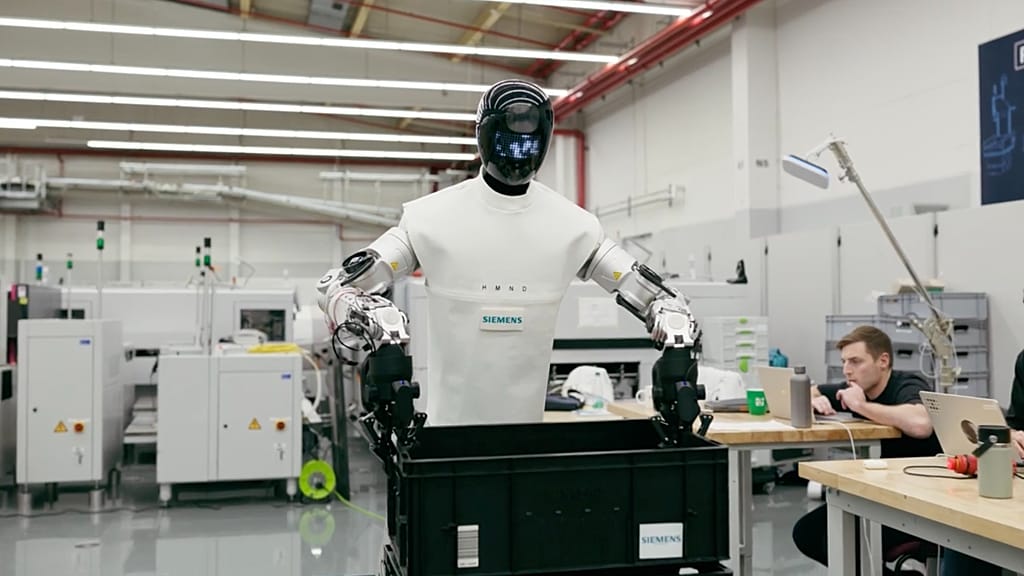
German technology company Siemens and semiconductor giant Nvidia tested humanoid robots on actual factory floors.
The test, in partnership with UK-based robotics company Humanoid, marks a step toward artificial intelligence-driven production, where machines and humans work together. Siemens said in an announcement that robots powered by Nvidia’s AI technology have been installed at its electronics factory in Erlangen, southwestern Germany.
The robot, humanoid HMND 01, performed routine logistics tasks such as picking up, moving, and placing containers for use by human workers.
Siemens said the robot operated autonomously for more than eight hours, moving about 60 containers per hour during the test and completing more than 90% of its tasks.
related
The project is part of a partnership with Nvidia to develop “the world’s first AI-driven adaptive” factory.
said Deepu Talla, vice president of robotics and edge AI at Nvidia.
“With Siemens providing the industrial integration backbone and humanoids deploying NVIDIA’s complete physical AI stack, from simulation-first training to real-time edge inference, this deployment paves the way for humanoid robots to meet real production goals on real production floors.”
related
Humanoid robots have previously demonstrated fast learning, locomotion, and dexterity in real-world environments.
Using Nvidia’s simulation and training tools, much of the robot development can be done virtually, reducing the need for physical testing and reducing design time from up to two years to about seven months, the companies said.
This could help solve labor shortages by allowing robots to take on complex tasks that currently require human involvement, which are difficult to handle with traditional automation.
The companies described the trial as “a milestone in the journey to bring physical AI from vision to industrial reality,” but did not provide a timeline for when such systems might be more widely deployed.


