Many security and operations teams are spending less time considering whether agent AI belongs in production and more time considering how to run it securely at scale. A new Dynatrace research report examines how large organizations are moving agent AI from pilot to production environments and where their efforts are stalling.
The report shows that agent AI is already being incorporated into core operational functions such as IT operations, cybersecurity, data processing, and customer support. 70% of respondents use AI agents for IT operations and system monitoring, and nearly half say they run agent AI for both internal and external use cases.
The budget reflects that momentum. Most respondents expect spending on agent AI to increase over the next year, with many organizations already investing $2 million to $5 million annually. Funding levels closely track use cases related to reliability and operational performance.
From pilot versions to limited production products
Adoption of Agentic AI remains uneven, but progress is visible. Half of the organizations surveyed reported having agent AI projects running in production with limited use cases, and the remaining 44% said the projects were widely adopted within specific departments. Most teams run between 2 and 10 active agent AI projects.
IT operations, cybersecurity, and data processing lead the go-live preparation. Approximately half of projects in these areas are in production or in the process of operationalization.
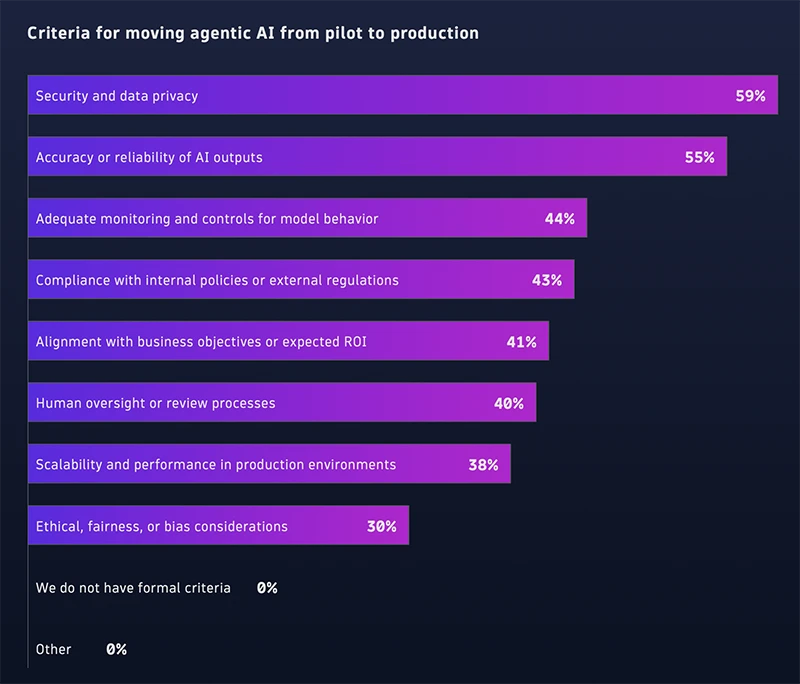
The criteria for moving the project forward is centered around technical performance. Security and data privacy are highest, followed by accuracy and reliability of AI output. Monitoring and control mechanisms also play a central role, with many teams treating observability as a prerequisite for widespread deployment.
Observability gaps slow progress
Technical barriers remain common. Most people cite security, privacy, and compliance issues as deterrents. Similar shares report difficulty managing and monitoring agents at scale. Limited visibility into agent behavior and the challenge of tracking the downstream effects of autonomous actions is common across regions and industries.
These issues become even more pronounced as systems become more interconnected. Agentic AI systems often collaborate across multiple tools, models, and data sources, increasing the need for real-time insight into decision-making and execution paths. Without this visibility, teams struggle to diagnose unexpected behavior and connect technical signals to business outcomes.
This report emphasizes observability as a fundamental control layer. Nearly 70% of respondents are already using observability tools during their agent AI implementation, and more than half rely on them during the development and production stages. Common uses include monitoring the quality of training data, detecting anomalies in real-time, validating output, and ensuring compliance.
humans remain part of the loop
Despite increasing levels of autonomy, human oversight remains standard practice. Currently, more than two-thirds of AI decisions made by agents are verified by humans. The most widely used validation methods include data quality checks, human review of output, and drift rank monitoring.
Only a few organizations are building fully autonomous agents with no oversight. Most teams develop a mix of autonomous and human-supervised agents, depending on the task and risk profile. Business-oriented applications tend to involve a higher level of human involvement than infrastructure-centric use cases.
Measuring success by credibility
When organizations evaluate the results of agent AI, reliability and resilience stand out. 60% of respondents say technical performance is their number one success indicator. Operational efficiency, developer productivity, and customer satisfaction are also highly rated.
Monitoring methods remain mixed. About half rely on logs, metrics, and traces, and almost half still manually review communication flows between agents. Automated anomaly detection and dashboards are popping up frequently, but many teams continue to mix automated and manual approaches.
Respondents describe success in terms of systems that maintain performance under stress and recover quickly from failures. Given the speed at which errors propagate between interconnected agents, early detection and rapid response remain central goals.
Scaling with tighter control
This report lays out the next stage of agent AI adoption with a focus on governance and control. The team points to the need for shared factual signals, standardized metrics, and consistent guardrails to guide autonomous actions. Observability serves as the mechanism that ties these elements together throughout the AI lifecycle.
“Organizations are slowing adoption not because they doubt the value of AI, but because safely scaling autonomous systems requires confidence that those systems will reliably behave as intended in real-world situations,” said Alois Reitbauer, chief technology strategist at Dynatrace.
The introduction of Agentic AI expands the operational attack surface and increases the reliance on monitoring, verification, and surveillance. As more projects reach production, trust becomes an operational requirement, with tools, processes, and human judgment working together.